
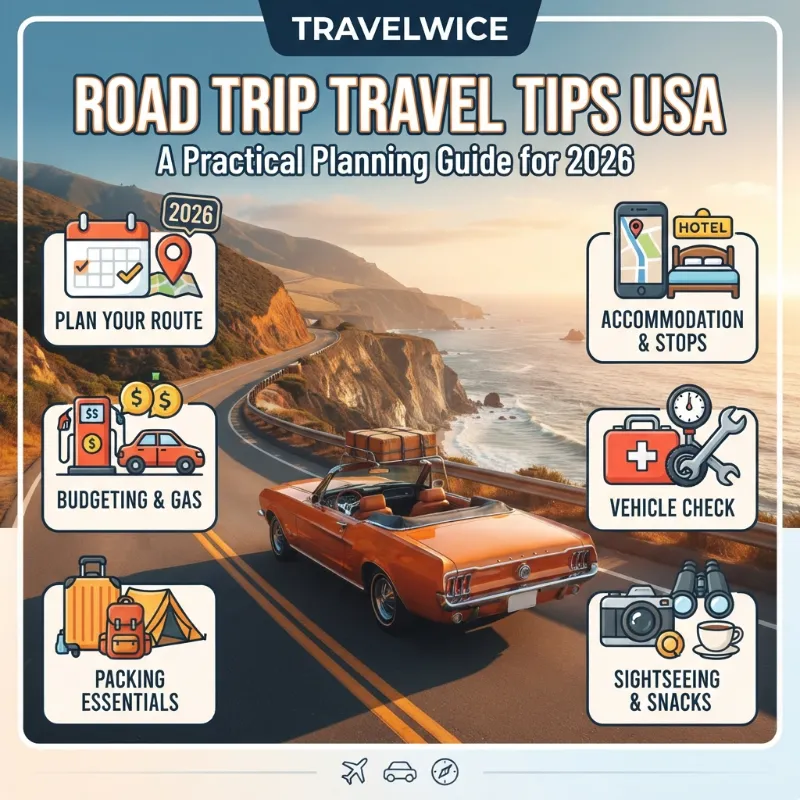
Gas just crossed $4.45 a gallon, and the national park rules changed for visitors this year. Because of that, a smart plan matters more now than it did two years ago. These road trip travel tips USA drivers can trust come from current prices, official park pages and the mistakes first-timers make again and again. Read this once, and you will know your route, your budget and your packing list before you book a single night.
TL;DR
- Plan 6 hours of driving per day if you drive alone, and up to 8 hours if you share the wheel.
- Budget at least $4.46 per gallon for gas and check state prices, because California costs far more than Midwest states.
- If you live outside the USA, compare the $250 nonresident park pass with the $100 per person fee at 11 popular parks.
- Book the first and last night, and leave the rest flexible.
Key Takeaways at a Glance
| Topic | What to know in 2026 |
|---|---|
| National gas average | About $4.46 per gallon on Sept 29, 2026 |
| Safe daily driving | 6 hours solo, 8 hours with two drivers |
| Nonresident park pass | $250 for 12 months |
| Nonresident park fee | $100 per person at 11 parks, plus the normal entry fee |
| Best seasons | May, June, September and October |
| Tipping | 15 to 20% in restaurants |
| Must-have apps | Google Maps offline, GasBuddy, Roadtrippers, AllTrails |
Why Your USA Road Trip Needs a Real Plan
The United States is huge. A drive from New York to Miami covers about 1,280 miles, and coast to coast runs close to 2,800 miles. As a result, many first-time visitors pack too many stops into too few days. One experienced American blogger says the same thing: first-timers often underestimate the size of the country and cram in too much. wanderlustingk
So this USA road trip planning guide starts with one simple rule. Pick fewer places and stay longer. Two nights in one spot beats one night in two spots, since crowds thin out in the mornings and after dinner when you stay at least two nights. travelingwithpurpose
If you want ideas before you plan, the official Visit The USA road trips page lists classic routes by region. Meanwhile, Honeytrek’s USA road trip guide shows real itineraries with stop lengths. Both help you see how much ground a week really covers.
How to Plan a USA Road Trip in 7 Steps
Here is how to plan a USA road trip without stress. Follow the steps in order, because each one affects the next.
- Pick your season. Most visitors travel between May and September, and July and August are the busiest and hottest. Shoulder months like May, June, September and October give you thinner crowds and milder weather, as one European planner also recommends. lesdeuxpiedsdehors
- Choose one region. Do not try the whole country. The Southwest, the Pacific Coast, the Deep South and New England each take 7 to 14 days.
- Set a daily driving limit. One experienced road tripper suggests 8 to 10 hours at most with several drivers, and 6 to 7 hours with a single driver. I would go lower. Five or six hours leaves time for stops. travelingwithpurpose
- Map the route. Use Google Maps to draw the line, then add two or three must-see stops per day at most.
- Book anchor nights. Reserve the first night, the last night and any park lodges. National park lodges fill up months ahead.
- Price the trip. Add gas, lodging, food, park fees, parking and tolls. The next sections show you real numbers.
- Leave gaps. Keep at least one free day for weather, a surprise town or a rest day.
Match the Season to the Route
Timing changes everything. For example, fall color in Vermont, New Hampshire and Maine usually peaks from late September to mid-October. That makes October a smart month for New England right now. In contrast, the desert Southwest in July can pass 100°F, so save it for spring or fall. skyscanner
Choose a Vehicle That Fits the Plan
Small cars save gas, but big groups need space. Also, check the mileage terms in your rental contract. Unlimited mileage is worth paying for on a trip longer than 1,000 miles.
If you travel with kids, buy a car seat after you land. Retailers like Target and Walmart often sell one for less than a rental company charges per week.
Road Trip Travel Tips USA Drivers Use to Save Money
Money is where most plans break. However, a few habits cut costs without cutting fun.
Know What Gas Really Costs in 2026
Gas prices swung hard this year. The AAA national average was $4.4558 on September 29, 2026. In January, the price sat near $2.93, so fuel costs jumped by more than 50% in nine months. aaa
Here is a quick chart you can paste into your post or notes. Each block equals about $0.25.
US national average gas price, 2026 (per gallon, regular)
Jan 5    ████████████ $2.93
Mar 2    █████████████ $3.15
Mar 30   █████████████████ $4.13
May 11   ███████████████████ $4.63
Jun 29   ████████████████ $3.96
Aug 3    █████████████████ $4.21
Sep 29   ██████████████████ $4.46
Sources: YCharts weekly data, AAA (Sept 29)
State prices matter even more than the national average. On June 18, AAA listed California at $5.64 and Indiana at $3.39. Therefore, fill up in cheaper states before you cross into expensive ones. Download GasBuddy to compare stations as you drive. aaa
Run the Math on Your Own Route
Take a 10-day Southwest loop of about 1,800 miles. A midsize car that gets 28 miles per gallon uses about 64 gallons. At $4.46, that costs about $287. A large SUV at 22 miles per gallon uses about 82 gallons and costs about $365. So the vehicle choice alone changes your fuel bill by roughly $78.
Here is a sample budget for one traveler on that loop. These are planning estimates, not quotes. Prices vary by city and season.
| Cost | Estimate | Notes |
|---|---|---|
| Gas | $287 to $365 | 1,800 miles at $4.46 |
| Lodging | $1,170 | 9 nights at about $130 |
| Food | $450 | About $45 a day |
| Park fees | $0 to $270 | Depends on residency and pass |
| Parking and tolls | $60 | Cities and park shuttles |
| Total (excluding car rental) | About $1,970 to $2,315 | One traveler |
A couple splits lodging and gas, so the cost per person drops by about 40%.
Decide on the National Park Pass Early
This part changed for visitors in 2026. The National Park Service now sells a nonresident annual pass for $250, and U.S. residents pay $80. In addition, nonresident visitors aged 16 and older pay an extra $100 at 11 of the most popular parks, including the Grand Canyon, Yellowstone, Yosemite and the Everglades. The standard vehicle fee at big parks such as Yellowstone and Glacier is $35. Nonresident Fees on Commercial Tours: Frequently Asked Questions (U.S. National Park Service) +3
Here is the break-even math for a solo nonresident:
| Plan | Cost |
|---|---|
| Grand Canyon + Zion, pay at the gate | $100 + $35 twice, plus $100 again, about $270 |
| $250 nonresident pass | $250 |
| One park only, pay at the gate | About $135 |
So the pass wins once you visit two of the 11 surcharge parks. Check the National Park Service nonresident fee page for the current list, and confirm how many people one pass covers before you buy for a couple or a family.
U.S. residents can do even better. One blogger used her pass five times and saved about $155 compared with paying each entry. travellingwithnikki
Tip the Way Locals Do
Tipping surprises many European and UK visitors. Budget 15 to 20% in sit-down restaurants, because travel guides recommend 15 to 20% of the bill. Also, tip bartenders about $1 per drink and taxi drivers 10% or $1 to $3. lesdeuxpiedsdehors
Best Road Trip Tips USA Visitors Forget to Check
These are the best road trip tips USA newcomers ask about most. They also come up in real trips more than any scenic stop.
Understand the Driving Rules
Speed limits climb fast in the West. Several states post 75 or 80 mph on open highway, and one Texas toll road allows 85 mph. Nevertheless, rural speed traps are common, so stay at or near the limit.
Every state has a move over law, which means you change lanes or slow down for police, tow trucks and ambulances stopped on the shoulder. Likewise, you can turn right on a red light in most states after a full stop, unless a sign says no. New York City is the big exception.
Check your license rules before you leave. Many UK and EU licenses work for short visits, but some rental companies ask for an International Driving Permit. Call your rental desk to confirm.
Learn the Difference Between a Rest Stop and a Truck Stop
A rest stop is a free state-run area with toilets, picnic tables and maps. A truck stop is a business with fuel, showers, hot food and long parking lanes for trucks. Many beginners treat them the same, but they are not. As one guide points out, knowing the difference helps you plan food and fuel. wanderlustingk
Beat the Big City Traffic
Rush hour in Los Angeles, Atlanta or Washington, D.C. can add 90 minutes to a short drive. To avoid it, cross big cities before 7 a.m. or after 8 p.m. Alternatively, plan a stop there and enter after the evening peak.
Stop Before You Feel Tired
Driver fatigue is a quiet danger on long straight highways. Forbes Advisor makes a smart point here: stopping before you feel tired prevents drowsiness and bathroom emergencies. I follow a simple rule. Stop every two hours, even for five minutes, and switch drivers at each fuel stop. Forbes
Download Offline Maps
Large parts of Utah, Nevada, Montana and the Deep South have no phone signal. Therefore, download offline Google Maps for every region before you leave the hotel Wi-Fi. A paper road atlas costs about $15 and never loses signal.
If you fly in from abroad, buy an eSIM before landing. It saves roaming fees and works the moment you reach the rental counter.
Road Trip Checklist USA 2026
Use this road trip checklist USA travelers can print or screenshot. It covers the road trip essentials for beginners in four groups.
Documents and money
- Passport, driver’s license and any permit your rental company asks for
- Rental confirmation and proof of insurance
- Travel insurance paperwork, because medical care in the USA costs far more than in the UK or EU
- Two payment cards and about $100 in small bills for tips and tolls
- National park pass or booking confirmations
Car and safety
- Phone mount and a car charger
- Spare water, one gallon per person per day in desert areas
- Basic first aid kit, flashlight and jumper cables
- Tire pressure gauge, since temperature swings change pressure
- Sunshade for the windshield
Comfort and food
- Soft cooler with ice packs and fruit, nuts and sandwiches
- Reusable water bottles
- Wet wipes, sunscreen and a hat
- A small trash bag for the car
- Layers, because a mountain pass at 8,000 feet can be 30°F cooler than the valley
Tech and apps
- Google Maps with offline areas saved
- GasBuddy for fuel prices
- Roadtrippers for stops along your route
- AllTrails for hikes, which Forbes Advisor also lists as an app to download before you go Forbes
- A playlist, podcast or audiobook for long stretches
Road Trip Essentials for Beginners: What to Skip
Pack light. Clothes, shoes and gadgets cost less in the USA, so an empty suitcase makes room for shopping. One travel blogger puts it simply: stuff is cheap in America, so pack light. Leave your bulky guidebooks at home and use a free app instead. ytravelblog
Compare Five Classic USA Road Trips
Which route fits you? This table compares five famous drives so you can choose fast. Distances are approximate.
| Route | Approx. length | Best months | Typical days | Good for |
|---|---|---|---|---|
| Southwest national parks loop | 1,500 miles | Apr, May, Sep, Oct | 8 to 10 | Big landscapes, hiking |
| Pacific Coast Highway | 650 miles in California | May to Oct | 5 to 7 | Ocean views, coastal towns |
| Route 66 | 2,400 miles | Apr to Jun, Sep, Oct | 10 to 14 | Retro stops, history |
| Blue Ridge Parkway | 469 miles | May to Oct | 3 to 5 | Slow drives, fall color |
| New England fall loop | Varies | Late Sep to mid Oct | 5 to 7 | Foliage, small towns |
If you love the South, read Melanie May’s Deep South road trip story. It shows how music, food and small towns can anchor a trip better than a long list of landmarks.
For more route ideas, see our best road trips by region page. Also, our national parks planning guide goes deeper on permits and timed entry.
Real Trip Examples and What They Teach
Numbers help, so here are three short cases. I built them from public prices and common routes, and you can swap in your own stops.
Case 1: The solo Southwest loop. A UK traveler flies into Las Vegas in October, drives to Zion, the Grand Canyon and back, and covers 1,500 miles in 8 days. Gas at $4.46 and 28 miles per gallon costs about $239. The $250 pass saves money because two surcharge parks cost about $270 at the gate.
Case 2: The fall foliage week. A couple from Germany lands in Boston on October 1 and drives through New Hampshire and Vermont. They skip national parks and spend the savings on two inns with fireplaces. October is peak season, so they book lodging at least six weeks ahead.
Case 3: The family Blue Ridge drive. A family of four drives 469 miles on the Blue Ridge Parkway over 4 days. Their drive time stays under 4 hours per day. As a result, the kids stay calm and the parents stay rested.
[Add your own trip note here. For example: where you stayed, what you paid and one lesson you learned. A real detail from your own drive makes this section stronger.]
Smart Local Habits That Make a Trip Better
Local habits matter more than famous landmarks. First, talk to people. Gas station staff, motel owners and park rangers give better tips than most apps. One American writer also suggests that you connect with locals and use each city’s visitor bureau website. wanderlustingk
Second, call the hotel directly. Front desks often match or beat online rates, and they may add free breakfast. Third, try one local meal a day. Small diners and farm stands cost less than chain restaurants and give you a real taste of the place. Another traveler adds that eating a big breakfast and a late lunch saves money. travelingwithpurpose
Finally, plan rest days. After three long drives, take a day to walk, swim or do laundry. That one break prevents the grumpy fourth day.
Seven Mistakes That Ruin Road Trips
- Packing too many stops in one week
- Skipping reservations at popular parks and lodges
- Driving after dark in rural areas, where deer and cattle cross roads
- Letting the gas tank fall below a quarter in desert regions
- Ignoring the nonresident park fee until the entrance gate
- Relying only on cell service for maps
- Forgetting travel insurance
Of these, number 5 hurts most in 2026. Many blogs written before this year still list old prices, so double check dates on any guide you read.
Conclusion
A good USA drive comes down to four choices. Pick one region, keep daily drives short, price the trip with real 2026 numbers and leave room for surprises. The road trip travel tips USA planners share online all point to the same truth: a simple plan beats an ambitious one. Start with the checklist, run the gas and park pass math for your route, and book your first night. Then hit the road and enjoy it.
Frequently Asked Questions
How much does a USA road trip cost per day in 2026?
A solo traveler on a mid-range trip spends about $200 to $230 a day, including gas, lodging, food and parking. Two people sharing a room and car spend about 40% less each.
How many hours should I drive each day?
Aim for 5 to 6 hours of driving per day. If two people share the wheel, you can stretch to 8 hours on a few days, but not every day.
What is the best time of year for a USA road trip?
May, June, September and October give the best mix of weather and smaller crowds. October is ideal for New England color.
Do I need an International Driving Permit?
It depends on your home country, the state and your rental company. Many UK and EU licenses work for short stays. Call your rental company before you travel.
Is the America the Beautiful pass worth it for visitors?
For nonresidents, the $250 pass pays off once you visit two of the 11 parks that charge the extra $100 fee. For one park only, paying at the gate costs less.
What apps should I download before a road trip?
Download Google Maps with offline areas, GasBuddy, Roadtrippers and AllTrails.
Quick Quiz: Test Your Road Trip Knowledge
1. What is the 2026 price of the nonresident America the Beautiful pass?
A) $80
B) $250
C) $100
Answer: B
2. How many hours should a solo driver aim for each day?
A) 6 to 7 hours
B) 10 to 12 hours
C) 3 to 4 hours
Answer: A
3. Which state had the highest gas prices on AAA’s June 18, 2026 list?
A) Indiana
B) Texas
C) California
Answer: C
4. What is a truck stop?
A) A free state rest area with picnic tables
B) A business with fuel, showers and food
C) A weigh station for trucks only
Answer: B
5. Which months give the best mix of weather and fewer crowds?
A) July and August
B) December and January
C) May, June, September and October
Answer: C
References
- Visit The USA, Road Trips
- Honeytrek, USA Road Trips
- Melanie May, Great American Road Trip: Deep South
- National Park Service, Nonresident Fees FAQ
- AAA, State Gas Price Averages and June 18, 2026 report
- Finder, US gas prices
- YCharts, US Retail Gas Price
- Forbes Advisor, Tips for a Successful Road Trip in the USA
- Skyscanner, How to plan the ultimate road trip across the USA
- Traveling with Purpose, My Best USA Road Trip Tips
- Wanderlusting K, 20 Tips for a First USA Road Trip
- Les Deux Pieds Dehors, Planning a road trip in the United States
- Travelling with Nikki, How to Plan an Amazing Road Trip in the USA
- Y Travel Blog, How to Plan a USA Road Trip