


Georgia rewards travelers with an unusual mix of landscapes packed into one road trip. You can walk oak-lined squares in Savannah on Monday and stand on a mountain overlook near Blue Ridge by Wednesday. This guide covers the best places to visit in Georgia USA, organized by region, so you can build a trip around what actually interests you rather than a generic checklist.
Quick Answer
The best places to visit in Georgia USA include Savannah’s historic district, Atlanta’s museums and BeltLine, the Golden Isles (Jekyll Island, St. Simons Island, and Sea Island), the North Georgia mountains around Blue Ridge and Helen, and Tybee Island’s beaches. Outdoor destinations such as Providence Canyon, Amicalola Falls, and Cumberland Island round out a well-balanced itinerary for history, nature, and coastal travel.
TL;DR
- Savannah and Atlanta anchor most first-time Georgia itineraries with history, food, and museums.
- The Golden Isles (Jekyll, St. Simons, Sea Island) suit travelers who want quieter beaches than Florida’s.
- North Georgia’s mountain towns, including Blue Ridge and Helen, work well for a fall or spring weekend trip.
- Cumberland Island and Okefenokee Swamp offer the state’s most unspoiled nature, though both require advance planning.
- Most regions are a two- to four-hour drive from Atlanta, so a loop itinerary is realistic in one to two weeks.
Savannah: Georgia’s Most Photographed City
Savannah remains the state’s signature stop, and for good reason. Its historic district holds 22 public squares shaded by live oaks and Spanish moss, alongside more than 1,000 restored 18th- and 19th-century buildings. Forsyth Park, with its cast-iron fountain, sits at the district’s southern edge and makes a natural starting point for walking tours.
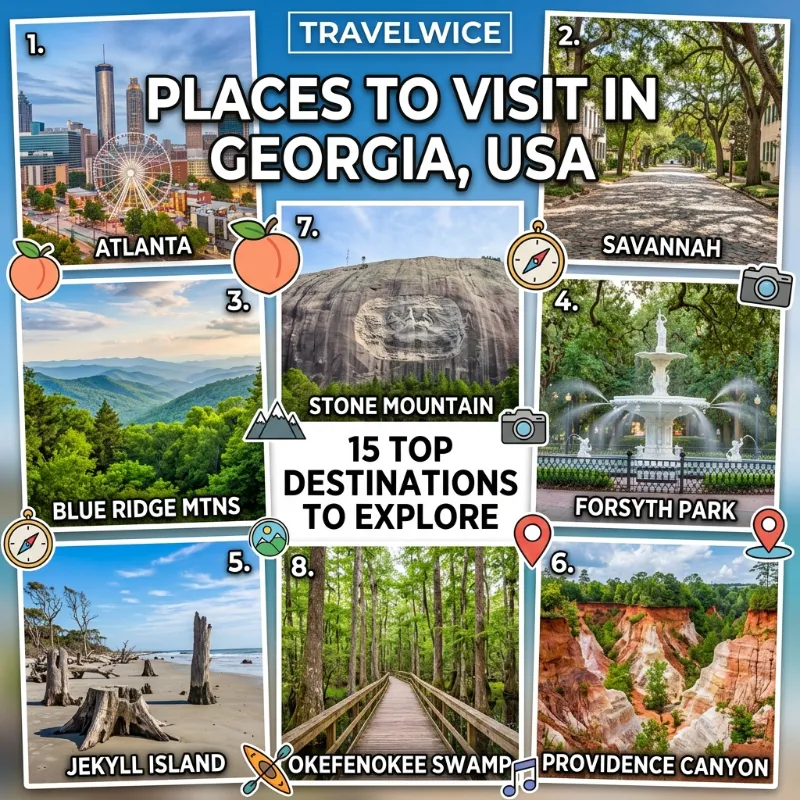
Beyond the squares, Bonaventure Cemetery offers a quieter, atmospheric walk through Savannah’s history along the Wilmington River. The Cathedral of St. John the Baptist and River Street’s converted cotton warehouses add architectural variety. Because the historic core is compact, most visitors comfortably explore it on foot or bicycle in two to three days.
United States: Savannah is roughly a four-hour drive from Atlanta and has its own regional airport (SAV), making it an easy standalone destination or the start of a coastal loop toward the Golden Isles.
Atlanta: Culture, Civil Rights History, and Modern Attractions
Atlanta works as both a gateway city and a destination in its own right. The World of Coca-Cola and the Georgia Aquarium draw families to downtown, while the Center for Civil and Human Rights anchors the city’s role in American civil rights history. The Atlanta Botanical Garden, home to the Fuqua Orchid Center, provides a calmer counterpoint to the busier downtown attractions.
For a more local experience, the BeltLine’s Eastside Trail connects street art, breweries, and neighborhood restaurants across several miles of converted rail corridor. Renting a bike or scooter is the easiest way to cover ground here. Atlanta’s food scene, spanning Southern classics to a growing international restaurant district, also makes it worth an extra day even for travelers primarily headed to the mountains or coast.
The Golden Isles: Jekyll Island, St. Simons Island, and Sea Island
Georgia’s barrier islands offer a beach experience that feels calmer and less developed than much of Florida’s coast. Jekyll Island, once a private retreat for wealthy families, now operates as a state-managed park with historic mansions, a sea turtle rehabilitation center, and miles of public beach. St. Simons Island pairs a walkable lighthouse district with quiet swimming beaches favored by locals rather than large crowds.
Sea Island, adjacent to St. Simons, leans upscale, with resort-style accommodations and golf courses. Fort Frederica National Monument, also on St. Simons Island, preserves the ruins of a 1730s British fort and adds a historical layer to a beach-focused trip. Because the islands sit close together, a single coastal itinerary can cover all three without much extra driving.
Tybee Island: Savannah’s Closest Beach
Tybee Island sits just 18 miles from downtown Savannah, which makes it the easiest beach add-on for anyone already visiting the city. The island’s lighthouse, built in 1736 and rebuilt several times since, remains climbable and offers coastal views worth the stair climb. Tybee’s beaches are more casual and budget-friendly than the Golden Isles, with a small-town pier and a handful of seafood restaurants along the main strip.
Blue Ridge and North Georgia’s Mountain Towns
North Georgia’s mountain region offers a genuinely different Georgia than its coastal counterpart. Blue Ridge, a small railroad town in the Appalachian foothills, has become known for scenic train rides, cabin rentals, and access to hiking trails with fall foliage views. Nearby, Amicalola Falls State Park features Georgia’s tallest waterfall, dropping 729 feet, along with the southern approach trail to the Appalachian Trail.
Helen, styled as a Bavarian alpine village, draws visitors for its distinctive architecture, tubing on the Chattahoochee River, and Oktoberfest celebrations each fall. Dahlonega, site of America’s first major gold rush in 1828, still offers gold panning experiences alongside a growing number of wineries. Together, these towns support a compact three- to four-day mountain loop that pairs well with a spring or fall visit, when temperatures are milder and crowds are smaller.
Providence Canyon: Georgia’s “Little Grand Canyon”
Located in southwest Georgia, Providence Canyon State Park protects a series of colorful canyons formed by 19th-century erosion from poor farming practices. The canyon walls display layered reds, oranges, and purples that shift with the light, and a series of hiking trails let visitors walk down into the canyon floor. It receives far fewer visitors than Georgia’s coastal or mountain attractions, which makes it a strong option for travelers who prefer uncrowded outdoor destinations.
Cumberland Island: Wild Horses and Untouched Beaches
Cumberland Island National Seashore is the least developed of Georgia’s barrier islands and among the most rewarding for nature-focused travelers. Access is limited to a passenger ferry from St. Marys, and there are no paved roads or large hotels on the island itself. In exchange, visitors get feral horses roaming undeveloped beaches, the ruins of the Carnegie family’s Dungeness estate, and maritime forest trails largely free of crowds.
Because ferry space is limited and camping permits sell out during peak season, this destination requires more advance planning than most other entries on this list. Travelers who book ahead, however, generally rank it among the most memorable stops in the state.
Okefenokee Swamp: One of the Largest Blackwater Wetlands in the U.S.
The Okefenokee National Wildlife Refuge covers roughly 400,000 acres along the Georgia-Florida border and ranks among the largest intact freshwater wetlands in the country. Guided boat tours through cypress-lined waterways offer close views of alligators, wading birds, and, in spring, blooming water lilies. The refuge’s isolation and dark night skies also make it a notable stargazing destination, with limited light pollution compared to Georgia’s cities.
Stone Mountain Park: A Day Trip From Atlanta
Just 16 miles from downtown Atlanta, Stone Mountain Park centers on the largest exposed granite monolith in the world. A cable car or hiking trail leads to the summit for panoramic views of the surrounding area, while the park grounds include a historic plantation site, a wildlife area, and seasonal light shows. It works well as a half-day trip for travelers based in Atlanta who want outdoor scenery without leaving the metro area.

Comparing Georgia’s Regions
| Region | Best For | Typical Trip Length | Drive From Atlanta |
|---|---|---|---|
| Savannah & Coast | History, architecture, food | 2–3 days | ~4 hours |
| Golden Isles | Beaches, resorts, wildlife | 3–4 days | ~5 hours |
| North Georgia Mountains | Hiking, foliage, small towns | 3–4 days | 1.5–2 hours |
| Southwest Georgia | Canyons, quiet nature | 1–2 days | 2–3 hours |
| Cumberland Island | Wilderness, ferry access | 2–3 days | ~5.5 hours |
This regional split matters because Georgia’s attractions cluster geographically. Rather than crisscrossing the state, most travelers get better results by choosing one or two adjacent regions per trip.
When to Visit
Spring (March through May) and fall (September through November) offer the most comfortable temperatures statewide and the clearest mountain views around Blue Ridge and Amicalola Falls. Summer suits coastal destinations like Tybee Island and the Golden Isles despite higher humidity, since beach travel benefits from warmer water temperatures. Winter stays mild in the south but can bring cold snaps to the North Georgia mountains, so pack layers if visiting Blue Ridge, Helen, or Dahlonega outside of peak season.
FAQs
What is the number one tourist attraction in Georgia? Savannah’s historic district, including Forsyth Park and its 22 squares, draws the most consistent visitor traffic of any single destination in the state.
How many days do you need to see Georgia’s main attractions? A trip covering Atlanta, Savannah, and one coastal or mountain region generally takes seven to ten days. Travelers with two weeks can add Cumberland Island or the Okefenokee Swamp without rushing.
Is North Georgia or coastal Georgia better for a first visit? Neither region is objectively better; the choice depends on preference. Coastal Georgia suits travelers seeking history and beaches, while North Georgia suits those who prefer hiking and small-town scenery.
Do you need a car to visit Georgia’s best destinations? Yes, in most cases. Savannah and Atlanta are walkable once you arrive, but reaching the coast, mountains, or Cumberland Island’s ferry dock requires a car, since public transit between regions is limited.
Conclusion
Georgia’s appeal comes from contrast rather than any single attraction. Savannah’s history, Atlanta’s culture, the Golden Isles’ beaches, and the North Georgia mountains each offer a distinct trip, and most travelers find that pairing two adjacent regions makes for the most satisfying itinerary. Whichever combination you choose, booking ferry tickets and mountain-town accommodations early will save you the most trouble during peak spring and fall travel seasons.