


The United States packs an unusual amount of variety into one country. You can watch the sun rise over the Atlantic in Maine. A week later, you can stand at the edge of a canyon carved over six million years in Arizona. Deciding where to go often comes down to what kind of trip you want. Cities offer culture and nightlife. National parks offer dramatic scenery. Coastal towns are built for slowing down.
This guide covers destinations that consistently reward a visit. It’s organized by experience type, with practical details on cost, timing, and access. These details matter whether you’re driving from the next state or flying in from London.
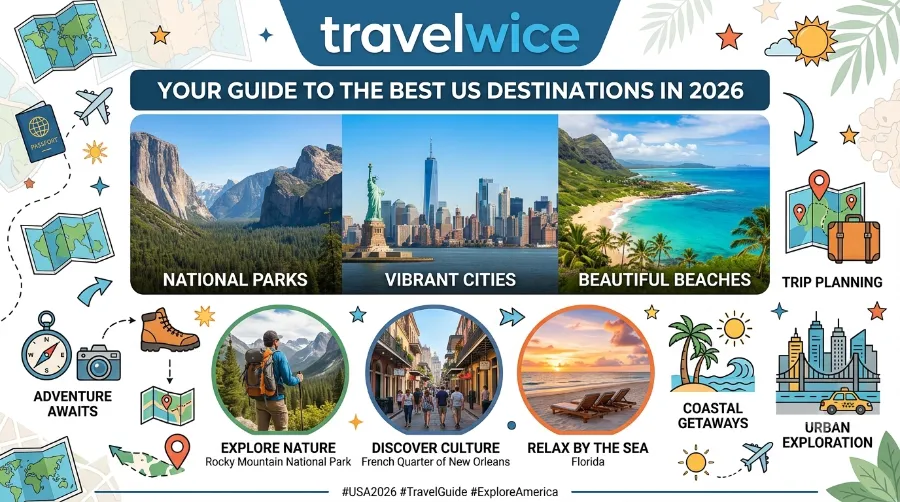
Major Cities Worth Building a Trip Around
New York City remains the most visited urban destination in the country. It earns that reputation through sheer density of things to do. Central Park, the Metropolitan Museum of Art, Broadway theatre, and neighborhoods like Greenwich Village and Williamsburg each feel like a different city. Public transit makes it easy to navigate without a car.
San Francisco combines steep hills, the Golden Gate Bridge, and quick access to wine country in Napa and Sonoma. The city is compact enough to cover major sights on foot or by streetcar. A short ferry ride reaches Alcatraz Island.
Chicago offers architecture tours along the river, deep-dish pizza, and a lakefront that rivals any coastal city. The Art Institute of Chicago and Millennium Park’s Cloud Gate sculpture (known locally as “the Bean”) are standard stops. The city’s food and jazz scenes reward a longer visit.
New Orleans stands apart for its French and Spanish colonial architecture. Live music fills nearly every corner of the French Quarter. Local food culture centers on gumbo, beignets, and po’boys. It’s one of the few US cities where the atmosphere itself is the main attraction.
National Parks and Natural Landmarks
The National Park System includes more than 400 sites, though only a portion charge entrance fees. Grand Canyon National Park in Arizona is the most recognizable. The South Rim is open year-round and offers the easiest access for a first visit. Yellowstone, spanning Wyoming, Montana, and Idaho, holds the largest concentration of geysers in the world, including Old Faithful. Wildlife here ranges from bison to grizzly bears.
Yosemite National Park in California draws visitors for granite cliffs like El Capitan and Half Dome, plus waterfalls that peak in late spring from snowmelt. Zion National Park in Utah has become one of the most popular parks for hiking. The Narrows and Angels Landing are the standout trails, though Angels Landing now requires a permit due to visitor volume.
Entrance Fees and Passes
For US residents, the America the Beautiful Annual Pass costs $80. It covers entrance fees at more than 2,000 federal recreation sites for 12 months from the month of purchase. Non-US residents pay $250 for an equivalent annual pass. Without it, a $100 per-person fee applies at 11 of the most visited parks, on top of the standard entrance fee. Spectrum Local News

This distinction matters for UK travelers planning a national park road trip. The surcharge applies at high-traffic parks including Zion. Non-US residents aged 16 and older must pay this fee at Bryce Canyon and Zion. It doesn’t apply everywhere; Arches and Canyonlands, for example, are excluded. Green card holders count as residents and are exempt. Check the current fee structure for any specific park before you go, since these rules only started in January 2026 and vary by site. Southwest Adventure Tours
Great Smoky Mountains National Park, straddling Tennessee and North Carolina, is the most visited national park in the country. It charges no entrance fee at all, making it a practical stop for budget-conscious travelers exploring the Appalachian region.
Coastal and Island Escapes
The Florida Keys offer a string of islands connected by the Overseas Highway. Key West sits at the southern end, known for sunset celebrations and a laid-back, subtropical atmosphere. Cape Cod and Martha’s Vineyard in Massachusetts provide a New England coastal experience with lighthouses, cranberry bogs, and small fishing villages. Visit between June and September for the best weather.
Maui, part of Hawaii, combines beaches with the volcanic landscape of Haleakalā National Park and the winding, waterfall-lined Road to Hana. Hawaii sits far enough from the mainland that flights typically route through Los Angeles, San Francisco, or Honolulu’s own international connections.
Desert and Southwest Destinations
Las Vegas works as both a standalone trip and a base for exploring nearby natural sites. The Grand Canyon, Zion, and Death Valley are all within a few hours’ drive. Sedona, Arizona offers red rock formations and hiking without the crowds of the larger national parks. It pairs well with a Grand Canyon itinerary.
When to Go
National parks in the West are most accessible from late spring through early autumn. Mountain passes and higher elevations can close with snow outside that window. Coastal Northeast destinations peak in summer.
Southern cities like New Orleans and Florida destinations are more comfortable from November through April. This avoids both summer heat and the Atlantic hurricane season, which runs June through November.
Getting Around
Cities like New York, Chicago, and San Francisco are workable without a car. National park routes and multi-stop road trips generally require one. Distances between major sights are often larger than they appear on a map. The drive from Las Vegas to the Grand Canyon’s South Rim, for instance, takes around four and a half hours.
Entry Requirements for UK Visitors
UK visitors typically fall under the Visa Waiver Program. This requires an approved ESTA rather than a full visa for stays under 90 days. Requirements can change, so confirm current rules directly through the US Customs and Border Protection or State Department websites before booking.
Choosing Where to Go
A first-time visitor with two to three weeks might combine one major city with one or two national parks. Trying to cover both coasts in a single trip usually means spending more time in transit than in any destination.
Travelers focused on cities can build a strong itinerary around two or three. New York, New Orleans, and San Francisco each feel different enough to justify visiting all three. Those prioritizing scenery are better served concentrating on one region, such as the Southwest’s cluster of national parks, rather than spreading a short trip across the country.
Whichever route you take, check current park fees, seasonal closures, and entry requirements a few weeks before departure. That preparation will save more time than any amount of research into which sights to prioritize.