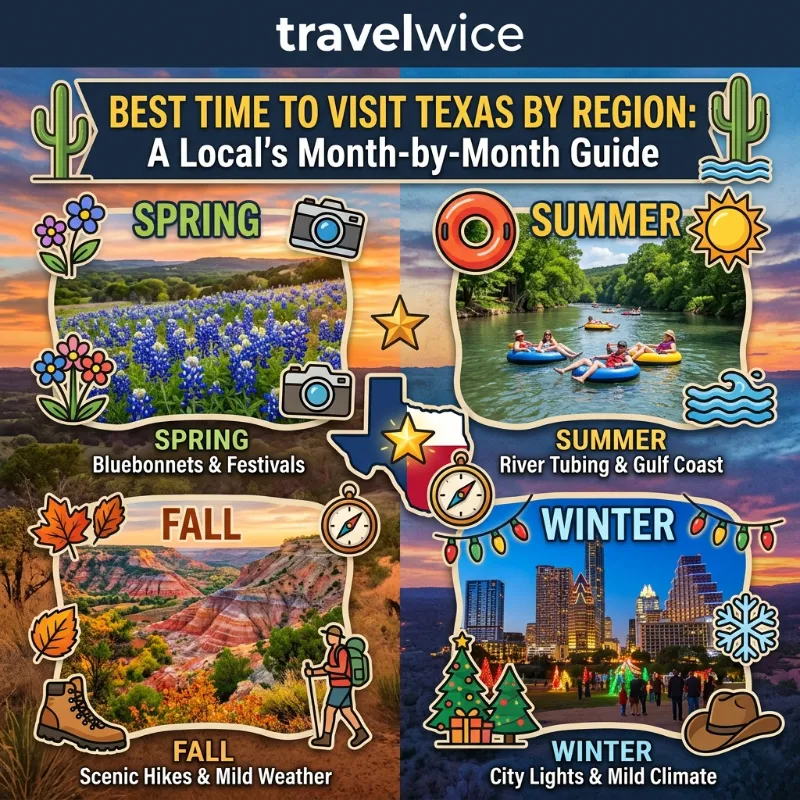

Texas does not really have one climate. It has about five of them stitched together under one flag, and that is the first thing to understand before you book a single flight. So when people ask me for the best time to visit Texas, my honest answer is always the same: it depends on which Texas you are actually going to. The Hill Country in April looks nothing like the Gulf Coast in April, and Big Bend in July is a different planet from Dallas in July. This guide breaks the state down region by region, using current weather data, festival calendars, and a few lessons I only learned the hard way, so you can pick your dates with confidence instead of guessing.
Key Takeaways
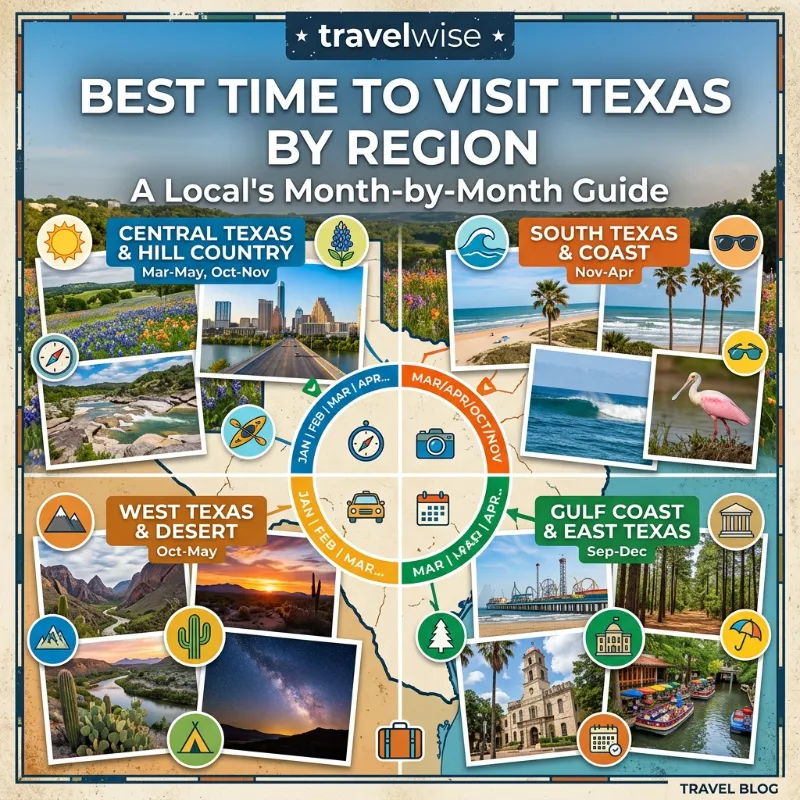
| Region | Best Months | Avoid | Why It Matters |
|---|---|---|---|
| Hill Country (Austin, San Antonio, Fredericksburg) | March to May, October to November | July to August | Bluebonnet season and mild river weather |
| North Texas (Dallas, Fort Worth) | March to May, late September to November | July to August | State Fair, mild temps, lower humidity |
| Gulf Coast (Houston, Galveston, South Padre) | Late October to April | August to October | Hurricane season peaks August to October |
| West Texas (Big Bend, El Paso) | Late October to April | June to August | Desert heat tops 100°F in summer |
| Statewide | March to May, September to November | June to August | Comfortable temps, big festivals, fewer heat warnings |
TL;DR: The best time to visit Texas overall is spring (March through May) or fall (September through November), when highs sit in the comfortable 70s and 80s statewide. If you are chasing beaches, flip that advice and go in winter, since hurricane season runs June through November on the Gulf Coast. For the tightest budget, aim for January, February, or early June, when flights and hotel rates both drop.
Why “Best Time to Visit Texas” Depends on Where You Are Going
Texas covers roughly 268,000 square miles, which is bigger than France. That scale is exactly why a single, one-size-fits-all answer to the best time to visit Texas falls apart fast. Fly into Houston in January and you might need a light jacket. Drive six hours west to Big Bend the same week and you could be hiking in a t-shirt under a bone-dry desert sun.
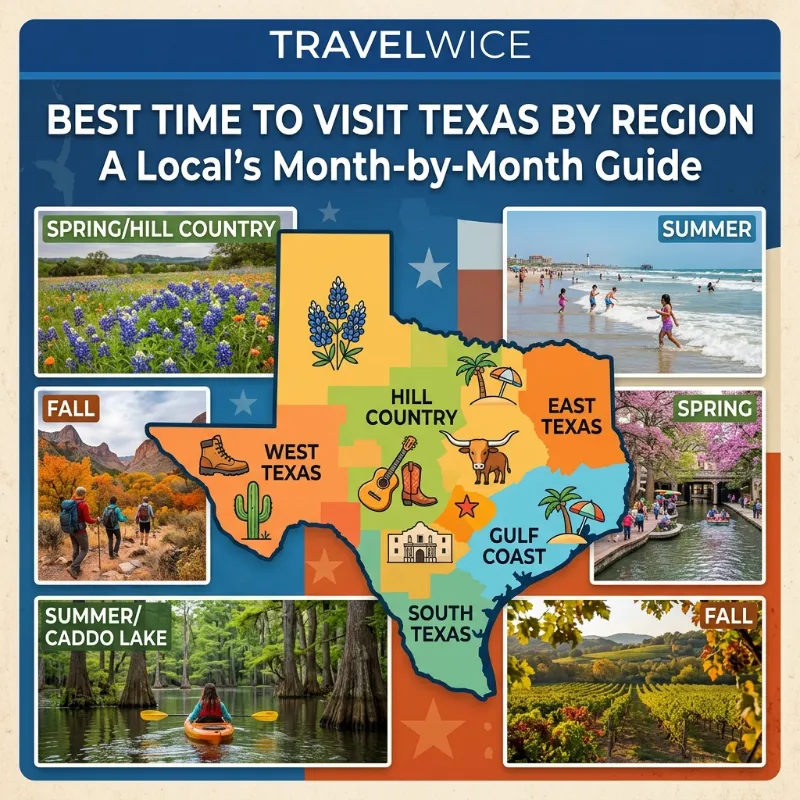
I have made the mistake of applying “Texas weather” as one blanket idea, and it cost me a soggy, humid Fourth of July on the coast when I should have been up in the Hill Country instead. This guide from TravelWice’s Texas travel guide for 2026 exists so you do not repeat that mistake. Below, we break the state into its four practical travel regions and walk through what each one actually feels like, month by month.
Best Texas BBQ Towns Worth a Road Trip
Central Texas and the Hill Country: Best Time to Visit for Wildflowers and River Towns
Central Texas, including Austin, San Antonio, and the Hill Country towns like Fredericksburg and Wimberley, is the region most travel writers picture when they think of the best time to visit Texas. It is also the busiest, so timing matters if you want good weather without SXSW-level crowds.
Spring in the Hill Country (March to May)
Spring is when this region earns its reputation. Bluebonnets carpet the roadsides from mid-March through mid-April, especially around Ennis, Burnet, and the Willow City Loop near Fredericksburg. Average highs climb from the mid-70s in March to the mid-80s by May, and rainfall stays light enough that road trips rarely get rained out.
This is also festival season, so plan around it rather than being surprised by it:
- South by Southwest (SXSW) takes over Austin for roughly two weeks in March, pushing hotel rates up sharply.
- Fiesta San Antonio runs for about eleven days in April, filling downtown San Antonio with parades and street food.
- Houston’s Livestock Show and Rodeo usually wraps in March, which explains a small bump in regional traffic even outside Houston itself.
If you want the wildflowers without the SXSW price spike, aim for the back half of April into early May. For more ideas once you land, our guide to things to do in Austin covers the neighborhoods that get genuinely pleasant in spring air.
Summer in the Hill Country (June to August)
Summer is the season to plan around, not toward, in this part of Texas. Austin regularly sees highs in the mid-90s to low 100s by August, and San Antonio is not far behind. If you are set on a summer trip, mornings and swimming holes like Barton Springs or Jacob’s Well become your best friends, since afternoons often feel too hot for extended walking tours.
Fall in the Hill Country (September to November)
Fall quietly rivals spring here, and I would argue it is the more underrated pick. Temperatures ease back into the 70s and 80s by October, the Austin City Limits Music Festival fills Zilker Park across two weekends, and Hill Country wineries around Fredericksburg host harvest events without the spring crowds. As one Hill Country lodging guide points out, late fall through early winter is genuinely the best time of year to visit the Hill Country if peace and quiet matter more to you than festival energy, since the crowds thin out but the weather stays walkable (Texas Hill Country Resort).
Winter in the Hill Country (December to February)
Winter is the Hill Country’s best-kept secret for budget travel. Rates at wineries and bed-and-breakfasts often drop, and towns like Fredericksburg lean into German-heritage Christmas markets. Nights get cold enough for a real fire, with lows sometimes dipping into the 30s, but daytime highs generally stay comfortable enough for hiking at places like the Hill Country’s scenic trails.
If you want a second city base for this trip, things to do in San Antonio pairs naturally with a Hill Country loop, since the drive between the two is under two hours.
Big Bend National Park Guide 2026: Everything You Need Before You Go
North Texas: Best Time to Visit Dallas and Fort Worth
Dallas and Fort Worth sit far enough north that they run a few degrees cooler than the rest of the state in winter, and noticeably hotter and drier in late summer.
Here is how the seasons break down for North Texas:
- Spring (March to May): Highs move from the low 70s to mid-80s, with occasional severe thunderstorms in April and May. This is peak tornado-watch season in North Texas, so check forecasts before long drives.
- Summer (June to August): This is the hottest stretch, with August routinely hitting the low 100s and very little rain. Locals plan outdoor time for early morning.
- Fall (September to November): The State Fair of Texas runs for 24 straight days from late September into October at Fair Park in Dallas, and it is genuinely one of the best reasons to time a Texas trip around a single event.
- Winter (December to February): Mild by national standards, but North Texas is the part of the state most likely to see an actual cold snap or icy morning, so pack layers if you are visiting in January.
For a deeper dive once you arrive, our things to do in Dallas guide lines up nicely with a fall State Fair trip.
The Gulf Coast: Best Time to Visit Houston, Galveston, and South Padre Island
The Gulf Coast, running from Houston down through Galveston to South Padre Island, plays by different rules than the rest of Texas, mainly because of humidity and hurricane season.
Texas Hurricane Season Travel Tips
Texas hurricane season runs officially from June 1 through November 30, with the highest risk window falling between August and October, when Gulf sea surface temperatures peak. For the 2026 season, NOAA forecast eight to fourteen named storms for the wider Atlantic basin, with three to six expected to reach hurricane strength. If a coastal trip is on your list, a few practical habits go a long way:
- Buy travel insurance that specifically covers named-storm cancellations, not just generic trip interruption.
- Check the National Hurricane Center’s forecast cone before finalizing a beach trip booked less than two weeks out.
- Keep your accommodation’s cancellation policy flexible during August, September, and October.
- Have a backup inland plan, since Hill Country or Dallas trips can often be swapped in with only a day or two of notice.
This does not mean you should avoid the coast entirely during those months. It means you plan with your eyes open, the same way a longtime Gulf Coast resident would, rather than finding out the hard way that a named storm has entered the forecast three days before your flight.
Texas Road Trip Itinerary: 7-Day Route Guide
Best Months on the Gulf Coast
Late October through April is genuinely the sweet spot for Houston and Galveston, since humidity drops, hurricane risk fades, and daytime highs stay pleasant in the 60s and 70s. South Padre Island runs slightly warmer year round, which makes it one of the few parts of Texas where a winter beach trip actually works. If your main goal is Houston’s museums and food scene rather than the beach itself, our things to do in Houston guide is built around exactly that shoulder-season window.
West Texas and Big Bend: Best Time to Visit the Desert
West Texas, anchored by Big Bend National Park and El Paso, runs on desert rules, and those rules are almost the opposite of the Gulf Coast’s.
Big Bend’s own seasonal pattern is stark. Summer highs regularly climb past 100°F at lower elevations, while the Chisos Mountains stay somewhat cooler. Winter brings mild days but genuinely cold nights, sometimes dropping into the 30s, so a decent sleeping bag matters if you are camping. Spring, particularly mid-March through May, and fall, from mid-September through mid-November, deliver the most reliable combination of comfortable daytime hikes and clear night skies for stargazing.
A few numbers worth knowing before you go:
- March and April are Big Bend’s busiest months, largely due to spring break traffic, so book campsites and lodging well in advance.
- October and November are widely considered the best months to camp, with highs in the 70s to low 80s and noticeably fewer crowds than spring.
- Summer (June through August) sees the fewest overnight visitors for a reason, since daytime heat at lower elevations can make midday hiking genuinely risky.
Our full Big Bend National Park guide goes deeper on trail-specific timing if a desert hike is the centerpiece of your trip.
Planning a Texas Trip from the UK or Europe
If you are flying in from London, Manchester, or anywhere in mainland Europe, a couple of extra factors shape your best time to visit Texas beyond just the weather. Direct flights from London Heathrow to Dallas Fort Worth or Houston typically run around nine to ten hours, and jet lag tends to hit harder on the way home than on the way out, so building a rest day into either end of the trip is worth it.
Currency and pricing swings matter too. Hotel and car rental rates in Texas are quoted in US dollars, and the exchange rate against the pound or euro can shift the real cost of a trip by a noticeable margin from one booking window to the next. Booking flights three to five months ahead of shoulder season travel, rather than waiting for last-minute deals, tends to protect European travelers from the sharpest price spikes around SXSW and the State Fair of Texas.
A few practical notes for first-time visitors from overseas:
- Most UK and EU passport holders need either an ESTA (if flying under the Visa Waiver Program) or a standard US visa, so apply at least a few weeks before departure.
- Car hire is close to essential outside the main downtown cores, since Texas cities are spread out and public transit is limited compared to European cities.
- Air conditioning runs cold almost everywhere in summer, so a light layer indoors is genuinely useful even during the hottest months outside.
Best Time to Visit Texas by Activity
Weather alone does not tell the whole story, since what you actually want to do in Texas should shape your dates just as much as the thermometer does. Here is how the calendar breaks down by activity type rather than by region.
Road trips: Spring and fall both work well, but fall generally wins for road trips specifically, since storm season has eased and daylight hours still support long driving days between stops like Austin, Fredericksburg, and San Antonio.
Hiking and outdoor recreation: Stick to October through April almost everywhere except the immediate coast, where winter humidity is lower and heat exhaustion risk drops sharply compared to summer trail conditions.
Beach and water activities: Late spring through early fall works for Gulf Coast swimming, though savvy travelers thread the needle between May and the start of true hurricane risk in August to get warm water without the highest storm odds.
Festivals and live music: March and October are unmatched, thanks to SXSW, Fiesta San Antonio, the Austin City Limits Music Festival, and the State Fair of Texas all landing within these two windows.
Wildlife and stargazing: Big Bend’s clearest, driest skies tend to show up in November and December, once summer humidity has fully cleared and before spring break traffic returns.
Comparing Texas’s Four Main Regions Side by Side
Since travelers rarely stick to just one part of the state, this side-by-side comparison helps with multi-stop itineraries that hop between regions in a single trip.
| Factor | Hill Country and San Antonio | North Texas (Dallas-Fort Worth) | Gulf Coast (Houston to South Padre) | West Texas (Big Bend, El Paso) |
|---|---|---|---|---|
| Signature draw | Bluebonnets, wine country, river tubing | State Fair, museums, sports culture | Beaches, seafood, coastal wildlife | Desert hiking, stargazing, canyon views |
| Peak crowd months | March, April, October | September, October | March (spring break), summer | March, April |
| Biggest weather risk | Summer heat above 95°F | Spring severe storms | Hurricane season, June to November | Extreme summer heat above 100°F |
| Best value season | Winter | Late January to February | Late October to early December | Late fall to early winter |
| Ideal trip length | 3 to 5 days | 2 to 3 days | 4 to 7 days | 3 to 4 days |
Reading this table alongside the earlier weather table should make it much easier to build a two-region itinerary, such as pairing a Hill Country wine weekend with a Gulf Coast beach stretch in the same trip, without accidentally scheduling either leg during its worst weather window.
How Locals Actually Plan Around Texas Weather
After years of building itineraries around this state, a few habits consistently save both money and comfort. First, we check the National Weather Service’s regional outlook about ten days out rather than trusting a single seasonal average, since Texas weather can swing hard within the same month. Second, we treat festival calendars as fixed anchors and build travel dates around them rather than hoping a favorite event will simply line up with an already-booked trip.
Third, and this one surprises a lot of first-time visitors, we rarely trust a single “best month” answer from any one source, including this one. Weather patterns shift year to year, so cross-checking a current forecast against the historical averages in the tables above gives a much more realistic picture than relying on outdated blog advice.
Texas Weather by Month: A Quick Reference Table
Here is a simplified statewide snapshot pulling together average highs across the major cities, useful as a fast reference before you commit to dates. Numbers are rounded averages and will vary slightly by year.
| Month | Austin High | Dallas High | Houston High | San Antonio High | Big Bend High |
|---|---|---|---|---|---|
| January | 62°F | 57°F | 63°F | 63°F | 62°F |
| February | 66°F | 62°F | 67°F | 66°F | 67°F |
| March | 73°F | 70°F | 73°F | 74°F | 75°F |
| April | 80°F | 78°F | 79°F | 80°F | 82°F |
| May | 86°F | 85°F | 85°F | 85°F | 90°F |
| June | 92°F | 92°F | 90°F | 92°F | 96°F |
| July | 95°F | 96°F | 92°F | 95°F | 97°F |
| August | 96°F | 97°F | 93°F | 95°F | 96°F |
| September | 90°F | 89°F | 90°F | 89°F | 91°F |
| October | 82°F | 79°F | 84°F | 82°F | 84°F |
| November | 71°F | 68°F | 74°F | 72°F | 73°F |
| December | 63°F | 58°F | 66°F | 64°F | 64°F |
Two things jump out from that table. First, June through August is uncomfortably hot almost everywhere in the state at once, which is exactly why this stretch is considered Texas’s true low season for anything other than water-based activities. Second, Big Bend runs hotter than the cities for most of the year but actually holds a milder spring window than you might expect, which is why late October through April remains the desert’s real sweet spot.
Cheapest Month to Visit Texas
If your main priority is stretching your travel budget, the cheapest month to visit Texas is generally found in the deep of winter, specifically January and February, when both flights and hotel rates dip below their yearly average. Early June, right before summer camps and family vacations ramp up, can also offer a short pocket of lower hotel pricing, even though the heat is already climbing.
Spring and fall, ironically the most pleasant weather windows, are also the most expensive due to festival demand, so if your dates are flexible, consider these trade-offs:
- Booking a Hill Country or Dallas trip in late February can dodge both SXSW pricing and peak summer heat.
- Flying into Texas on a Tuesday or Wednesday, rather than a weekend, consistently shows lower fares across most booking platforms.
- Locking in accommodation at least a month ahead helps in shoulder months, since last-minute rates tend to climb once festival dates are announced.
Texas Travel Seasons Guide: High Season vs Shoulder Season vs Low Season
Breaking the calendar into three practical bands makes planning easier than trying to memorize twelve individual months.
High season (March, October): This is when Texas is at its most crowded and most expensive, driven by SXSW, spring break, the State Fair of Texas, and the Austin City Limits Music Festival. Weather is close to ideal statewide, but book everything early.
Shoulder season (February, April, May, September, November): Slightly cooler crowds, still-good weather, and noticeably better rates. This band is where most seasoned Texas travelers, myself included, try to land a trip.
Low season (June through August, plus January): Summer is defined by heat rather than crowds, since plenty of domestic travelers still visit for family trips and water activities despite the temperatures. January is genuinely quiet almost everywhere except for a brief spike around major college football bowl games.
A Full Year of Texas Events Worth Building a Trip Around
Beyond the big four festivals already mentioned, Texas runs a packed events calendar that shapes when locals actually plan their own travel. Grouping these by season makes it easier to see which month deserves your attention depending on your interests.
Winter events: The San Antonio Stock Show and Rodeo typically runs across February, drawing rodeo fans from across the region, while Fort Worth’s Stockyards host weekend rodeos at the Cowtown Coliseum all year long, making January and February surprisingly lively despite the cooler weather.
Spring events: GrapeFest in Grapevine each September might be the state’s best-known wine festival, but spring has its own version of that energy through Fredericksburg’s wine trail events and Fiesta San Antonio’s eleven days of parades, food, and river celebrations each April.
Summer events: Summer leans into water-based traditions, from tubing the Guadalupe River near New Braunfels to Fourth of July fireworks over Lady Bird Lake in Austin, both of which lean into the heat rather than fighting it.
Fall events: This is Texas’s undisputed events season, anchored by the State Fair of Texas in Dallas, the Austin City Limits Music Festival, and Wurstfest, a ten-day German heritage celebration held each November in New Braunfels that pairs surprisingly well with a Hill Country wine trip.
Firsthand Notes From the Road
A few things only become obvious once you have actually driven this state end to end rather than just read about it. Central Texas humidity feels noticeably different from Gulf Coast humidity, even at the same temperature reading, since the coastal air carries more moisture and makes an 88°F afternoon in Galveston feel considerably heavier than the same number in Austin. Big Bend’s cell service is close to nonexistent past Marathon, so downloading offline maps before you lose signal is not optional, it is essential.
Locals also tend to track two things outsiders often miss: the Texas heat index, which regularly runs five to ten degrees above the actual air temperature during summer humidity spikes, and the state’s habit of sudden spring cold fronts, sometimes called “blue northers,” which can drop temperatures by twenty degrees or more within a few hours in March and April. Neither shows up clearly in a simple monthly average, which is exactly why checking a short-range forecast close to your travel dates still matters even after reading a guide like this one.
Real Trip Examples
A few concrete examples make this easier to picture than averages alone. In April 2025, a five-day Hill Country loop covering Austin, Fredericksburg, and Wimberley saw daytime highs hover between 78°F and 84°F, with only one afternoon shower, and bluebonnets still visible along back roads outside Burnet. In late September 2025, a Gulf Coast trip to Galveston avoided any named storm activity entirely, with humidity finally easing and water temperatures still warm enough for swimming into early October. And in November 2024, a three-night Big Bend camping trip recorded lows near 38°F overnight but highs reaching a comfortable 76°F by early afternoon, which meant daytime hikes felt great even though a proper sleeping bag was non-negotiable after dark.
Packing and Planning Checklist by Season
- Spring: Light layers, a rain shell, sunscreen, and closed-toe shoes for uneven wildflower trails.
- Summer: Maximum sun protection, a refillable water bottle, and a plan to be outdoors before 10am or after 6pm.
- Fall: A light jacket for evenings, comfortable walking shoes for festival crowds, and flexible dining reservations around major events.
- Winter: A warm layer for North Texas mornings, swimwear if you are heading to South Padre Island, and a flexible itinerary in case of a rare ice event.
For additional context on how other guides frame the seasonal trade-offs, both Wander’s seasonal Texas guide and Southern Living’s rodeo-and-wildflower breakdown are worth a skim, since they add color on specific towns this guide does not cover in depth.
Frequently Asked Questions
What is the overall best time to visit Texas? Spring (March to May) and fall (September to November) offer the most comfortable statewide temperatures and the richest festival calendar, though your ideal window still shifts depending on which region you are visiting.
Is it safe to visit the Texas coast during hurricane season? Yes, with planning. Hurricane season runs June through November, with the highest risk in August, September, and October, so buying flexible, storm-covered travel insurance is smart during those months.
When do the Texas bluebonnets bloom? Peak bloom typically runs from late March through mid-April, with the Hill Country and areas around Ennis and Burnet offering the most reliable displays.
What is the cheapest month to visit Texas? January and February generally offer the lowest flight and hotel rates, alongside early June before summer travel fully ramps up.
Is Big Bend open year round? Yes, Big Bend National Park stays open all year, but summer heat at lower elevations can make midday hiking genuinely dangerous, so spring and fall remain the safer, more comfortable windows.
Quick Texas Travel Quiz
Test what you just learned before you start booking.
- When does Texas’s official hurricane season run? a) May to September b) June to November c) July to December Correct answer: b) June to November
- Which festival takes over Fair Park in Dallas for 24 days? a) South by Southwest b) Austin City Limits c) State Fair of Texas Correct answer: c) State Fair of Texas
- What is generally the cheapest time to visit Texas? a) March and October b) January and February c) June and July Correct answer: b) January and February
- Which region of Texas typically stays open and mild enough for winter beach trips? a) Big Bend b) South Padre Island c) Fort Worth Correct answer: b) South Padre Island
- When do Texas bluebonnets typically peak? a) Late March to mid-April b) Early June c) Late October Correct answer: a) Late March to mid-April
Conclusion
There is no single best time to visit Texas, and honestly, that is part of what makes the state such a rewarding place to plan around. Once you match your travel dates to the specific region you actually care about, whether that is Hill Country bluebonnets in April, a Gulf Coast escape in November, or a Big Bend stargazing trip in late October, the whole trip gets easier to plan and noticeably cheaper to book. Use the tables above as your starting point, check the current forecast and hurricane outlook closer to your travel dates, and build the rest of your itinerary around whichever Texas region matches the season you are chasing.
References
- National Hurricane Center, NOAA. Atlantic Hurricane Season Outlook. https://www.nhc.noaa.gov/
- National Park Service. Big Bend National Park Weather and Climate. https://www.nps.gov/bibe/
- Wander. The Best Time to Visit Texas for a Luxury Vacation. https://www.wander.com/article/best-time-to-visit-texas
- Texas Hill Country Resort. Best Time of Year to Visit Texas Hill Country for Peace and Quiet. https://www.txhillcountryresort.com/blog/best-time-of-year-to-visit-texas-hill-country-for-peace-and-quiet/
- Southern Living. The Best Times of Year to Visit Texas. https://www.southernliving.com/best-times-of-year-to-visit-texas-11914560
- State Fair of Texas. Official Event Dates. https://bigtex.com/
- Austin City Limits Music Festival. Official Site. https://www.aclfestival.com/