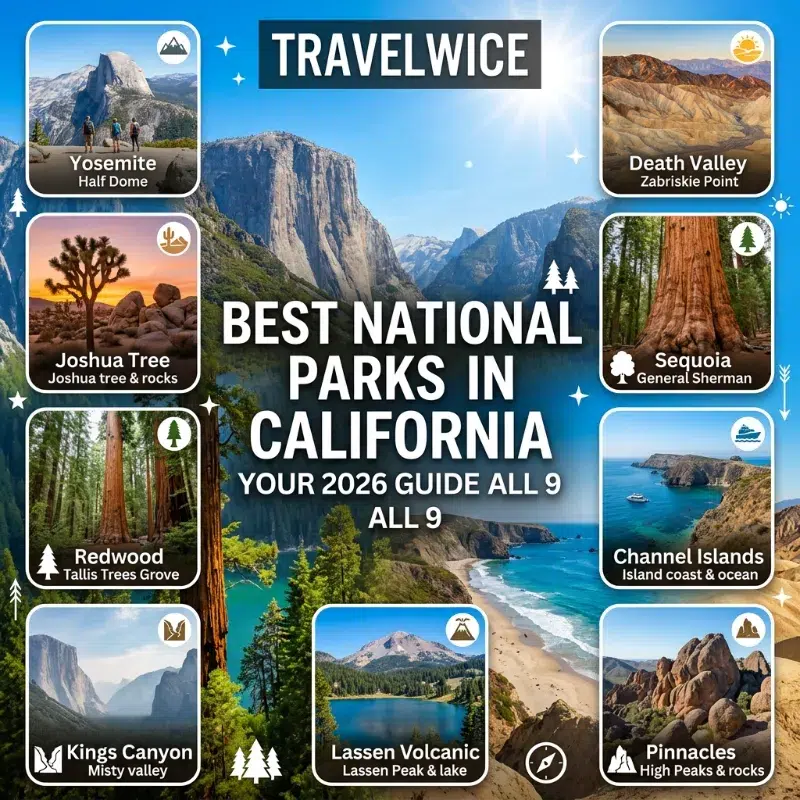

Picture a waterfall that drops 2,425 feet in the morning. Then, by lunch, you stand under a tree taller than a 27 story building. Later, you sit in a desert of boulders and Joshua trees at sunset. That is why the best national parks in California are so hard to plan, because nine parks sit in one state and they range from snow to sand to sea.
I wrote this guide for real trip planning, so it covers costs in USD, GBP and EUR. It also shares honest crowd notes. In addition, it explains the new 2026 fee rules that surprise many visitors from the UK and Europe. So pick your park, check the season, and then book with confidence.
TL;DR
- First, California has nine national parks, and Yosemite, Sequoia and Kings Canyon, Joshua Tree, and Death Valley suit most first trips.
- Also, Yosemite works best in late spring, while Joshua Tree works best from October to April.
- However, non-US residents aged 16 and over pay an extra $100 per person at Yosemite and Sequoia and Kings Canyon, so a $250 annual pass often saves money.
Key Takeaways at a Glance
| Question | Short answer |
|---|---|
| How many national parks does California have? | Nine |
| First trip pick | Yosemite, from mid May to June |
| Easy desert option | Joshua Tree, from October to April |
| Giant trees | Sequoia and Kings Canyon, from June to October |
| Winter choice | Death Valley, from November to March |
| Extra fee for non-US residents in 2026 | $100 per person, ages 16 and up, at Yosemite and Sequoia and Kings Canyon |
| Non-resident annual pass | $250 (about £185 or €215) |
| Ideal road trip length | 8 to 10 days for four parks |
California National Parks Map: How the Nine Parks Fit Together
Before you book anything, look at the geography. Once you open a California national parks map, you see three clusters, and each cluster works as its own mini trip.
National Parks to Visit Fall 2026: The 10 Best for Color, Calm and Wildlife
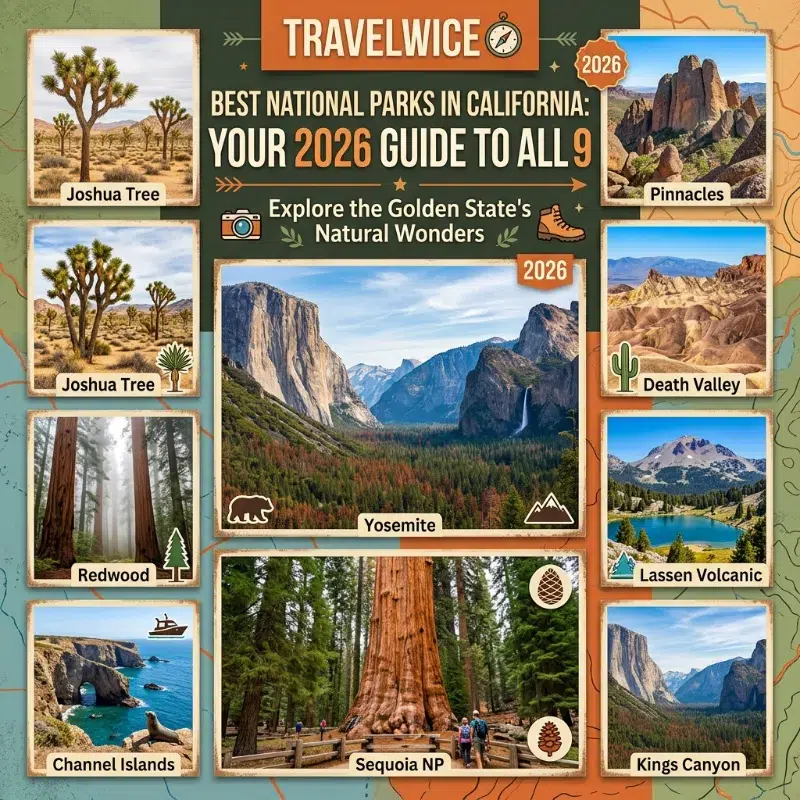
The Sierra Nevada cluster sits in the middle of the state, and it holds Yosemite, Sequoia and Kings Canyon. Meanwhile, the desert cluster sits in the southeast with Joshua Tree and Death Valley. Finally, the coast and north cluster holds Redwood, Lassen Volcanic, Channel Islands and Pinnacles.
Drive Times Between Regions
Distances matter more than the map suggests. For example, driving from Joshua Tree to Yosemite takes a full day of about eight to nine hours. Because of that, most visitors pick two clusters instead of all three.
| Region | Parks | Nearest big airport | Typical drive from airport |
|---|---|---|---|
| Sierra Nevada | Yosemite, Sequoia, Kings Canyon | San Francisco (SFO) or Fresno (FAT) | 4 hours to Yosemite, 1 hour to Kings Canyon from Fresno |
| Southern desert | Joshua Tree, Death Valley | Los Angeles (LAX) or Las Vegas (LAS) | 2.5 hours to Joshua Tree, 2 hours from Las Vegas to Death Valley |
| North coast | Redwood, Lassen Volcanic | Sacramento (SMF) or Medford (MFR) | 3 to 5 hours |
| Central and south coast | Pinnacles, Channel Islands | San Jose (SJC) or Los Angeles (LAX) | 2 hours to Pinnacles, 1.5 hours to the Ventura boat dock |
Where to Find Official Maps
Tip: because signal drops in Death Valley, deep Kings Canyon, and much of Lassen, save an offline map before you leave.
For official maps and alerts, use the National Park Service site. Also, if you prefer a photo-led overview, California Through My Lens lays out the parks and nearby monuments well.
Best National Parks in California: My Ranking for 2026
A ranking only helps when it explains the trade-offs, so here is a simple comparison, followed by the reasons.
| Rank | Park | Best for | Best months | Vehicle fee | Crowd level |
|---|---|---|---|---|---|
| 1 | Yosemite | Waterfalls, granite walls, first trips | May to June, September to October | $35 | Very high |
| 2 | Sequoia and Kings Canyon | Giant trees, quiet trails | June to October | $35 (one fee covers both) | Medium |
| 3 | Joshua Tree | Rock climbing, stargazing, short hikes | October to April | $30 | High |
| 4 | Death Valley | Big landscapes, winter sun | November to March | $30 | Medium |
| 5 | Redwood | Old growth forest, coast | May to September | No national park fee | Low to medium |
| 6 | Channel Islands | Kayaking, wildlife, quiet | September to November | No park fee, boat ticket needed | Low |
| 7 | Lassen Volcanic | Hot springs, volcano views | July to September | $30 in peak season | Low |
| 8 | Pinnacles | Condors, caves, spring flowers | March to May | $30 | Low |
Fees come from the National Park Service list. However, they can change, so check the official fee page before you travel.
Why this order? Yosemite and Sequoia offer the biggest “wow” per day of driving. Likewise, Joshua Tree wins on ease, while Death Valley wins on scale. Still, the last four reward people who have more time and a taste for quiet.
1. Yosemite National Park: The Icon That Still Earns Its Fame
Yosemite is the park most people mean when they search for the best national parks in California. It has Yosemite Falls at 2,425 feet, El Capitan, Half Dome, and a valley floor you can walk in flip flops.
What to Do in Yosemite
First, start in the valley and walk the flat loop to Lower Yosemite Fall. Next, drive up to Tunnel View for the classic photo. After that, take the road to Glacier Point, which usually opens by late spring.
For a bigger hike, try the Mist Trail to Vernal Fall. Because it climbs about 600 steps and spray soaks you in May and June, bring a light rain jacket even on a sunny day.
Half Dome is the famous cable route, but it needs a permit. So apply through the official lottery instead of counting on a walk-up spot.
National Parks to Visit in the USA: The Complete 2026 Guide
2026 Yosemite Facts You Should Know
- First, standard entry costs $35 per private vehicle for seven days, and that one fee covers everyone in the car.
- Also, entrance stations take cards only, because the gates no longer take cash.
- Notably, the park ran 2026 without an entrance reservation system, and Tioga Road opened on May 15, its earliest date in 16 years.
- Still, rules can change fast, so read the official Yosemite page the week you leave.
Where to Stay
Yosemite Valley lodging fills up months ahead. Therefore, book the day your window opens. If rooms sell out, try Mariposa, Oakhurst, or El Portal instead. In summer, expect roughly $180 to $350 (£135 to £260, €155 to €300) a night for a decent gateway motel or inn. Since prices vary a lot, treat this as a range and not a quote.
My honest take is that Yosemite is worth the crowds, but only if you go early. For example, reach the trailhead by 7:30 a.m. As a result, you get quiet light, open parking spots, and cooler air.
Best National Parks to Visit Spring 2026: Bloom Dates, Fees, and Real Tips
2. Sequoia and Kings Canyon: The Best Parks for Giant Trees
These two parks share a border and one entrance fee. Together, they hold the General Sherman Tree, the largest tree on Earth by volume.
Sequoia Highlights
First, walk the paved trail to General Sherman early, before the tour buses arrive. Then climb Moro Rock, a 350 step granite staircase with a huge view of the Great Western Divide. Finally, finish with the Crescent Meadow loop, which stays flat and easy for kids.
The Generals Highway twists a lot, so allow more time than the map says. Likewise, motorhomes and long trailers should check size limits first.
Kings Canyon Highlights
Grant Grove has the General Grant Tree, and you can reach it close to the road. Next, drive the Kings Canyon Scenic Byway toward Road’s End. It is one of the most dramatic drives in the state, although snow closes it in winter.
Fees and Timing
The fee is $35 per vehicle, and it covers both parks. Also, both parks are cashless. In addition, both apply the $100 nonresident surcharge for visitors without a pass.
For full access, go from June to October. In July and August, afternoons get hot at lower elevations. However, the big trees sit high and stay cooler.
3. Joshua Tree National Park: The Easiest Desert Win
Joshua Tree sits about two and a half hours from Los Angeles. Also, it mixes two deserts, thousands of boulder stacks, and some of the darkest night skies in southern California.
Best Things to Do
- Hidden Valley Nature Trail: First, try this one mile loop through boulders, because it suits almost everyone.
- Keys View: Next, drive to this short stop for a view of the Coachella Valley.
- Barker Dam: Here, a gentle loop leads to old petroglyphs and sometimes bighorn sheep.
- Cholla Cactus Garden: Also, visit at sunset, when the spines glow.
- Skull Rock: Finally, stop at this rock right by the road, since it takes only five minutes.
Practical Advice
The entrance fee is $30 per vehicle. Best of all, this park does not charge the extra non-resident fee, so it works well for international visitors on a budget.
Summer is harsh, however. Because highs often pass 100°F (38°C) in July, plan hikes for the first two hours after sunrise. Also, carry at least one gallon of water per person per day.
Stay in Joshua Tree town, Twentynine Palms, or Yucca Valley. Since spring weekends and October sell out early, book ahead. In addition, check the official Joshua Tree page for campground status.
4. Death Valley National Park: Extreme, Huge, and Better in Winter
Death Valley is the largest national park in the lower 48 states. It covers about 3.4 million acres, and it holds the lowest point in North America at Badwater Basin, 282 feet below sea level.
Must See Stops
First, start at Zabriskie Point for sunrise. Next, walk out onto the salt flats at Badwater. Then drive Artists Palette in late afternoon, when the rock shows pink, green, and purple.
Mesquite Flat Sand Dunes look best at dawn. Meanwhile, Ubehebe Crater offers a short walk with a wide view. Also, Dante’s View gives you a cool break above the heat.
Safety Notes
Death Valley recorded 134°F (56.7°C) on July 10, 1913, a widely cited world record. Therefore, do not visit in summer without serious planning.
Because distances are big and stations are few, fill your gas tank in Furnace Creek or Stovepipe Wells. In addition, keep your phone map offline.
The fee is $30 per vehicle. Since many visitors arrive from Las Vegas, about two hours away, the park fits easily into a Nevada trip. Finally, the Death Valley park page lists road closures and flash flood alerts.
5. Redwood National and State Parks: Quiet Giants on the Coast
Redwood sits near the Oregon border. It protects some of the tallest trees on Earth, and the misty coast makes the forest feel calm and huge.
First, drive the Newton B. Drury Scenic Parkway for a slow tour. Then stop at Lady Bird Johnson Grove for an easy loop. Also, if you like beaches with your forest, try Gold Bluffs Beach, where elk often graze.
Permit or day-use rules can apply at some spots, such as Fern Canyon in busy months. So check the Redwood park page before you go.
Bring a fleece, even in July. Because coastal fog keeps temperatures in the 50s and 60s °F (10 to 18°C), the air stays cool for much of the year.
Best National Parks in Colorado to Add to Your List
6. Channel Islands National Park: Wildlife With a Boat Ride
Channel Islands is the least crowded of the popular parks, since you need a boat or plane to reach it. Most visitors sail from Ventura on a day trip to Santa Cruz Island or Anacapa.
The park charges no entrance fee. However, a boat ticket usually costs roughly $70 to $100 per adult, so check the operator before you plan. Because seas can be rough, take seasickness tablets if you are unsure.
Once you land, kayak the sea caves on Santa Cruz. Also, hike to Inspiration Point on Anacapa. Meanwhile, keep an eye out for the island fox, a small fox that lives only on these islands. For boat schedules and camping options, see the park page.
7. Lassen Volcanic National Park: The Quiet Northern Option
Lassen shows what a volcano looks like when it stays alive underground. Lassen Peak erupted from 1914 to 1917, so today you can see steaming vents, boiling mud, and clear alpine lakes.
For the best view, hike to Bumpass Hell, a boardwalk trail of about 3 miles round trip. Along the way, you pass hot pools and steam. Because the ground can be dangerously hot, stay on the boardwalk.
In peak season, from April 16 to November 30, a private vehicle pays $30. Meanwhile, off season fees run lower. Since snow often blocks the main road into early summer, aim for July to September.
8. Pinnacles National Park: Condors and Cave Scrambles
Pinnacles is a smaller park about two hours south of San Jose. It sits on the remains of an ancient volcano, and it has rock spires and talus caves you can walk through with a flashlight.
Here, you have one of the best chances in California to see the California condor. So look up along the High Peaks trail. Also, spring brings wildflowers and mild air. In summer, however, the park gets hot. Because no road crosses the park, the east and west entrances do not connect by car. Therefore, pick one side.
Yosemite vs Joshua Tree: Which One Should You Pick?
People ask me this question more than any other. In short, the answer depends on the season, your fitness, and your budget.
| Factor | Yosemite | Joshua Tree |
|---|---|---|
| Landscape | Granite cliffs, waterfalls, forest | Boulders, desert, Joshua trees |
| Best months | May to June, September to October | October to April |
| Vehicle fee | $35 | $30 |
| Non-resident surcharge | Yes, $100 per person 16 and over | No |
| Crowds | Very high in summer | High on spring weekends |
| Hiking difficulty | Easy to very hard | Easy to moderate |
| Drive from a big city | About 4 hours from San Francisco | About 2.5 hours from Los Angeles |
| Ideal for | Big scenery and waterfalls | Short walks, climbing, stars |
Pick Yosemite if you want dramatic water and huge cliffs and your dates fall between late April and October. On the other hand, Joshua Tree suits you better from November to March. Also, it works well for a relaxed trip with young kids.
If you have five days or more, do both. Even though the two parks sit far apart, a loop from Los Angeles works well.
Best Time to Visit National Parks in California
The best time for national parks in California changes by park. For instance, a cool desert in January turns into a hot oven in July. Likewise, a snowy mountain in March becomes a green paradise in June.
| Park | Best window | Avoid | Why |
|---|---|---|---|
| Yosemite | May to June, late September | July to August weekends | Full waterfalls, fewer crowds in fall |
| Sequoia and Kings Canyon | June to October | Deep winter for Kings Canyon road | Open roads and warm days |
| Joshua Tree | October to April | July to August | Mild days, cool nights |
| Death Valley | November to March | June to September | Safe temperatures |
| Redwood | May to September | Heavy winter storms | Drier trails |
| Channel Islands | September to November | Foggy early summer mornings | Clearer seas and skies |
| Lassen Volcanic | July to September | October to May | Roads and trails open |
| Pinnacles | March to May, October to November | July to August | Flowers, cooler air |
Average High Temperatures (Rounded, °F)
Use this chart to see why season matters. Keep in mind that it shows rounded long-term averages, so treat it as a guide.
Average July high (°F)
Death Valley           ██████████████████████ 117
Joshua Tree            ███████████████████    100
Yosemite Valley        ██████████████████     92
Sequoia (Giant Forest) ██████████████         78
Redwood                ████████████           65

Average January high (°F)
Joshua Tree            ██████████████         60
Death Valley           ██████████████         65
Yosemite Valley        ███████████            50
Sequoia (Giant Forest) ███████                42
Redwood                ██████████             55
Visitor Numbers: Where the Crowds Go
Crowds shape your trip more than the weather does. This chart shows rounded, recent annual visits, and each block equals about 200,000 visits. For exact and current numbers, see the National Park Service statistics page.
Yosemite           ████████████████████ ~4.1 million
Joshua Tree        ███████████████      ~3.0 million
Sequoia            ███████              ~1.4 million
Death Valley       ██████               ~1.2 million
Kings Canyon       ███                  ~0.6 million
Redwood            ██                   ~0.5 million
Lassen Volcanic    ██                   ~0.4 million
Pinnacles          ██                   ~0.4 million
Channel Islands    █                    ~0.3 million
The lesson is simple. If you hate crowds, add Sequoia, Kings Canyon, Redwood or Lassen to your list. As a result, you get big scenery with far fewer people.
2026 Fees and Passes: What You Will Actually Pay
The rules changed on January 1, 2026, and they matter most for visitors from the UK and Europe.
Now, the National Park Service charges a $100 fee to non-US residents aged 16 and over at 11 parks, including Yosemite and Sequoia and Kings Canyon. That fee adds to the normal entrance fee. However, Joshua Tree, Death Valley, Redwood, Lassen, Pinnacles and Channel Islands do not charge it.
A $250 non-resident annual pass removes the surcharge for the holder. In fact, it pays for itself at about three surcharge parks. In my view, the pass wins for most groups in a car, because one pass also covers the holder plus three passengers in the same vehicle.
Sample Cost Comparison (A Couple in One Car, Both Aged 16+)
This worked example uses the fees in this guide. Therefore, it will change if fees change.
| Trip | Without pass | With $250 pass |
|---|---|---|
| One park: Yosemite | $35 + $200 (2 × $100) = $235 | $250 |
| Two parks: Yosemite and Sequoia and Kings Canyon | $235 + $235 = $470 | $250 |
| Four parks: add Joshua Tree and Death Valley | $470 + $30 + $30 = $530 | $250 |
The $250 pass equals about £185 or €215. Still, rates move, so check on the day you buy.
For a Yosemite only trip, paying at the gate costs slightly less than the pass. Once you add a second surcharge park, however, the pass wins by a wide margin. Meanwhile, US residents have a simpler choice. Their $80 America the Beautiful pass covers fees at all federal sites, and it breaks even at about three parks.
Buy the pass on Recreation.gov or at an entrance station. Also, bring your passport, since staff may ask for proof of residency.
Best National Parks in Utah Worth the Drive
California National Park Road Trip: A 10 Day Route
A California national park road trip works best as a loop. So start in Los Angeles and end in San Francisco. Because this direction keeps the desert in cooler months, you also reach Yosemite when Tioga Road usually stands open.
The Route Day by Day
Here is the route I recommend for spring or fall.
- Joshua Tree first (days 1 and 2): Fly into LAX and drive about 2.5 hours. Then do Hidden Valley, Keys View, and a sunset at Cholla Cactus Garden.
- Then Death Valley (days 3 and 4): Drive 4 to 5 hours from Joshua Tree. Once you arrive, spend one full day on Zabriskie Point, Badwater, and Artists Palette, and watch your fuel level.
- Next comes Sequoia and Kings Canyon (days 5 and 6): Drive 5 to 6 hours via Lone Pine and the Owens Valley. After that, walk General Sherman, climb Moro Rock, and finish at Grant Grove.
- After that, Yosemite (days 7 to 9): Drive about 4 hours. Give the valley one full day and Glacier Point a half day. Then use the last day for Tuolumne Meadows if Tioga Road is open.
- Finally, San Francisco (day 10): Drive 4 to 5 hours, return your rental car, and rest.
A Summer Version of the Route
Death Valley in summer would break this plan. Therefore, if you travel from June to September, swap the desert for the coast. For example, take Redwood and Lassen in the north, and then finish at Yosemite.
More Route and Planning Help
For more route ideas, see our California road trip itinerary guide. Meanwhile, our national parks to visit in the USA pillar guide shows how California fits into a wider US trip. You can also browse the TravelWice homepage for more planning help.
Another useful read is Road Tripping California, which gives good route detail. In addition, Paula Gaston’s local guide offers a local view on parks and monuments.
Quick Road Trip Budget (Two Adults, 10 Days, Rough Estimate)
| Item | Estimate |
|---|---|
| Rental car and gas | $900 to $1,400 |
| Lodging (mid range) | $1,500 to $2,800 |
| Food | $700 to $1,100 |
| Park fees or $250 pass | $250 to $530 |
| Activities and extras | $200 to $500 |
| Total | $3,550 to $6,330 |
That total equals about £2,650 to £4,700, or €3,050 to €5,450. Since costs vary with season, use it as a starting point.
Expert Tips From Years of Park Planning
Small choices decide whether a park day feels great or stressful. Therefore, I follow these rules on every trip.
- Arrive early: Enter Yosemite or Joshua Tree before 8 a.m., so you beat the heat and the lines.
- Book lodging first: Because gateway towns sell out long before the season starts, lodging comes before flights.
- Download maps: Also, data drops without warning in every California park.
- Carry more water than you think: In the desert, aim for one gallon per person per day.
- Check road status the night before: Since snow and rockfall can close roads with little notice, a quick check saves hours.
- Skip the rush: After all, two or three parks done well beat six parks done in a hurry.
Common Mistakes I See Visitors Make
Most planning errors repeat. If you avoid these, your trip improves right away.
First, many visitors squeeze Yosemite and Death Valley into a weekend, but the drive alone takes about eight hours each way. Second, some people book Death Valley in July because they want “the hottest place on Earth.” That plan looks fun on paper. In real life, however, it feels unsafe.
Third, travelers forget the non-resident fee until they reach the gate, so budget for it early. Finally, many visitors skip the lesser known parks. Yet Redwood and Sequoia often leave people happier than the crowded headline parks.
Frequently Asked Questions
How many national parks are in California?
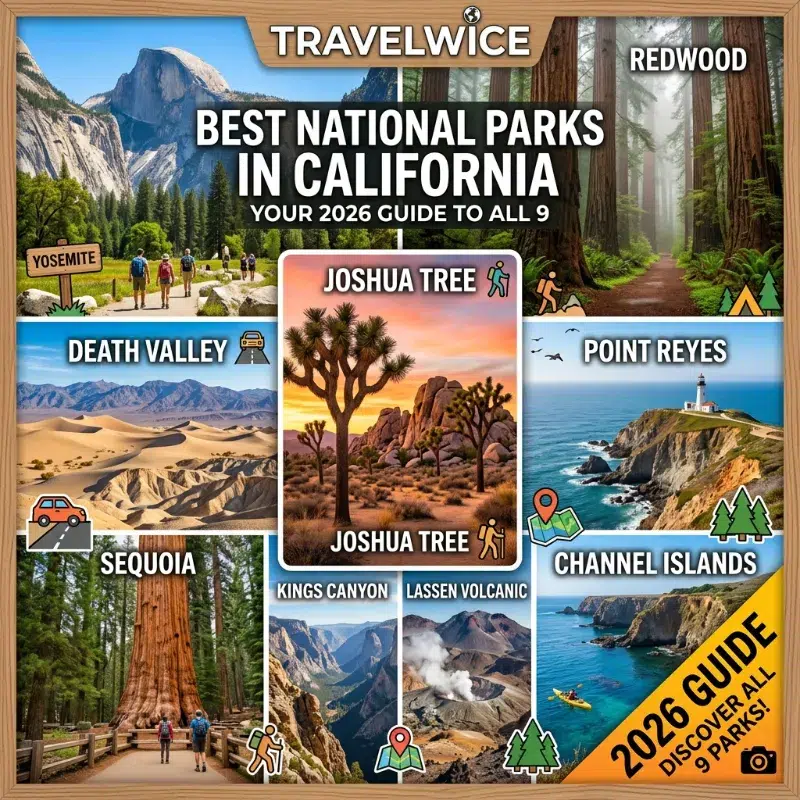
California has nine national parks: Channel Islands, Death Valley, Joshua Tree, Kings Canyon, Lassen Volcanic, Pinnacles, Redwood, Sequoia, and Yosemite. In fact, that total beats every other US state.
What is the best national park in California for first-time visitors?
Yosemite suits most first-time visitors best. Because it has waterfalls, easy valley walks, and big views, it gives you the most variety. For the strongest water flow, go in May or June.
What is the best time to visit national parks in California?
It depends on the park. For example, choose May to June or late September for Yosemite, October to April for Joshua Tree, and November to March for Death Valley.
Do I need a reservation to enter Yosemite in 2026?
Park announcements said there was no entrance reservation system in 2026. However, lodging, Half Dome, and some permits still need advance booking. Since rules change, check the official page before you travel.
Is the $250 America the Beautiful pass worth it for international visitors?
Yes, if you visit two or more surcharge parks or travel in a group in one car. For a Yosemite only trip for two people, though, paying at the gate costs a little less.
Which is better, Yosemite or Joshua Tree?
Yosemite is better for waterfalls and cliffs between late April and October. On the other hand, Joshua Tree is better for mild winter days, short hikes, and star gazing.
Can I visit California national parks without a car?
It is possible, but hard. Yosemite has a shuttle system and regional buses. Still, most other parks work best with a rental car.
Which California park is best in winter?
Death Valley and Joshua Tree are the best winter choices, because both offer mild days. Yosemite looks beautiful in snow. However, you need chains and flexible plans.
How many days do I need for the best national parks in California?
Plan two days for Yosemite, one to two days for Sequoia and Kings Canyon, and one to two days for Joshua Tree or Death Valley. As a result, ten days let you see four parks without rushing.
Test Your Knowledge: 5 Quick Quiz Questions
1. How many national parks does California have?
A) 7
B) 9
C) 12
Correct answer: B) 9
2. Which park is the best choice for a January trip?
A) Lassen Volcanic
B) Yosemite high country
C) Death Valley
Correct answer: C) Death Valley
3. In 2026, at which of these parks do non-US visitors pay the extra $100 fee?
A) Joshua Tree
B) Yosemite
C) Death Valley
Correct answer: B) Yosemite
4. What is the home of the General Sherman Tree?
A) Sequoia National Park
B) Redwood National Park
C) Pinnacles National Park
Correct answer: A) Sequoia National Park
5. Where does North America hit its lowest point?
A) Keys View
B) Badwater Basin
C) Glacier Point
Correct answer: B) Badwater Basin
Conclusion
The best national parks in California give you every landscape from ancient forest to salt flat, so you can pick a trip that fits your season and budget. For most first trips, Yosemite, Sequoia and Kings Canyon, and Joshua Tree deliver the most value. In addition, Death Valley shines in winter, while Redwood and Lassen shine in summer.
Because the 2026 rules changed, plan your fees before you land. If you visit more than one surcharge park, the $250 pass saves real money. Then book lodging early, start each day at sunrise, and keep your route realistic. Now pick your two or three parks and build the trip around them.
References
- Entrance fees by park, official list: nps.gov/aboutus/entrance-fee-prices.htm
- Yosemite main page and current conditions: nps.gov/yose
- Fees and passes for Yosemite: nps.gov/yose/planyourvisit/fees.htm
- Joshua Tree park page from the NPS: nps.gov/jotr
- Death Valley alerts and road status: nps.gov/deva
- Redwood park information and permits: nps.gov/redw
- Channel Islands boat and camping details: nps.gov/chis
- Visitor use statistics dashboard: nps.gov visitor use statistics
- Passes and permits at Recreation.gov: recreation.gov
- California Through My Lens, park and monument overview: californiathroughmylens.com
- Road Tripping California, park route ideas: roadtrippingcalifornia.com
- Paula Gaston, a local’s guide to parks and monuments: paulagaston.com
- Park Adventurer’s 2026 fee breakdown: parkadventurer.com
- More Than Just Parks, Yosemite reservations in 2026: morethanjustparks.com