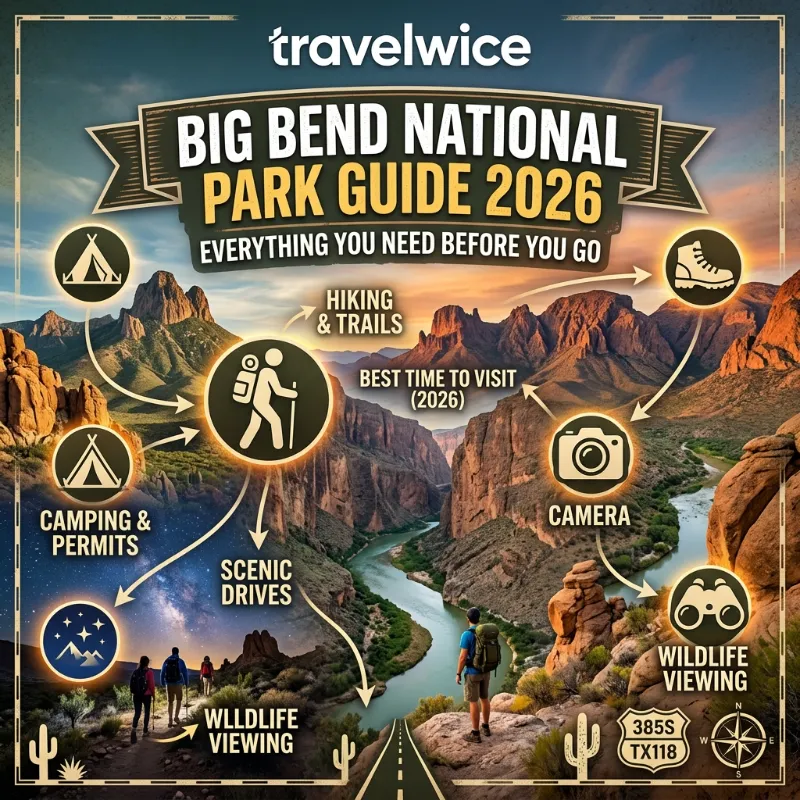

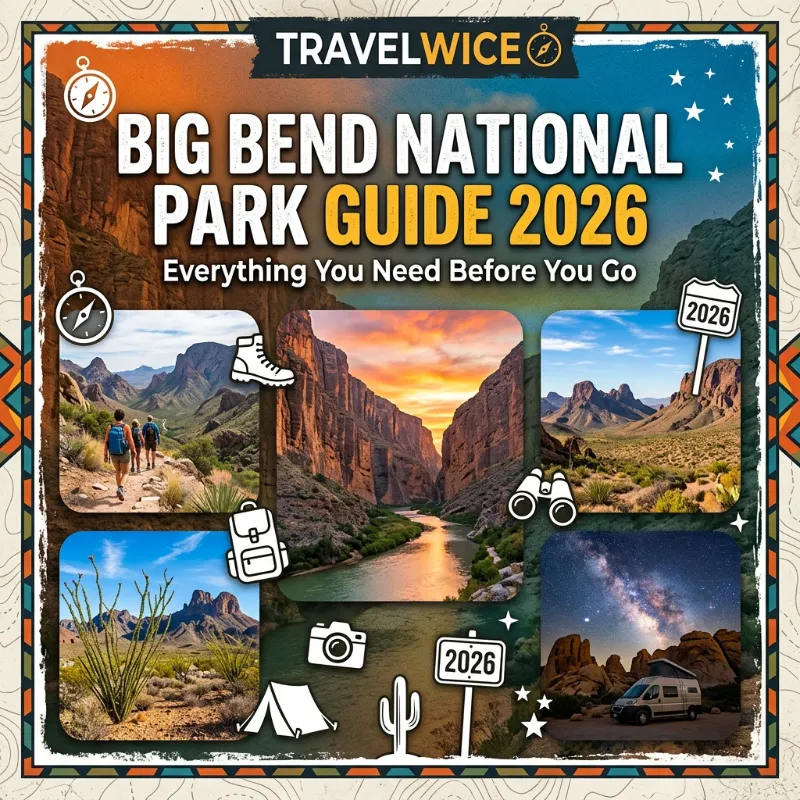
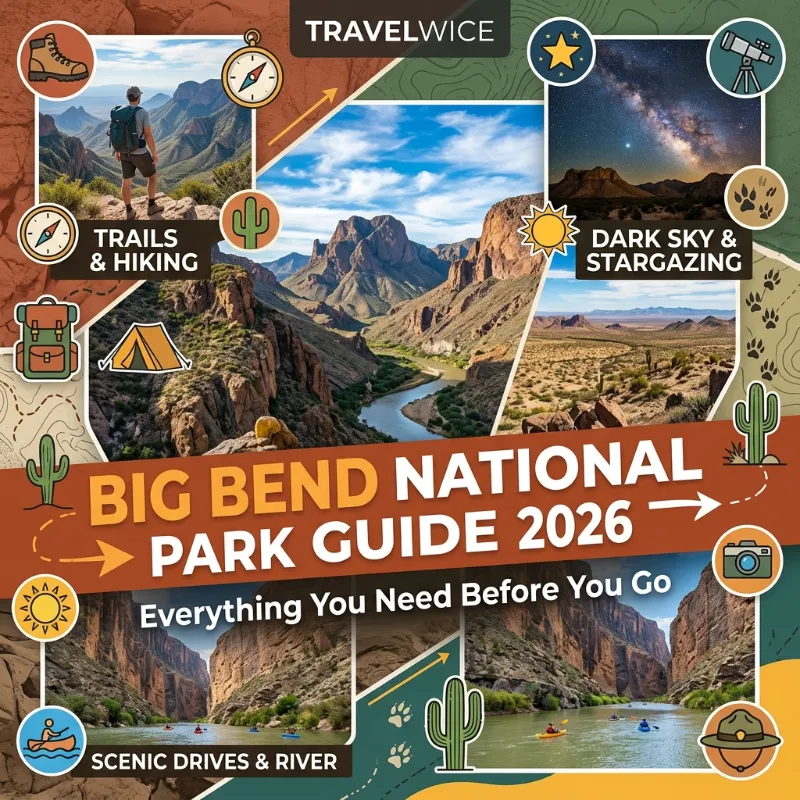
The first time you drive into Big Bend National Park, the cell signal drops and the road narrows. Then the Chisos Mountains rise out of the desert like something from another planet. That single moment explains why this park is worth the drive. This Big Bend National Park guide covers everything you need for 2026, including the best time to visit, a tested 3 day itinerary, and honest camping and lodging advice, so you don’t end up sleeping in your car in a gas station lot in Marathon, Texas.
Big Bend sits in a remote corner of West Texas along the Rio Grande. Even so, it ranks among the least visited yet most rewarding national parks in the country. Because it sits so far from a major airport, most travelers only get one shot at this trip, so it pays to plan properly. Below, we break the park down piece by piece, with real prices, real trail distances, and the kind of logistics that generic travel sites tend to skip.
Key Takeaways
| Topic | Quick Answer |
|---|---|
| Best time to visit | November through April, with March being the sweet spot for wildflowers and mild temperatures |
| Ideal trip length | 3 to 4 days minimum, 5 days if you want to raft the Rio Grande |
| Entrance fee | 30 USD per vehicle, valid for 7 days (check NPS.gov for current rates) |
| Top hike | The South Rim Trail, roughly 12 to 14.5 miles round trip |
| Where to sleep | Chisos Mountains Lodge for comfort, Chisos Basin Campground for the views |
| Nearest airports | Midland International (MAF) or El Paso (ELP), both 3.5 to 4.5 hours away |
| Cell service | Almost none inside the park, so download offline maps first |
TL;DR
- Visit between November and April, and book Chisos Basin Campground or the Lodge at least 3 to 6 months ahead.
- Plan for 3 full days minimum, since the South Rim Trail and Santa Elena Canyon both deserve real time.
- Fill up on gas and groceries in Marathon, Alpine, or Terlingua first, because fuel is scarce inside the park.
Why Big Bend Deserves a Spot on Your 2026 Texas Road Trip
Big Bend National Park protects roughly 801,000 acres where the Chihuahuan Desert, the Chisos Mountains, and the Rio Grande all meet. Congress established the park in 1944, and unlike more famous parks, it still feels genuinely empty even during the busy season. For that reason, anyone mapping out a wider road trip should treat this as a highlight, not an afterthought, alongside a longer Texas travel guide for 2026.
Many travelers coming from Austin treat Big Bend as the finale of a bigger West Texas loop. If you are also researching things to do in Austin or things to do in San Antonio for the front half of the trip, plan on Big Bend adding at least 3 extra driving days. For a slower, scenic route in between, meanwhile, the Texas Hill Country travel guide is worth reading before you lock in a driving plan.
Best Texas BBQ Towns Worth a Road Trip
Admittedly, this is not a weekend park. Once you stand on the South Rim looking down 2,000 feet into Mexico, though, the long drive stops mattering.
Best Time to Visit Big Bend National Park
Big Bend sits at a lower elevation than most people expect for a mountain park. As a result, summer temperatures on the desert floor regularly climb above 100°F (38°C). Because of this heat, most experienced visitors treat June through August as a season to avoid, unless they plan to stay up in the cooler Chisos Basin.
| Season | Months | Daytime Temp (Desert Floor) | Crowd Level | Best For |
|---|---|---|---|---|
| Winter | December to February | 55 to 70°F (13 to 21°C) | Moderate, busy around holidays | Hiking, stargazing, cooler days |
| Spring | March to April | 70 to 88°F (21 to 31°C) | Highest of the year | Wildflowers, ideal hiking weather |
| Summer | May to August | 95 to 108°F (35 to 42°C) | Lowest | Not recommended for hiking |
| Fall | September to November | 75 to 90°F (24 to 32°C) | Low to moderate | Birdwatching, fewer crowds |
So, if someone asks about the best time to visit Big Bend, the honest answer is March. That said, spring break weeks bring the biggest crowds of the year, so anyone wanting the same weather with fewer people should aim for early November or the first two weeks of April instead. Additionally, Big Bend holds a designation as an International Dark Sky Park, and new moon nights between October and March offer some of the clearest stargazing conditions in the country, according to the National Park Service.
Big Bend Itinerary: 3 Days Done Right
A 3 day Big Bend itinerary gives you enough time to hit the three main areas of the park without feeling rushed. This version is built around actual driving times, since the park itself is larger than Rhode Island.
Day 1: Chisos Basin
- Arrive by early afternoon and check in at Chisos Basin Campground or the Lodge.
- Hike the Window Trail, a 5.6 mile round trip, ideally before sunset for the light through the rock formation.
- Then grab dinner at the Chisos Mountains Lodge restaurant, the only sit-down option inside the park.
Day 2: Santa Elena Canyon and the Ross Maxwell Scenic Drive
- Drive the 30 mile Ross Maxwell Scenic Drive, stopping at Sotol Vista and Mule Ears Viewpoint.
- Next, hike Santa Elena Canyon, a 1.7 mile round trip that ends at a 1,500 foot canyon wall.
- Finally, cool off at Terlingua Creek and watch sunset from Sotol Vista.
Day 3: South Rim and Rio Grande Village
- Tackle the South Rim Trail early, before 8 a.m., since it is the longest hike in the park.
- Alternatively, spend a lighter day at Rio Grande Village, soaking in Hot Springs and birdwatching along the river.
- If your passport is on hand, cross into Boquillas del Carmen, Mexico, for lunch and a genuinely different perspective.
If you have a 4th or 5th day, add a half day rafting trip through Santa Elena or Mariscal Canyon with a Terlingua-based outfitter, since a permit and specialized gear rule out doing this alone.
Big Bend Hiking Trails Guide
Big Bend offers more than 150 miles of trails, ranging from paved half mile loops to multi day backcountry routes. Here is a practical hiking guide, broken down by difficulty, since matching fitness level to trail is the biggest factor in how much you enjoy this park.
| Trail | Distance | Difficulty | Highlight |
|---|---|---|---|
| Window Trail | 5.6 miles round trip | Moderate | Sunset views through a rock “window” |
| Santa Elena Canyon | 1.7 miles round trip | Easy to moderate | 1,500 foot canyon walls |
| Lost Mine Trail | 4.8 miles round trip | Moderate | Best panoramic view for the effort |
| South Rim Trail | 12 to 14.5 miles round trip | Strenuous | Sweeping views into Mexico |
| Hot Springs Historic Trail | 0.5 miles round trip | Easy | Natural riverside hot springs |
| Grapevine Hills Trail | 2.2 miles round trip | Easy | Balanced Rock formation |
For first-timers, Lost Mine Trail offers the best payoff for the effort, and rangers often call it the single trail worth doing if time is short. On the other hand, skip the South Rim after 10 a.m. in warmer months, since there is little shade and heat exhaustion causes most park rescues, based on NPS incident reports.
Big Bend Camping and Lodging Options
Big Bend’s remote location means booking a place to sleep is not something to leave until the last minute. In fact, reservations for Chisos Basin Campground and Chisos Mountains Lodge regularly sell out 3 to 6 months ahead for the popular spring season.
Inside the park:
- Chisos Basin Campground: 60 sites at 5,400 feet elevation, cooler nights, closest to the main trailheads, roughly 16 USD per night.
- Rio Grande Village Campground: Near the river and good for birdwatching, with hookups at the adjacent RV park, roughly 16 to 40 USD per night.
- Cottonwood Campground: Quiet, with no generators allowed, ideal for travelers who want true silence.
- Chisos Mountains Lodge: The only in-park option with real beds and air conditioning, typically 150 to 220 USD per night, and by far the most requested reservation in the park.
Outside the park:
- Terlingua and Study Butte offer casitas, motels, and glamping, usually cheaper than the Lodge and closer to the west entrance.
- Marathon, about an hour from the north entrance, has a handful of boutique stays and a genuine restaurant scene.
Overall, anyone used to city travel should reset expectations set by places like things to do in Dallas or things to do in Houston. Unlike those cities, Big Bend has no big-box grocery store, almost no gas stations, and spotty to nonexistent cell service throughout.
Texas Road Trip Itinerary: 7-Day Route Guide
Getting There and Practical Logistics
The nearest commercial airports, Midland International Air and Space Port (MAF) and El Paso International Airport (ELP), sit roughly 3.5 to 4.5 hours from the park. Since no public transportation reaches Big Bend, a rental car becomes essential, and a vehicle with decent clearance helps on the unpaved backcountry roads.
A few practical notes worth knowing before you go:
- Fill your gas tank in Marathon, Alpine, Study Butte, or Panther Junction, since fuel inside the park is limited to one station.
- Download offline maps in advance, because cell service disappears almost entirely once you cross into the park.
- Carry at least 1 gallon of water per person per day, a figure the Park Service recommends, since dehydration causes most medical issues here.
- Check current entrance fees on the official NPS site before you travel, since pricing does change from year to year.
Local Tips From Someone Who’s Actually Done This Drive
A few things only become obvious once you are actually there. For instance, the drive between the west entrance and Rio Grande Village takes close to 2 hours, so don’t plan to see both sides in one afternoon. Likewise, the Chisos Mountains Lodge restaurant closes its kitchen earlier than most expect, generally by 8 p.m., so plan dinner accordingly.
Best Time to Visit Texas by Region: A Local’s Month-by-Month Guide
Also, bring your passport if you want the Boquillas crossing experience, since a driver’s license alone will not get you across. Detailed reporting from independent guides like bigbendguide.com and visitbigbend.com confirms the crossing is worth the extra planning, and the burro rides and lunch spots on the Mexican side genuinely rank among the trip’s highlights. Similarly, the Hearnes’ Big Bend blog offers a useful breakdown of seasonal trail conditions if you want to time a hike around wildflower blooms or river levels.
Frequently Asked Questions
How many days do you need for Big Bend National Park? Most experienced visitors recommend at least 3 full days. However, 4 to 5 days lets you add rafting or a Boquillas crossing without rushing.
What is the best time to visit Big Bend? March offers the best mix of mild temperatures and wildflowers, though it is also the busiest month. Otherwise, early November through mid-April generally offers the safest window for comfortable hiking.
Is Big Bend National Park hard to hike? It depends on the trail. For example, Santa Elena Canyon and Hot Springs Historic Trail suit most fitness levels, while the South Rim Trail delivers a genuinely strenuous full day out.
Do I need a reservation for Chisos Basin Campground? Yes, and booking 3 to 6 months ahead for spring dates makes sense, since it stays the most requested campground in the park.
Can I see Big Bend in one day? You can see a small slice, such as Santa Elena Canyon and one short hike. Still, one day won’t let you experience what makes the park worth the trip.
Quick Quiz: How Well Do You Know Big Bend?
- What year was Big Bend National Park established? a) 1916 b) 1944 c) 1972 Correct answer: b) 1944
- Roughly how large is Big Bend National Park? a) About 100,000 acres b) About 400,000 acres c) About 801,000 acres Correct answer: c) About 801,000 acres
- Which trail offers the best panoramic view for the least effort? a) South Rim Trail b) Lost Mine Trail c) Hot Springs Historic Trail Correct answer: b) Lost Mine Trail
- What river forms the southern boundary of the park? The Rio Grande.
- What type of park designation does Big Bend hold for stargazing? An International Dark Sky Park.
Conclusion
Big Bend is not a park you stumble into on the way to somewhere else, and that is precisely its appeal. Because of its remote location, it rewards travelers who plan ahead with empty trails, genuinely dark skies, and a version of Texas most visitors never see. Whether you have 3 days or a full week, book your campground or lodge early and pack more water than you think you need. In the end, that preparation, more than any single trail or viewpoint, is what people remember most.
References
- National Park Service, Big Bend National Park official site: https://www.nps.gov/bibe/index.htm
- Big Bend Guide: https://bigbendguide.com/
- The Hearnes’ Big Bend National Park Guide: https://thehearnes.com/blog/guide-big-bend-national-park
- Visit Big Bend: https://visitbigbend.com/
- Texas Travel Guide for 2026, TravelWice: https://travelwice.com/texas-travel-guide-for-2026/