
If you’re planning a trip and searching for the best places to visit in Seattle, USA, the city rewards you with a rare mix of waterfront views, coffee culture, and mountain scenery within a single skyline. Seattle sits between Puget Sound and Lake Washington, so water shapes almost everything you’ll see here, from ferry rides to salmon-filled locks. This guide covers the landmarks worth your time, the neighborhoods locals actually love, and a few day trips that make the most of a Pacific Northwest visit.
Quick Answer
The best places to visit in Seattle include Pike Place Market, the Space Needle, and Chihuly Garden and Glass at Seattle Center, plus Pioneer Square, the Seattle Waterfront, and Kerry Park for skyline views. For a fuller trip, add Capitol Hill, Ballard, and a day trip to Mount Rainier or Bainbridge Island. Two to four days lets most visitors cover the highlights without rushing.
TL;DR
- Pike Place Market and Seattle Center (Space Needle, Chihuly Garden and Glass, MoPOP) form the essential first-day route, and both areas are walkable or connected by monorail.
- Kerry Park offers the classic skyline-and-Mount-Rainier photo, best visited near sunset on a clear evening.
- Ballard, Fremont, and Capitol Hill show a more local side of the city, with breweries, markets, and independent shops.
- Mount Rainier National Park and Bainbridge Island are the two most rewarding day trips from downtown.
- Book timed-entry tickets for the Space Needle and Chihuly Garden and Glass in advance, especially in summer.
- Seattle is walkable downtown, but a car or reliable transit plan helps for day trips outside the city.
Seattle’s appeal goes beyond any single attraction, so the sections below group the city’s highlights by area. This approach makes it easier to plan a route instead of crisscrossing town.
Pike Place Market and the Downtown Core
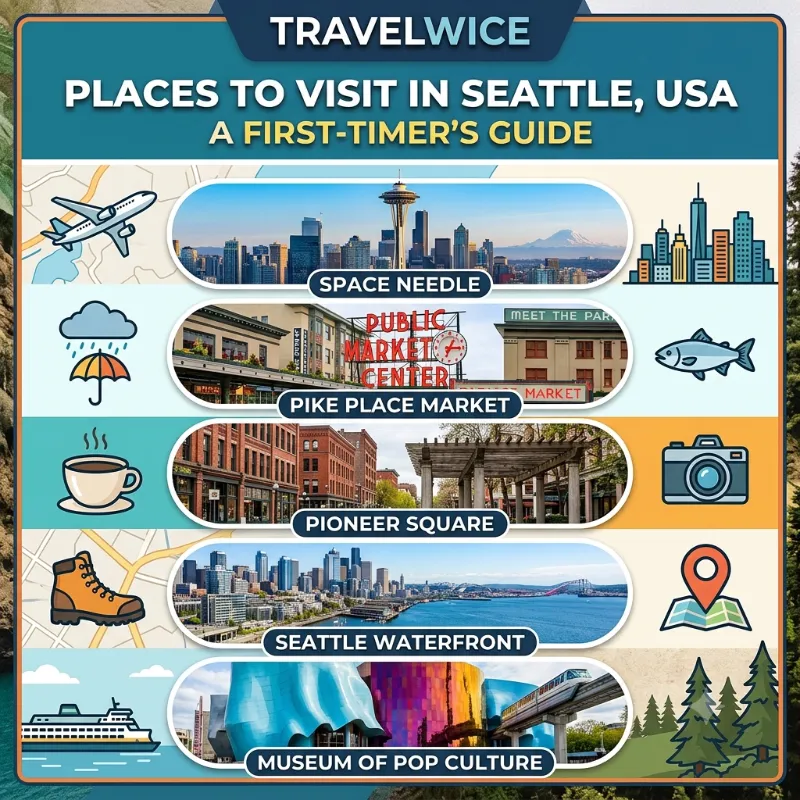
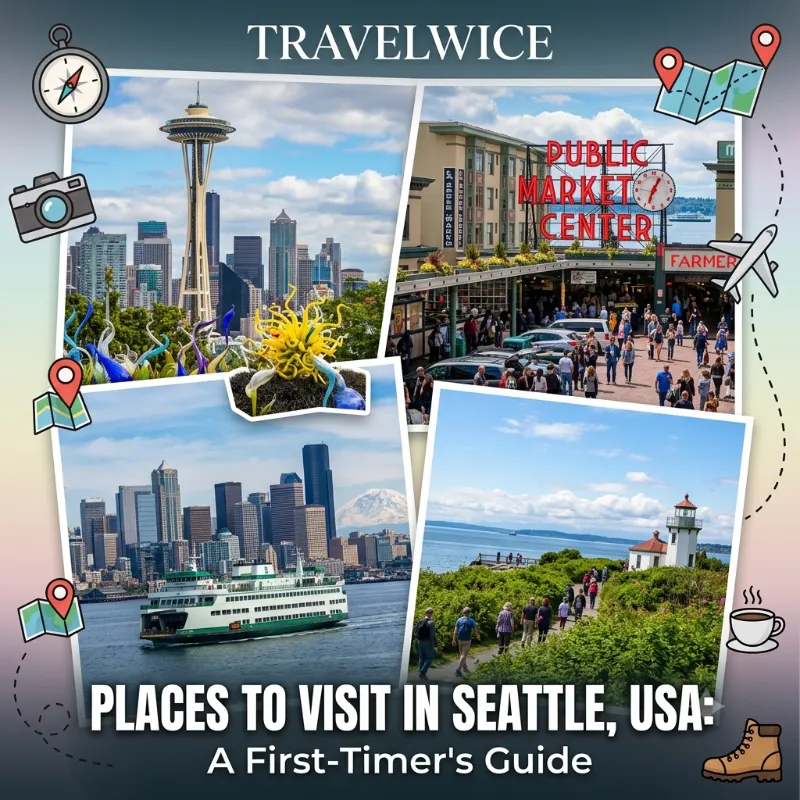
Pike Place Market has anchored downtown Seattle for more than a century, and it remains the city’s most photographed spot. Vendors sell fresh seafood, flowers, and produce, while the lower levels hide small shops, comic stores, and the original Starbucks location. Arrive before 9 a.m. if you want to see the famous fish-throwing without a crowd blocking your view.
Just west of the market, the Seattle Waterfront runs along Elliott Bay. Here you’ll find the Seattle Great Wheel, the Seattle Aquarium, and piers where whale-watching tours depart in search of orcas and gray whales. The Olympic Sculpture Park sits a short walk north and offers free outdoor art with a Puget Sound backdrop, which makes it a good stop if you want scenery without an admission fee.
For art beyond the sculpture park, the Seattle Art Museum downtown houses a broad collection spanning contemporary and historical work. It pairs well with a Pike Place morning, since both sit within a few blocks of each other.
Seattle Center: Space Needle, Chihuly, and MoPOP
Seattle Center, built for the 1962 World’s Fair, remains the city’s cultural hub. The Space Needle is still the most recognizable structure, and a recent renovation added a rotating glass floor called the Loupe along with an open-air observation deck roughly 520 feet above the city. Consequently, views stretch to Mount Rainier, the Olympic Mountains, and Puget Sound on a clear day.

Right next door, Chihuly Garden and Glass displays Dale Chihuly’s blown-glass artwork across eight galleries, an outdoor garden, and a large glasshouse. Many visitors combine both attractions in one ticket, since the sites sit steps apart and the combined visit takes roughly three hours. Because lines can build quickly in summer, book timed entry ahead of your visit.
The Museum of Pop Culture, known as MoPOP, occupies a striking Frank Gehry-designed building at the same complex. Inside, exhibits cover music history, science fiction, and video games, making it a strong option for travelers who want an indoor activity on a rainy afternoon. The Seattle Center Monorail connects this whole area back to downtown in about two minutes, so you don’t need a car to move between the two zones.
Pioneer Square and the Underground Tour
South of downtown, Pioneer Square holds Seattle’s oldest architecture, with red-brick buildings dating to the 1890s rebuild after the Great Seattle Fire. Art galleries and cafés now fill many of the original storefronts. Underneath the sidewalks, guided Underground Tours lead visitors through the original street level, buried when the city raised its roads more than a century ago. The tour blends local history with genuinely odd trivia, which makes it a memorable stop even for travelers who usually skip guided tours.
From Pioneer Square, it’s a short walk to the International District, where dim sum restaurants, Asian markets, and the Wing Luke Museum document the neighborhood’s immigrant history.
Kerry Park and the City’s Best Views
Kerry Park, perched on Queen Anne Hill, delivers the skyline photograph you’ve likely already seen online: downtown Seattle with the Space Needle in the foreground and Mount Rainier rising behind it on clear days. The park itself is small, so plan to arrive early if you want a spot along the railing during sunset. Because the mountain only appears in clear weather, check conditions before making a special trip.
If Kerry Park feels crowded, nearby Bhy Kracke Park and the Betty Bowen Viewpoint offer similar angles with fewer visitors.
Capitol Hill, Ballard, and Fremont
Capitol Hill sits just east of downtown and functions as Seattle’s most eclectic neighborhood, with independent bookstores, live music venues, and a dense restaurant scene. It’s a good base if you want walkable nightlife rather than a downtown hotel.
Ballard, a former Norwegian fishing village, has become known for craft breweries and the Hiram M. Chittenden Locks, where boats pass between Puget Sound and Lake Union. In late summer, salmon climb the adjacent fish ladder, giving visitors a rare close-up view of the migration. Nearby, the Ballard Farmers Market runs every Sunday year-round.
Just south of Ballard, Fremont has a playful, artsy identity, anchored by the Fremont Troll sculpture under the Aurora Bridge and a lively Sunday market. Lake Union sits between Fremont and downtown, and renting a kayak here lets you paddle past houseboats with the Space Needle visible in the distance.
Outdoor Escapes: Discovery Park and the Waterfront Trails
For travelers who want nature without leaving the city, Discovery Park in Magnolia offers over 500 acres of forest, bluffs, and beach along Puget Sound. Trails here lead to a lighthouse and sweeping water views, and the park rarely feels crowded compared with downtown attractions. Similarly, Alki Beach in West Seattle gives visitors a walkable stretch of sand with skyline views across Elliott Bay, plus a genuinely different pace from the city center.
Museum of Flight and Beyond
South of downtown, the Museum of Flight sits on the site of Boeing’s original factory and holds one of the world’s largest air and space collections. Exhibits include a walk-through Air Force One and a Concorde, so it’s a strong stop for aviation enthusiasts or families looking for a half-day activity outside the usual tourist route.
Day Trips: Mount Rainier and Bainbridge Island
Mount Rainier National Park lies roughly two hours southeast of Seattle by car, and the Paradise area offers some of the most accessible alpine scenery in the contiguous United States. Wildflower meadows peak in late July and August, while winter brings heavy snowfall that closes some roads. Check park conditions before driving up, since weather changes quickly at elevation.
Closer to the city, a ferry ride to Bainbridge Island takes about 35 minutes from the downtown waterfront and offers a quieter, small-town alternative to Seattle’s pace. The crossing itself is worth the trip, particularly at sunrise or sunset, when the skyline reflects across the water.
United States: Both destinations are reachable without a passport, and ferries operated by Washington State Ferries accept walk-on and vehicle passengers.
United Kingdom: UK visitors should note that Washington State uses US dollars and imperial measurements, so fuel and distances will read differently than at home; renting a car for the Mount Rainier trip is generally more practical than relying on public transit.
Planning Your Visit
Seattle’s weather shifts noticeably by season. Summer, from June through August, brings the driest, sunniest days and the clearest mountain views, though it’s also the busiest and most expensive time to visit. Spring and fall offer smaller crowds and lower hotel rates, but pack a rain jacket regardless of season, since light rain is common most months.
Getting around is straightforward without a car if you stick to downtown, Seattle Center, Capitol Hill, and Pioneer Square, all of which connect by light rail, monorail, or a short walk. However, a car or rideshare becomes more useful for Ballard, Fremont, Discovery Park, and any day trip beyond the city limits.
FAQs
How many days do you need in Seattle? Three to four days lets most visitors cover downtown, Seattle Center, and at least one neighborhood or day trip without rushing. A shorter visit of one to two days can still cover Pike Place Market, the Space Needle, and Chihuly Garden and Glass.
Is Seattle walkable for tourists? Downtown, Pike Place Market, Pioneer Square, and Seattle Center are all walkable or connected by short transit rides. Neighborhoods like Ballard and Fremont are best reached by bus, rideshare, or car.
What is the best month to visit Seattle? July and August offer the driest weather and clearest mountain views, though September often keeps similar conditions with fewer crowds.
Do you need a car in Seattle? Not for the downtown core, but a car makes day trips to Mount Rainier and outlying neighborhoods considerably easier.
Final Thoughts
Seattle rewards visitors who go beyond the Space Needle photo, even though that view remains genuinely worth the trip. Pair the essential downtown sights with at least one neighborhood like Ballard or Capitol Hill, and if your schedule allows, add a day trip to Mount Rainier or Bainbridge Island. That combination captures both the city’s energy and the natural landscape that surrounds it.