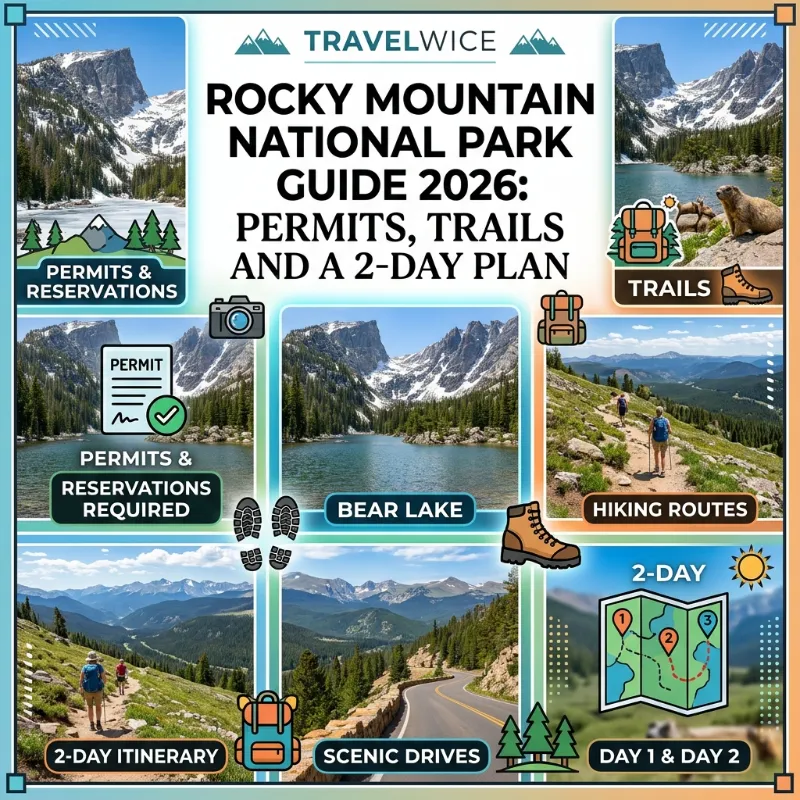

Rocky Mountain National Park Guide 2026: Permits, Trails and a 2 Day Plan
Rocky Mountain National Park looks simple on a map, yet one missed reservation can wreck a whole day. This Rocky Mountain National Park guide fixes that problem. You will get the 2026 permit rules, real costs in dollars, pounds and euros, a clear two day plan and beginner hikes that fit a first trip.
TL;DR
- Rocky Mountain National Park (RMNP) is about 65 miles (105 km) from Denver, and most visitors need two to three days.
- The 2026 timed entry system ran from May 22 to mid October and cost only $2 per vehicle, plus the normal park fee.
- The best months for hiking are late June to September, while late September brings elk and golden aspens.
- Visitors from outside the US now pay an extra $100 per adult at RMNP, so the $250 annual pass can save money.
- Start every hike early, because afternoon storms and full parking lots hit most days in summer.
Key takeaways at a glance
| Question | Short answer |
|---|---|
| Where is it? | North of Denver, Colorado, with the main base in Estes Park |
| Park size | About 265,800 acres (415 square miles) |
| Visitors | More than 4.1 million in 2024, the fifth busiest US park that year |
| Standard fee | $35 per vehicle for 7 days (about £26 or €30) |
| Timed entry fee | $2 per vehicle on Recreation.gov |
| Extra fee for non US residents | $100 per adult aged 16 and over |
| Highest point on the main road | 12,183 feet (3,713 m) on Trail Ridge Road |
| Best time | Late June to September, with fall colour in late September |
| Ideal stay | Two full days at minimum, three if you like hiking |
A quick note before you plan. The 2026 permit season ended in mid October, so this guide shows how the system worked and how to prepare for the next summer. The rules usually repeat from year to year, but always check the official Rocky Mountain National Park site before you book.

Quick Answers About Rocky Mountain National Park
Many travelers want fast answers first. So here they are, in plain words.
Do you need a reservation for Rocky Mountain National Park? Yes, in peak season. During the 2026 season, drivers needed a timed entry reservation between 9 a.m. and 2 p.m. They also needed a special Bear Lake Road version if they wanted to reach that popular corridor between 5 a.m. and 6 p.m.
How many days do you need? Two full days cover the big views. However, three days give you time for a longer hike and the quiet west side.
What is the best time to visit? June to September gives the most open roads and trails. Still, September and early October often feel better, because the elk rut and fall colour arrive while crowds start to thin.
Is Rocky Mountain National Park good for beginners? Yes. Short lake walks like Bear Lake, Sprague Lake and Lily Lake need little effort. Also, Trail Ridge Road lets you see the high tundra from the car.
How high is the park? Estes Park sits at about 7,522 feet (2,293 m). Bear Lake sits near 9,475 feet (2,888 m), and the Alpine Visitor Center stands near 11,796 feet (3,596 m). Because of that, take it slowly on day one.
Rocky Mountain National Park Guide to Timed Entry Permits
Timed entry confuses more travelers than any other part of this trip. Luckily, the rules are simple once you see them in a table.
First, the park splits access into two permit types. Each one lets you enter during a two hour window. After you enter, you can stay as long as you like.
| Permit type | Hours it applies | What it covers |
|---|---|---|
| Timed Entry | 9 a.m. to 2 p.m. | The whole park except the Bear Lake Road corridor, including Trail Ridge Road |
| Timed Entry plus Bear Lake Road | 5 a.m. to 6 p.m. | The whole park and the Bear Lake Road corridor |
Next, a few rules matter a lot. The park wrote them down clearly, and they have not changed much since 2025.
- You need one reservation per vehicle per day, not one per person.
- The name on the reservation must match the driver or a passenger who carries photo ID and the QR code.
- You can enter the park before 9 a.m. or after 2 p.m. without a normal timed entry permit.
- You cannot book at the gate. Recreation.gov is the only seller.
- Reservations are non refundable and cannot move to another person.
- The permit does not promise a parking space at any trailhead.
The park also holds about 7,200 reservations per day in summer, according to My Colorado Parks. That number sounds big. Even so, popular windows sold out within minutes on release days.
RMNP Timed Entry Permit Tips That Work
Here are the steps I would follow if I planned the trip again from scratch.
- Mark the release dates. In 2026, May 22 to June 30 opened on May 1, July opened on June 1, August opened on July 1, September opened on August 1 and early October opened on September 1. Each release started at 8 a.m. Mountain Time.
- Convert the time for your home. For example, 8 a.m. Mountain Time was 3 p.m. in London and 4 p.m. in Paris or Berlin during summer.
- Create your Recreation.gov account a week early and save your payment card.
- Open two browser tabs on release day. One tab can hold your first choice, and the other can hold a backup date.
- Check again at 7 p.m. Mountain Time the night before your visit. The park drops extra permits then. For Europeans, that is 2 a.m. in the UK and 3 a.m. in central Europe, so set an alarm or ask a friend.
- Cancel any permit you will not use at least 24 hours before. That frees a spot for another traveler.
Here is a case study that shows why the second window matters. In 2025, the Bear Lake corridor sold out on many peak weekend dates within the first hour. Travelers who also picked a lower demand permit, such as the 9 a.m. to 2 p.m. type, still got in and saw Trail Ridge Road. As a result, they lost only the lake hikes, not the whole trip.
My honest view is this. Do not chase the Bear Lake permit at all costs. If you cannot get it, arrive before 5 a.m. is not allowed without it, so switch your lake time to Sprague Lake or Lily Lake instead. Both sit outside the corridor, and both feel peaceful.
Campers get a break here. If you hold a reservation at Aspenglen, Glacier Basin, Moraine Park or Timber Creek, the park includes timed entry with your campsite booking. Backpackers with a wilderness permit also skip the extra step.
What Does a Visit Really Cost in 2026?
Money questions cause the most stress for travelers from the UK and Europe. So let us break it down with real numbers. Exchange rates move, so treat the pound and euro figures as rough guides.
| Item | Cost in USD | About in GBP | About in EUR |
|---|---|---|---|
| Vehicle entry, 7 days | $35 | £26 | €30 |
| Vehicle entry, 1 day | $30 | £22 | €26 |
| Timed entry reservation | $2 | £1.50 | €1.80 |
| Non resident surcharge, per adult 16 and over | $100 | £75 | €86 |
| America the Beautiful pass, US resident | $80 | £60 | €69 |
| America the Beautiful pass, non resident | $250 | £185 | €215 |
| Camping at Aspenglen | $35 per night | £26 | €30 |
| Mid range hotel in Estes Park | $150 to $300 per night | £110 to £225 | €130 to €260 |
The surcharge started on January 1, 2026. It hits 11 of the most visited parks, and Rocky Mountain is one of them. According to the Denver Gazette, children under 16 do not pay it.
Here is a simple case study. Two adults from London share one rental car. At RMNP they pay $35 for the vehicle plus $200 in surcharges. That adds up to $235 for one day, or about £175.
Now add a second surcharge park, for example Yellowstone or Zion. The total reaches $470, while the $250 annual pass covers both parks and the whole car load of up to four adults. So for most couples, the pass wins once you visit two parks.
Also, the fee free days in 2026 only apply to US residents. International visitors still pay the surcharge on those days. Therefore, do not plan your dates around them.
One more tip: the park runs on card payments. Bring a debit or credit card, because cash does not work at the entrance.
Best Time to Visit Rocky Mountain
The best time to visit Rocky Mountain depends on what you want to see. Because the park spans foothills and alpine tundra, the weather can change by 20 degrees Fahrenheit in a single drive.
| Month | What to expect | My rating for first timers |
|---|---|---|
| May | Snow on high roads, Trail Ridge Road often not open yet, fewer crowds | 3 out of 5 |
| June | Wildflowers start, trails clear in the lower valleys, afternoon storms begin | 4 out of 5 |
| July | Peak wildflowers, warm days, the busiest month | 4 out of 5 |
| August | Full services, many storms, heavy traffic | 3 out of 5 |
| September | Elk rut starts, aspens turn gold late in the month, cool mornings | 5 out of 5 |
| October | Quiet trails, elk early in the month, first snow possible | 4 out of 5 |
| November to April | Trail Ridge Road closed, snowshoeing and quiet views at lower levels | 2 out of 5 |
Here is my take. If you have flexible dates, choose the second half of September. You still have good road access, and the light feels warm at sunset. In addition, you skip the worst of the summer thunderstorms.
Trail Ridge Road Opening Dates: A Quick Data Check
Trail Ridge Road is the star drive in the park, so its opening date shapes your plan. The road usually opens near Memorial Day weekend, but snow can push it back.
| Year | Trail Ridge Road opening day |
|---|---|
| 2022 | May 27 |
| 2023 | May 26 |
| 2024 | May 31 |
| 2025 | May 30 |
| 2026 | May 29 |
The earliest opening on record came on May 7, 2002, and the latest came on June 26, 1943. In 2026, a foot of fresh snow in the week before Memorial Day made the date uncertain, and the road finally opened on May 29, according to National Parks Traveler. So if you visit in late May or early June, build a backup plan.
The road usually closes for winter in mid November. In 2025, it closed on November 14.
Getting There From Denver and From Abroad
Most visitors from the US, UK and Europe fly into Denver International Airport. From there, Estes Park is about 75 miles (120 km) away, and the drive takes roughly 1.5 to 2 hours in normal traffic.
A rental car gives you the most freedom. Yet some travelers prefer an airport shuttle to Estes Park, and that works well if you stay in town and use the park shuttles. Book shuttles early in summer.
Here are three entrances to know.
- Beaver Meadows Entrance: This gate sits near Estes Park, and it serves Bear Lake Road and Trail Ridge Road.
- Fall River Entrance: It sits north of town, and it leads to Old Fall River Road and Horseshoe Park.
- Grand Lake Entrance: This one opens the quiet west side and the Kawuneeche Valley.
If you also plan a Colorado road trip, read our Colorado travel guide for 2026 first. It shows how to link RMNP with Denver, Boulder and the mountain towns. Also, you can add things to do in Aspen if you have a few extra days, though Aspen sits several hours away by car.
For another traveler’s view of the park’s highlights, the team at The Blonde Abroad shares a detailed trip report. Likewise, Remitly’s park guide gives helpful context for international visitors.
RMNP Itinerary 2 Days: A Plan That Fits the Permit Rules
This two day plan uses the permit system in your favor. Day one uses the Bear Lake Road permit. Day two uses an early start, so you can drive Trail Ridge Road before the 9 a.m. permit window begins.
My main rule for any RMNP itinerary 2 days long is to see the busy places early. Then you can relax in the afternoon, when storms and crowds arrive.
Day 1: Bear Lake Road and the Lake Hikes
Book the Timed Entry plus Bear Lake Road permit for the earliest window you can get. A 5 a.m. to 7 a.m. entry feels hard, but it gives you the best parking.
- 6:00 a.m. Bear Lake loop. This flat loop is about 0.7 miles (1.1 km) and gains only 49 feet. It also sits at 9,475 feet, so it gives you a gentle start at altitude.
- 7:00 a.m. Emerald Lake. Walk about 3 miles round trip with roughly 700 feet of climbing. On the way, you pass Nymph Lake and Dream Lake. The reward is a clear alpine bowl under Hallett Peak.
- 10:30 a.m. Alberta Falls. If you still have energy, add this short waterfall walk on the way back down.
- 12:00 p.m. Lunch in Estes Park. Pack snacks for the trail, because food options inside the park stay limited.
- After 2:00 p.m. Moraine Park and Sprague Lake. Return to the corridor only after 2 p.m. if you left earlier, as the park allows re-entry then.
- Sunset: Elk watching. In fall, elk gather in Moraine Park meadows. Keep at least 25 yards (23 m) away.
If your permit sells out, swap the morning for Lily Lake or Sprague Lake. Both need only the normal park entry, and both give easy lake views.
Day 2: Trail Ridge Road and the West Side
Enter by 7:30 a.m. at the Beaver Meadows Entrance. Because you pass the gate before 9 a.m., you do not need a normal timed entry permit. That small trick saves many travelers from sold out windows.
- 8:00 a.m. Many Parks Curve. Stop here for one of the best views of the Continental Divide.
- 9:00 a.m. Forest Canyon Overlook. Look across a deep glacier valley. It is a short walk from the car.
- 10:00 a.m. Alpine Visitor Center. At about 11,796 feet, it is the highest visitor center in any US national park. Walk the nearby Tundra Communities Trail slowly, because the air feels thin.
- 12:00 p.m. Drive down to the Kawuneeche Valley. Look for moose near the Colorado River, especially in the morning and evening.
- 1:00 p.m. Lunch in Grand Lake. This small lakeside town feels quieter than Estes Park.
- 3:00 p.m. Return by Trail Ridge Road or loop back through Fall River. Check the road status first.
Also check whether Old Fall River Road is open. In 2026, the gravel road opened for the season on July 4. It is one way and slow, so give it an extra hour.
The round trip takes about 8 hours with stops. Still, many travelers add a night in Grand Lake and split the day.
Rocky Mountain Hiking Trails for Beginners
Good news for first timers. Rocky Mountain hiking trails for beginners start right at the car in many places. Distances and climbs below are approximate, so check the park’s trail pages for the latest numbers.
| Trail | Round trip | Climb | Why it works |
|---|---|---|---|
| Bear Lake Loop | 0.7 miles (1.1 km) | 49 feet | Flat, paved in parts, and great for kids |
| Sprague Lake Loop | About 0.9 miles (1.4 km) | Almost none | Wide path with mountain reflections, outside the Bear Lake corridor |
| Lily Lake Loop | About 0.8 miles (1.3 km) | Almost none | Easy, quiet and on the road to Wild Basin |
| Alberta Falls | About 1.6 miles (2.6 km) | About 160 feet | Short waterfall walk with fair crowds |
| Emerald Lake | About 3 miles (5 km) | About 700 feet | Three lakes in one hike, the best value for effort |
| Cub Lake | About 4.6 miles (7.4 km) | About 540 feet | Meadows, a pond and a good chance of elk |
| Coyote Valley Trail | About 1 mile (1.6 km) | Almost none | Flat west side walk with moose chances |
Here is my practical advice for any beginner hike. First, start before 8 a.m. Then, carry more water than you think you need, since the dry air pulls moisture from your body. Also, wear shoes with good grip, because rocks stay wet near falls.
If you want one big hike, pick Emerald Lake. Even so, give yourself three hours. The climb is short, but the altitude slows most visitors from sea level.
For a real world check, consider a family from Manchester that arrived at Bear Lake at 10:30 a.m. in July. They circled the lot for 40 minutes and finally gave up on the trailhead. Then they drove to Sprague Lake, parked in two minutes and enjoyed a calm loop. The lesson is simple: have a backup trail in your pocket.
Altitude, Weather and Safety Tips
The park sits high, so altitude matters more than any trail rule. Many visitors feel headaches, dizziness or poor sleep in the first 24 hours.
Follow these steps to feel better.
- Spend your first night in Estes Park at 7,522 feet, not higher.
- Drink water all day, and cut back on alcohol the first night.
- Eat small, regular snacks.
- Turn back if you feel nausea, confusion or a hard headache. Going lower fixes most mild cases.
Weather needs the same respect. In summer, thunderstorms often build by noon over the high country. Therefore, plan to leave ridges and the tundra before 11 a.m. or noon. Lightning above the tree line is a real danger, and a quick walk back can take a long time.
Also pack layers. The temperature can drop 20 to 30 degrees Fahrenheit (11 to 17 degrees Celsius) between town and Trail Ridge Road. A light rain jacket, a warm hat and sunscreen belong in every bag, even in July.
Fire rules can change fast too. When Stage 2 fire restrictions apply, the park bans all campfires, including charcoal fires. For this reason, check the park’s alerts before you leave.
Wildlife safety is simple. Keep at least 25 yards (23 m) from elk, moose and deer. Stay 100 yards (91 m) from bears and coyotes. Never feed any animal, because it harms the animal and risks a fine.
Wildlife You Can Actually Expect to See
Many guides promise too much here. So let us stay honest about what is likely.
- Elk: Very likely, especially at dawn and dusk in Moraine Park, Horseshoe Park and near Estes Park. The rut peaks from mid September to early October.
- Bighorn sheep: Likely around Horseshoe Park and Sheep Lakes, mostly in early summer.
- Marmots and pikas: Likely on the rocky slopes near Trail Ridge Road.
- Moose: Possible in the Kawuneeche Valley on the west side, mainly in the morning.
- Black bears: Rare to see, so do not count on it.
Bring binoculars if you can. A cheap pair adds a lot, and it keeps you at a safe distance.
Where to Stay and Eat
Estes Park works best for most travelers. It has hotels, restaurants, grocery stores and the closest gates. Expect about $150 to $300 per night in summer, and book several months ahead for July and September weekends.
Grand Lake suits you if you want quiet. It sits on the west side near the Kawuneeche Valley, and it adds a lake town feel. However, it adds a longer drive to Bear Lake Road.
Camping can save money. Aspenglen costs about $35 a night, and camping reservations include timed entry. On the other hand, sites sell out quickly, so check availability the day they open. Note that Timber Creek Campground closed on August 10, 2026 for a sewer project, so confirm status before you plan a west side stay.
Food inside the park stays limited. So pack a lunch, fill your bottles in town and keep snacks in the car. If you are heading on to Aspen afterward, our Aspen guide lists good stops for the second half of your Colorado trip.
For wider planning, our Colorado travel guide for 2026 compares towns, drive times and costs. Also browse more trip ideas on the TravelWice home page.
Common Mistakes and How to Avoid Them
After studying visitor reports and park notices for this guide, a few mistakes show up again and again.
- Skipping the permit check. Travelers assume they can buy a pass at the gate. They cannot.
- Starting hikes at 10 a.m. Lots fill by 8 a.m. in July, so late starters waste time in traffic.
- Ignoring Trail Ridge Road status. Snow can close it in late May and again in fall. Call the status line at (970) 586-1222 before you drive.
- Forgetting the surcharge. International visitors often learn about it at the gate. So budget for it early.
- Cramming too much. Two big hikes in one day at altitude can leave you sick. Choose one main hike and two short stops.
- Packing only for summer. A sunny morning can turn into hail by 2 p.m.
My honest opinion is that most guides push too many stops. In practice, a slow day with one lake, one drive and one meadow at sunset feels better than a long list.

How Rocky Mountain Compares With Other Big Parks
Some travelers wonder if RMNP is the right pick for a short trip. This table can help you decide.
| Factor | Rocky Mountain | Yellowstone | Zion |
|---|---|---|---|
| Distance from a major airport | About 75 miles from Denver | About 2 to 3 hours from Bozeman or Jackson | About 2.5 hours from Las Vegas |
| Reservation system in 2026 | Yes, timed entry | No parkwide timed entry | No parkwide timed entry |
| Non resident surcharge | Yes, $100 | Yes, $100 | Yes, $100 |
| Best for | Alpine views, short hikes, wildlife | Geysers and big wildlife | Canyon hikes |
| Two day trip works? | Yes | Tight | Yes |
So RMNP wins for a short trip from Denver. Still, if you want a longer road trip with geysers, Yellowstone fits better.
Frequently Asked Questions
What is the best way to plan a Rocky Mountain National Park trip? Start with your dates, then book the timed entry permit the day it opens. Next, book lodging in Estes Park, and finally pick two or three main stops from this guide.
Can I visit without a timed entry permit? Yes, if you enter before 9 a.m. or after 2 p.m. You still need the Bear Lake Road permit for that corridor during its hours.
How much is the timed entry permit? It costs $2 per vehicle through Recreation.gov. The normal park fee comes on top of that.
Do non US residents pay more? Yes. Since January 1, 2026, non US residents aged 16 and over pay an extra $100 each at RMNP, unless they hold a non resident annual pass.
Is the America the Beautiful pass worth it? For non US residents, the $250 pass pays off at two surcharge parks. For a single park visit with two adults, the pay as you go cost is slightly lower.
When does Trail Ridge Road open? It usually opens in late May, but snow can delay it. It opened on May 29 in 2026.
How many days should I spend in the park? Two days cover the highlights. Three days let you add a longer hike or the west side.
Is the park good with kids? Yes. Bear Lake, Sprague Lake and the Junior Ranger program suit young children well.
Can I go in winter? Yes, but Trail Ridge Road closes, and you will stay on lower roads. Snowshoeing and wildlife viewing work well then.
Quick Quiz: Test What You Learned
Try these five questions. The answers come after the last question.
1. How much does a timed entry reservation cost per vehicle?
- A. $2
- B. $20
- C. $35
2. What time window does the standard Timed Entry permit cover?
- A. 5 a.m. to 6 p.m.
- B. 9 a.m. to 2 p.m.
- C. Noon to 8 p.m.
3. How high does Trail Ridge Road climb?
- A. 9,475 feet
- B. 10,500 feet
- C. 12,183 feet
4. How much extra do non US adults pay at RMNP in 2026?
- A. $25
- B. $100
- C. $250
5. Which easy loop sits near 9,475 feet and gains only 49 feet?
- A. Bear Lake Loop
- B. Emerald Lake Trail
- C. Cub Lake Trail
Answers: 1. A. 2. B. 3. C. 4. B. 5. A.
Conclusion
Rocky Mountain National Park rewards travelers who plan the small details. Book your permit on release day, start hikes early and keep one backup trail ready. In addition, budget for the non resident surcharge, and decide early if the annual pass makes sense.
If you remember one idea from this Rocky Mountain National Park guide, make it this: the park feels calm in the early morning and in September. Follow the two day plan, pack layers and go slowly at altitude. Then, you will enjoy the lakes, the tundra and the elk instead of the traffic.
Ready to build a bigger trip? Our Colorado travel guide for 2026 shows how to link the park with other highlights.
References
- National Park Service: Rocky Mountain timed entry 2026 announcement
- Recreation.gov: RMNP timed entry reservations
- National Park Service: Overview of timed entry reservations
- Denver Gazette: Higher entrance fees for foreign visitors
- National Parks Traveler: Trail Ridge Road opens
- National Park Service: Trail Ridge Road winter closure 2025
- Estes Park: Timed entry permits 2026
- My Colorado Parks: Timed entry 2026
- Rocky Mountain National Park official site
- Remitly: Rocky Mountain National Park guide
- The Blonde Abroad: Ultimate guide to Rocky Mountain National Park