
Great road trips rarely fail because of the scenery. They fail on a quiet highway with a flat tire, a dead phone, and no gas station for 80 miles. The right road trip safety tips USA drivers can trust fix those problems before you leave the driveway. This guide shows you what to check, what to pack, and when to stop. It also covers a hidden risk most guides skip, which is a tired driver behind the wheel.
Key takeaways
| Topic | Quick answer | Why it matters |
|---|---|---|
| Car check | Service the car 2 to 3 weeks before you go | You have time to fix problems |
| Fuel | Refuel at a quarter tank | Rural gas stations can be 80 to 100 miles apart |
| Fatigue | Stop every 2 hours or 100 miles | Tired driving causes far more deaths than reports show |
| Night driving | Avoid 11 p.m. to 7 a.m. | Most fatal drowsy crashes happen in this window |
| Emergency kit | Pack water, charger, jumper cables, first aid | A breakdown stays small when you are ready |
| Navigation | Download offline maps and carry a paper atlas | Phones lose signal in remote areas |
TL;DR
- What is the most important safety step? Service your car early and sleep well before you drive. These two habits stop most trip problems.
- How often should you stop? Take a break every 2 hours, and swap drivers when you can.
- What should you carry? A basic emergency kit, a phone charger, offline maps, and water for every person.
Why Road Trip Safety Tips USA Drivers Follow Matter in 2026
The news on U.S. roads is better than it was. NHTSA estimates that 36,640 people died in motor vehicle traffic crashes in 2025, and deaths fell more than 8% in the first half of 2025 even as people drove more miles. That is real progress. Still, 36,640 deaths means about 100 people a day. dotnews5cleveland
Long trips raise your risk in ways short commutes do not. You drive more hours, on roads you do not know, often while tired. You also drive a car that may not have gone through a long, hot highway run in months.
The biggest hidden risk is fatigue. NHTSA counted 633 deaths from drowsy driving in 2023, but a 2026 GHSA analysis found more than 6,300 suspected deaths. That is about ten times higher. The gap exists because, unlike alcohol, fatigue leaves no physical evidence that police can test after a crash. codotcodot
Road Trip Planning Apps 2026 Compared: The Tools Worth Your Phone Space
Chart 1: Drowsy driving deaths in 2023 (official count vs. GHSA estimate)
Official (NHTSA)    ▇                    633
Estimated (GHSA)    ▇▇▇▇▇▇▇▇▇▇           6,300+
                    Each ▇ is about 630 deaths
Chart 2: U.S. traffic deaths in the first half of the year
Jan to Jun 2024     ▇▇▇▇▇▇▇▇▇▇▇▇▇▇▇▇▇▇▇  about 18,600
Jan to Jun 2025     ▇▇▇▇▇▇▇▇▇▇▇▇▇▇▇▇▇▇   about 17,140
Source: NHTSA early estimates| Statistic | Number | Source |
|---|---|---|
| Estimated U.S. traffic deaths, 2025 | 36,640 | NHTSA |
| Official drowsy driving deaths, 2023 | 633 | NHTSA |
| Suspected drowsy driving deaths, 2023 | 6,300+ | GHSA, 2026 |
| Drivers who admit drowsy driving in the past month | About 1 in 5 | AAA Foundation |
| Drowsy crash window with most deaths | 11 p.m. to 6:59 a.m. | AAA Foundation |
Here is my opinion after reading this data. Most people prepare the car and ignore the driver. A fresh set of tires helps, but a rested driver helps more.
Road Trip Car Maintenance Tips: Fix These Before You Leave
Your car works harder on a road trip. It runs at highway speed for hours, carries extra weight, and faces heat or cold you may not meet at home. So start early. Honest Accurate Auto suggests booking service at least a few weeks before you leave, so you have time to fix any bigger issue. honestaccurateauto
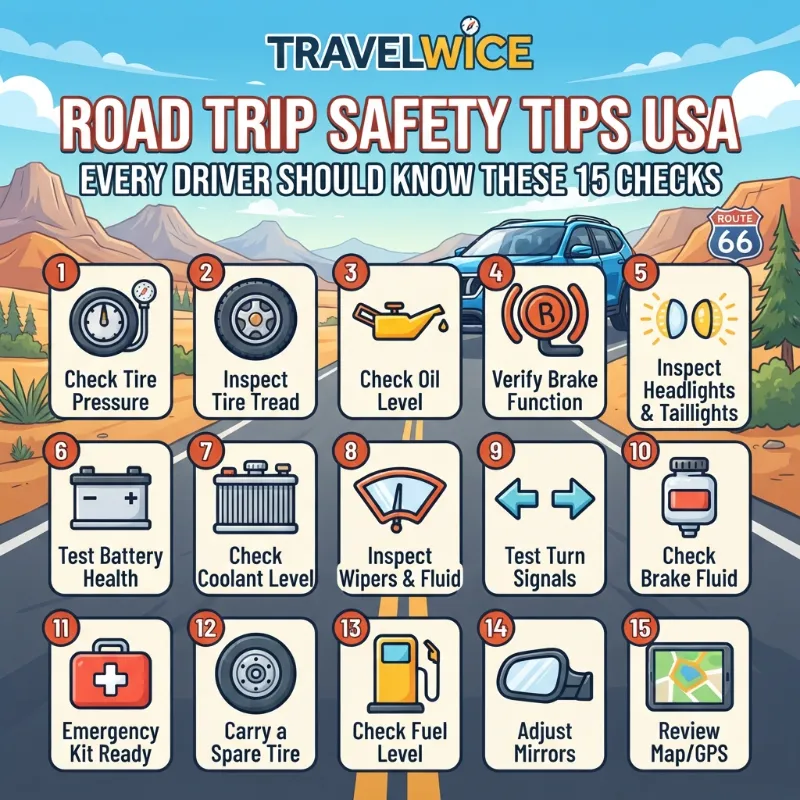
NHTSA gives a clear list for summer trips. It asks drivers to check tire pressure and condition, wiper blades, fluid levels, lights, batteries, and coolant. I would add one more item, which is a recall check. You can enter your license plate or VIN on the NHTSA recall lookup in under a minute. nhtsa
Your 3 week countdown
- Three weeks out: Book a shop visit. Ask for a tire, brake, battery, belt, and fluid check.
- Two weeks out: Test the air conditioning. A system that worked last summer can still fail today.
- One week out: Check tire pressure when the tires are cold. Use the number on the driver’s door sticker, not the number on the tire wall.
- Three days out: Look for recalls and check every light, including brake lights.
- Day before: Fill the tank, clean the windows, and pack the emergency kit.
| Pre-trip check | When | Who does it | Typical time |
|---|---|---|---|
| Oil and fluids | 2 to 3 weeks before | Shop or DIY | 30 to 60 minutes |
| Tire pressure and tread | 1 week before | DIY | 5 to 10 minutes |
| Battery test | 2 weeks before | Parts store or shop | 10 minutes |
| Brake check | 3 weeks before | Shop | 30 minutes |
| Air conditioning test | 2 weeks before | DIY, then shop if weak | 10 minutes |
| Wipers and lights | 3 days before | DIY | 10 minutes |
| Recall lookup | 3 days before | DIY online | 2 minutes |
The tire rules I trust
Tires cause more road trip trouble than any other part. First, check pressure when the car has sat for a few hours. Heat from driving raises the number and fools you. Cold weather also drops pressure by roughly 1 psi for every 10°F, so a morning at 40°F can leave a tire low.
Best Road Trip Snacks Ideas for Long Drives
Next, check tread with a penny. Put it in the groove with Lincoln’s head pointing down. If you can see the top of his head, the tire is worn and needs replacing. Finally, look at the spare. Honest Accurate Auto warns drivers not to assume the spare is in the trunk, and to confirm the jack and lug wrench too. honestaccurateauto
Rental cars need extra checks
If you rent, the same rules apply, and you have less history with the car. Walk around it and take photos before you drive away. Check the spare, the jack, and the warning lights. Our best car rental tips for the USA guide covers insurance, one way fees, and what to ask at the counter.
Common fluids and why they matter
- Engine oil: Old oil loses its ability to lubricate and cool.
- Coolant: It breaks down over time and can start to damage cooling parts.
- Brake fluid: It absorbs moisture, which can harm seals.
- Washer fluid: You will use more than you expect on bug season highways.
Long Drive Safety Checklist USA: Plan the Route Like a Pro
A good plan makes trouble smaller. It does not need to be strict. [Add your own story here: one time a plan, or the lack of one, changed a trip for you.]
Use this long drive safety checklist USA drivers can follow on any route.
- Pick your stops by miles, not by hope. Mark gas stations, rest areas, and towns every 100 miles.
- Refuel at a quarter tank. One van life writer on Maryland Road Trips says she tries never to drive below a quarter tank. I agree with this rule. marylandroadtrips
- Know the empty stretches. On Utah’s I-70 between Green River and Salina, you drive roughly 100 miles with almost no services. Nevada’s US-50 has similar gaps.
- Tell one person your plan. Share your route, your daily stops, and your estimated arrival time. Send a text when you arrive each night.
- Download offline maps. Do this on Wi-Fi at home.
- Carry a paper atlas. It sounds old-fashioned, but a phone does not guarantee service, and even a good GPS can lose power or send you the wrong way. honestaccurateauto
- Have a second route. Floods, fires, and crashes close roads without warning.
- Book your first night. A confirmed bed removes the pressure to keep driving when you are tired.
- Check weather by region. Mountain passes, deserts, and plains each carry different risks.
- Keep your phone charged. Use a car charger and bring a battery pack.
Many drivers skip step 7, and it hurts them most. When a highway closes, you need to decide in minutes. A second route saved in your phone or marked in your atlas makes that decision easy.
Before you go, review our road trip packing checklist essentials so nothing important stays at home. Our main road trip travel tips for the USA guide also helps you shape the route and the budget.
Road Trip Tips With Kids That Actually Work
Be careful what you share online
Safety also means privacy. Posting live photos tells strangers your home is empty. The same writer on Maryland Road Trips suggests waiting to post until after you have left a place, skipping exact location tags, and cropping license plates out of photos. That advice costs nothing and works. marylandroadtrips
Driving Fatigue Prevention Tips That Actually Work
Fatigue is the risk drivers underrate most. You may feel fine at hour six, but your reaction time has already slowed. Worse, going 21 hours without sleep affects your driving about as much as a blood alcohol level of 0.08%, the legal limit. The Hill
Road Trip Packing Checklist Essentials You Need in 2026
Here are the driving fatigue prevention tips I rely on.
- Sleep 7 hours or more the night before. A late night packing the car is a bad start.
- Stop every 2 hours or 100 miles. U-Save also recommends a break every couple of hours to stretch, refuel, and grab a snack. usave
- Skip the late night window. The AAA Foundation found that the greatest number of fatal drowsy driving crashes happens between 11 p.m. and 6:59 a.m. bodyshopbusiness
- Swap drivers. Change at every fuel stop if two adults share the car.
- Use the coffee nap. Drink a coffee, then sleep 15 to 20 minutes. Caffeine takes about 20 minutes to work.
- Eat light. Heavy fast food meals make you sleepy within an hour.
- Stay hydrated. Mild dehydration adds to tiredness.
Warning signs you must act on
- Yawning again and again
- Missing an exit or forgetting the last few miles
- Drifting toward the rumble strip
- Heavy eyelids or a nodding head
- Slow reactions and a wandering mind
If you see even one, stop at the next safe place. Do not try to push through to the next town.
| Tactic | Does it work? | My take |
|---|---|---|
| Sleeping 7+ hours before | Yes | The best fix you have |
| Stopping every 2 hours | Yes | Cheap and easy |
| 20 minute nap | Yes | Use it after caffeine |
| Coffee only | Short term | Wears off, so it is a bridge only |
| Loud music | Not really | It hides tiredness for a few minutes |
| Open window | Not really | Same as above |
Where to sleep when you are tired
Sleeping in a safe place beats driving on empty. Honest Accurate Auto lists rest stops, welcome centers, travel centers, Walmart lots with permission, and Bureau of Land Management land as safer stops. Rules vary by state, and many rest areas limit your stay. So check local signs and ask first. honestaccurateauto
RV Road Trip Tips USA: A First-Time Renter’s Guide for 2026
A daily driving plan that keeps you rested
| Trip style | Max hours behind the wheel | Break plan |
|---|---|---|
| Solo driver | 6 to 8 hours | Stop every 2 hours |
| Two drivers | 8 to 10 hours | Swap at every fuel stop |
| Family with kids | 5 to 6 hours | Stop every 90 minutes |
| Mountain or desert day | 5 to 6 hours | Slower pace and extra water |
I think most people plan too many miles. A 600 mile day looks fine on a map. In real life, with traffic, food, and fuel, it becomes 11 hours.
Road Trip Emergency Preparedness Guide: Kit, Steps, and Backup Plans
Breakdowns happen even to well kept cars. The goal is not to avoid every problem. The goal is to keep a small problem from becoming a dangerous one. NHTSA suggests packing a cell phone and charger, first aid kit, flashlight, jumper cables, nonperishable food, and water. nhtsa
Emergency kit: what to pack and why
| Item | Why you need it | Priority |
|---|---|---|
| Water (1 gallon per person extra) | Drinking and emergency use | Must have |
| Phone charger and battery pack | Calling for help | Must have |
| Jumper cables or jump starter | Dead battery fix | Must have |
| First aid kit | Minor injuries | Must have |
| Flashlight and spare batteries | Night repairs | Must have |
| Spare tire, jack, lug wrench | Flat tire | Must have |
| Reflective triangles or flares | Warn other drivers | Good to have |
| Blanket and warm jacket | Cold nights | Good to have |
| Snacks | Long waits | Good to have |
| Paper atlas | No signal | Good to have |
| Tire inflator | Slow leak | Good to have |
| Gloves and multitool | Basic repairs | Good to have |
For a longer kit list, see the one from Honest Accurate Auto, which sorts items into must haves and good to haves. honestaccurateauto
What to do when your car breaks down
- Turn on your hazard lights right away.
- Steer to the right shoulder as far from traffic as you can.
- Stay buckled in if the shoulder is narrow and traffic is fast. Call 911 if you feel unsafe.
- Get out only if it is safe, and stand well away from the road, behind a barrier.
- Call roadside assistance or 911 and share your mile marker.
- Put out triangles only if you can do it without stepping near traffic.
Every state has a move over law, but many drivers still ignore it. So make yourself visible and stay away from the lane.
Have two ways to call for help
Your phone is your lifeline, and phones break. The Maryland Road Trips writer carries a second form of communication such as a smartwatch or an old phone, and memorizes her emergency contacts. I like that approach. A cheap old phone with a SIM card or a satellite messenger can save the day in areas with no signal. marylandroadtrips
EV Road Trip Charging Tips for USA Drivers: The 2026 Plan That Works
Heat and cold plans
Hot cars become dangerous fast. Death Valley and parts of Arizona can pass 120°F in summer. Carry extra water, use sun shades, and never leave a child or pet in a parked car. NHTSA also provides a heatstroke prevention page for families.
In cold places, pack a blanket, gloves, hand warmers, and a small shovel. The Maryland Road Trips writer suggests a blanket, an extra jacket, a change of clothes, water, food, and hand warmers in case bad weather traps you. marylandroadtrips
Safe road trip habits for tough conditions
Different roads need different habits. This quick table helps you adjust.
| Condition | Main risk | Best move |
|---|---|---|
| Desert heat | Overheating and dehydration | Carry 1 gallon of water per person and watch your temperature gauge |
| Mountain roads | Brake fade and sharp curves | Use a lower gear on long descents |
| Heavy rain | Hydroplaning | Slow down and add following distance |
| Night driving | Low visibility | Clean windows and avoid late hours |
| Winter roads | Ice and closures | Check road reports before each leg |
| City traffic | Sudden stops | Leave 3 to 4 seconds of space |
Use the 3 second rule in normal traffic, and move to 4 or more seconds in rain. It is simple, and it works.
Phones, Playlists, and Distractions
Distraction is the other big driver risk on long trips. Set everything before you start the engine. That includes navigation, music, and podcasts. Our guide to road trip playlists and apps shows how to build a list that keeps you alert and stays out of your hands.
Group Travel Discount Tips for USA Vacations
Give the passenger a job. They can handle directions, music, and snacks. If you drive alone, use voice commands or pull over to change the route.
Also, plan for kids. If a child needs something, stop safely. Do not reach into the back seat while you drive.
Best Car Rental Tips USA: Save Money on Your Road Trip
Mistakes I See Drivers Make Most
- Skipping the service visit because the car “seems fine.”
- Trusting the phone only and leaving the atlas at home.
- Driving through the afternoon slump instead of taking a nap.
- Waiting for the fuel light in remote areas.
- Packing a kit but never checking it. Water goes stale and batteries die.
- Planning too many miles per day and driving tired to catch up.
[Add your own story here: one mistake you made on a past trip and what it taught you.]
What Safety Prep Costs
Most of this prep costs less than one tourist dinner. These are typical U.S. price ranges, and conversions are rough because exchange rates change.
| Item | USD | GBP (approx.) | EUR (approx.) |
|---|---|---|---|
| Oil change | $60 to $120 | £45 to £90 | €55 to €105 |
| Tire pressure gauge | $8 to $15 | £6 to £12 | €7 to €13 |
| Basic emergency kit | $40 to $90 | £30 to £70 | €35 to €80 |
| Portable jump starter | $60 to $120 | £45 to £90 | €55 to €105 |
| Roadside assistance plan (per year) | $60 to $120 | £45 to £90 | €55 to €105 |
If you fly in from the UK or Europe and rent a car, ask the rental company what roadside help comes with your plan. Some plans include it, and some charge extra.
Frequently Asked Questions
What are the most important road trip safety tips in the USA?
Service your car early, sleep well, and stop every 2 hours. Also carry an emergency kit and offline maps.
How often should I stop on a long drive?
Stop every 2 hours or 100 miles. Stop sooner if you feel tired.
What should I check on my car before a road trip?
Check tires, brakes, battery, fluids, lights, wipers, and air conditioning. Also look up recalls on the NHTSA site.
What is the safest time to drive on a road trip?
Daytime is safest. Fatal drowsy crashes peak between 11 p.m. and 7 a.m., so avoid that window.
What should be in a road trip emergency kit?
Pack water, a phone charger, jumper cables, a first aid kit, a flashlight, and tire tools. Add a blanket and snacks.
Is it safe to sleep in my car at a rest area?
Often yes, but rules differ by state. Many areas limit your stay, so read the signs first.
Quick Quiz: Test Your Road Trip Safety Knowledge
1. How often should you stop on a long drive?
a) Every 5 hours
b) Every 2 hours or 100 miles
c) Only when the tank is empty
2. Which time window has the most fatal drowsy driving crashes?
a) 9 a.m. to 12 p.m.
b) 1 p.m. to 4 p.m.
c) 11 p.m. to 7 a.m.
3. Where do you find the right tire pressure for your car?
a) On the tire wall
b) On the driver’s door sticker
c) In the glove box receipt
4. At what fuel level should you refuel in rural areas?
a) A quarter tank
b) The warning light
c) Empty
5. What is the best quick fix when you feel sleepy?
a) Turn up the music
b) Open the window
c) Pull over and take a 15 to 20 minute nap
Answers: 1) b, 2) c, 3) b, 4) a, 5) c
Conclusion
Road trips go best when you plan for the boring parts. Service the car early, pick fuel stops by mileage, and protect your sleep. Then pack a simple emergency kit and keep two ways to call for help. These road trip safety tips USA drivers can use take only a few hours to set up, and they protect the whole trip. Save the checklists, share them with your travel partner, and enjoy the drive.
References
- NHTSA, Early Estimate of Motor Vehicle Traffic Fatalities in 2025
- NHTSA, Summer driving and road trip tips (May 2025)
- GHSA, Wake Up Call: 2026 Update on drowsy driving
- Colorado Department of Transportation, Drowsy driving kills 6,000 Americans each year
- AAA Foundation for Traffic Safety, Prevalence of drowsy driving crashes
- Honest Accurate Auto, 5 Summer Road Trip Safety Tips
- Maryland Road Trips, 6 Tips for a Safe Road Trip
- U-Save Car Rental, Top Summer Road Trip Tips
- Internal: TravelWice home and road trip travel tips USA