
I have lost count of how many times a friend has texted me the night before a California trip asking, “wait, do I need a jacket or not?” The honest answer is: it depends entirely on where in California you are standing. This state is roughly the size of Sweden, and its climate zones do not care about your packing list. So if you are trying to figure out the best time to visit California, the real question is not “when” but “when, and where.”
Joshua Tree National Park Guide for 2026 Everything You Need to Plan Your Trip
That is exactly what this guide sorts out. Below, you will find a region-by-region breakdown of weather, crowds, and pricing, built from years of actually driving this coastline and hiking these mountains, not from a brochure. For the full trip framework, our California Travel Guide for 2026 is a solid starting point before you dig into the regional details here.
Key Takeaways
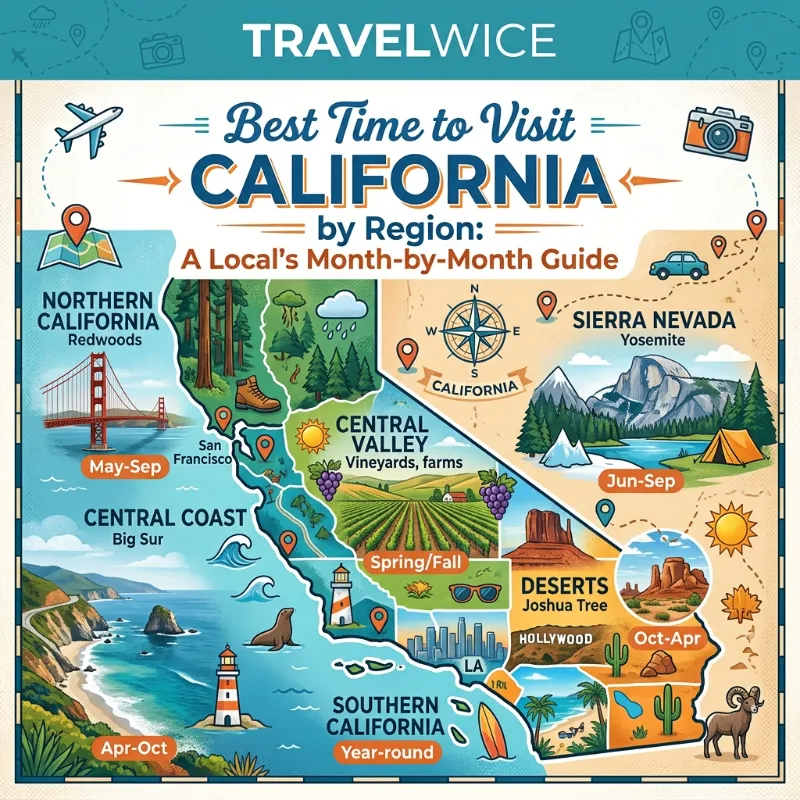
| Region | Best Months | Why | Avoid If Possible |
|---|---|---|---|
| Southern California (LA, San Diego) | March to May, September to November | Mild temps, thinner crowds | Late July to August (heat, tourist peak) |
| Northern California (San Francisco, Napa) | September to October | Warmest, least fog, harvest season | June (peak “June gloom” fog) |
| Central Coast (Big Sur) | Late spring, early fall | Clear skies, fewer crowds on Highway 1 | July to August (fog and traffic) |
| Sierra Nevada (Yosemite) | June to September | Full road and trail access | November to April (snow closures) |
| Desert (Palm Springs, Death Valley) | November to March | Escapes triple-digit heat | June to September (dangerous heat) |
TL;DR
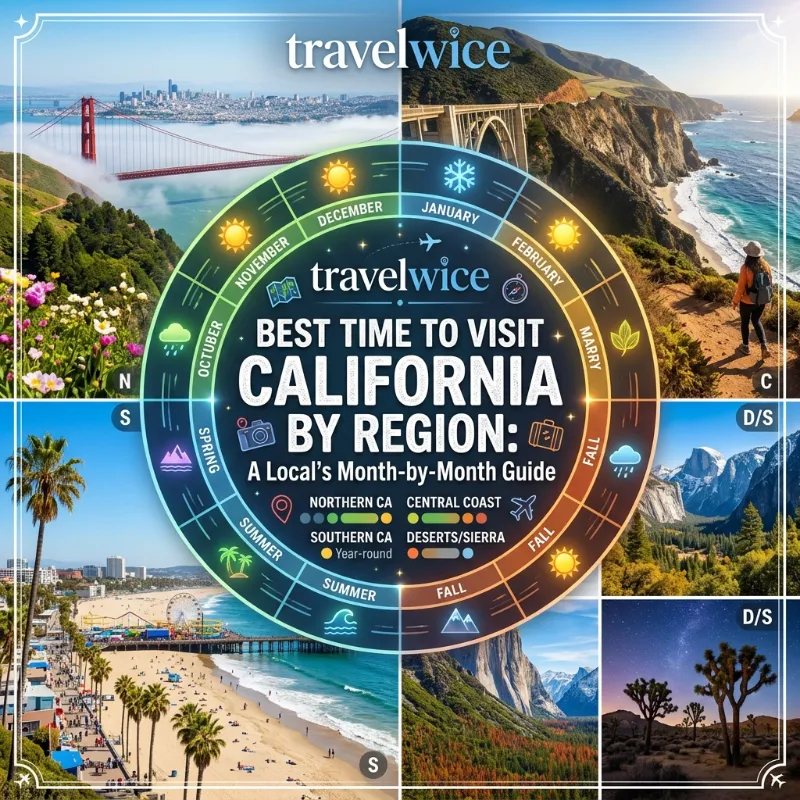
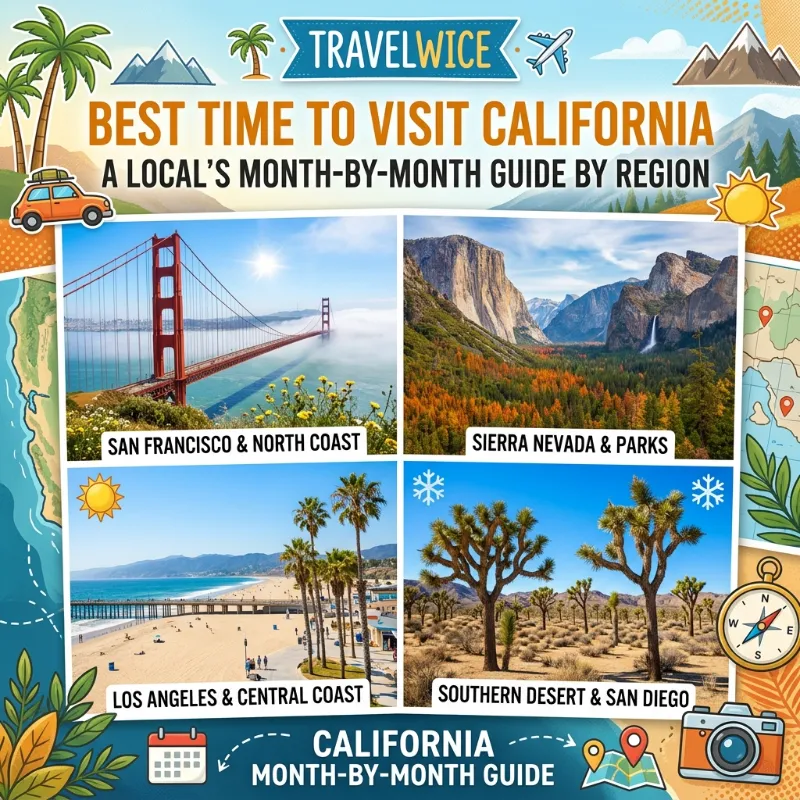
There is no single best time to visit California. Coastal cities like LA and San Diego are pleasant nearly year round, while mountain and desert regions swing hard between seasons.Shoulder seasons, specifically April to May and September to October, generally offer the best mix of good weather, manageable crowds, and lower prices across most of the state.If you are chasing one specific thing (Yosemite waterfalls, Napa harvest, desert wildflowers), the timing window narrows fast, so plan around that first.
California Weather by Month: The Big Picture
Before splitting things up by region, it helps to see how California weather by month actually behaves across the state. Because of the state’s size, a single month can mean sunburn in Palm Springs and a snowstorm in Lake Tahoe. Here is a simplified look at average highs across a few key cities, based on multi-year climate normals from the National Weather Service.
| Month | Los Angeles (F) | San Francisco (F) | Palm Springs (F) | Yosemite Valley (F) |
|---|---|---|---|---|
| January | 68 | 58 | 71 | 49 |
| April | 73 | 63 | 91 | 65 |
| July | 84 | 68 | 108 | 90 |
| October | 78 | 70 | 96 | 74 |
Notice how Palm Springs and Yosemite Valley move in almost opposite directions from San Francisco. Consequently, a trip built around “California in July” makes sense for the mountains but is a bad idea in the desert. This is the core reason travel forums are full of conflicting advice, because most answers only cover one part of the state.
Best Time to Visit California by Region
Since the state splits into a handful of distinct climate zones, the smartest way to plan is region first, then month. Here is how I would break it down after years of trips up and down this coastline.
Lake Tahoe Travel Guide 2026 What to Know Before You Go
Southern California: Los Angeles and San Diego
Southern California is the closest thing California has to “any time works,” but that does not mean every month is equal. Spring (March to May) and fall (September to November) bring the sweet spot: highs in the low to mid 70s, clear skies, and hotel rates that have not yet spiked for summer.
Summer is when everyone else has the same idea, so expect crowded beaches and Disneyland wait times pushing past 60 minutes for popular rides in July and August. Winter, meanwhile, is genuinely underrated. I stayed in Santa Monica one January and paid about USD 140 a night for a hotel that runs closer to USD 260 in July, with almost none of the marine layer fog that plagues early summer mornings.
For city-specific planning once you land, our guides to things to do in Los Angeles and things to do in San Diego break down neighborhoods and seasonal events in more detail.
Northern California: San Francisco and Napa Valley
Here is where a lot of first-time visitors get tripped up. They assume July, the classic “summer” month, is San Francisco’s warmest. It is actually one of its coldest and foggiest, thanks to a phenomenon locals call June gloom, which often stretches well into July. Mark Twain never actually said the famous quote about a cold summer in San Francisco, but whoever did was not wrong.
The real window for warm, clear San Francisco weather is September and October, when the fog retreats and highs regularly hit 70F. This also happens to line up with harvest season in Napa Valley, arguably the single best reason to plan a trip around this specific stretch of the year. Grape harvest typically runs from late August through October depending on the varietal, and wineries get noticeably livelier with crush activity you can actually watch.
If wine country is on your list, our Napa Valley wine country guide covers which wineries welcome walk-ins during harvest season versus which require reservations. For the city itself, check our things to do in San Francisco guide.
Central Coast: Big Sur and Highway 1
Big Sur runs on its own rules entirely. The famous coastal fog can roll in any month, but it is thickest in July and August, right when road traffic along Highway 1 also peaks. I have driven this route in early June and again in late September, and the September trip won by a wide margin: clearer views, easier parking at McWay Falls, and noticeably fewer RVs clogging the narrow turnouts.
Late spring (May to early June) is the other strong window, particularly if you want to catch wildflowers along the bluffs before the summer fog sets in. Whichever month you choose, check road conditions ahead of time since winter storms occasionally cause landslide closures on sections of Highway 1. Our Big Sur road trip guide has current route notes and where to stop.
Sierra Nevada and Yosemite National Park
Yosemite is the most seasonally extreme destination on this list. Tioga Road, the high-elevation pass through the park, is typically closed by snow from around November through late May or even June some years, based on National Park Service seasonal reports. That single fact reshapes the entire trip.
For waterfalls at their most dramatic, aim for May and early June, when snowmelt sends Yosemite Falls and Bridalveil Fall into full force. By August, some seasonal falls dry up almost completely. September offers a quieter alternative with warm days, cool nights, and thinner crowds, though the waterfalls will be a shadow of their spring selves.
- May to June: peak waterfall flow, but higher trail crowding and some snow lingering on higher trails
- July to August: warmest and busiest, full road access, ideal for high-country hiking
- September to October: fewer people, golden light, cooler mornings, and quieter valley floor
- November to April: dramatically fewer crowds and possible snow scenery, but many roads and facilities close
Full seasonal planning, including which trails open when, is in our Yosemite National Park travel guide.
Desert Regions: Palm Springs, Joshua Tree, and Death Valley
This is the one region where you genuinely need to avoid summer altogether. Death Valley regularly climbs above 120F in July and August, and in the summer of 2024, Furnace Creek recorded multiple days above 125F, conditions that are not just uncomfortable but can be dangerous without proper preparation, as the National Park Service repeatedly warns visitors each year.
The desert flips the usual calendar on its head. November through March is peak season here, with Palm Springs highs sitting comfortably in the low 70s and Joshua Tree seeing pleasant hiking weather. If wildflowers are the goal, Joshua Tree and the Anza-Borrego Desert typically bloom in March, though the exact timing shifts year to year with winter rainfall.
California Travel Seasons Guide
Zooming back out, it helps to think in four broad seasons rather than twelve individual months. This california travel seasons guide gives you the shorthand version.
Spring (March to May) brings wildflowers to the deserts and hills, waterfalls at their peak in Yosemite, and generally comfortable temperatures statewide. It is one of the most reliably good windows for a first trip, since almost no region is at a weather extreme.
Summer (June to August) is peak season everywhere except the coast, where fog can actually make June and early July disappointing for beach weather. Inland valleys, deserts, and mountain regions run hot to extremely hot. Meanwhile, prices for flights and hotels hit their yearly high almost across the board, particularly around the Fourth of July.
Fall (September to November) is, in my experience, the most underrated season for a California trip. Wine country hits harvest, coastal fog clears, crowds thin out after Labor Day, and prices soften. If I had to pick one season for a first-time visitor trying to see multiple regions, this would be it.
Winter (December to February) splits the state dramatically. The coast stays mild, often in the 60s, while the Sierra Nevada gets serious snowfall, turning Lake Tahoe and parts of Yosemite into a genuine winter destination. Rain is more likely statewide in these months, particularly in Northern California.
Cheapest Month to Visit California
If budget is driving your decision, the cheapest month visit California question has a fairly consistent answer: late January through early March, excluding the President’s Day weekend, tends to bring the lowest hotel and flight prices across most regions.
| Season Window | Relative Hotel Pricing (LA/SF average) | Crowd Level |
|---|---|---|
| Late Jan to early March | Lowest (often 25 to 35 percent below summer peak) | Low |
| April to May | Moderate | Moderate |
| June to August | Highest | Very High |
| September to mid-November | Moderate to low | Low to moderate |
| Mid-Nov to late Dec (excluding holidays) | Low to moderate | Low |
These figures are directional estimates based on typical seasonal hotel rate patterns rather than a specific booking snapshot, so always check live rates for your travel dates. Still, the pattern holds well enough that booking a February trip to coastal California can save real money without sacrificing much in the way of weather, since Southern California in particular stays mild through winter.
One caveat: if your trip depends on Yosemite’s high country, Tahoe skiing, or Big Sur road access, “cheap” months can also mean closed roads or limited services, so weigh savings against what you actually want to do.
California Weather Packing Guide
Because the climate swings so much by region, a single packing list rarely works for a trip that covers more than one part of the state. Here is a practical california weather packing guide based on what I actually pack for multi-region trips.
- Coastal cities (LA, SF, San Diego): layers are non-negotiable, since mornings and evenings run 15 to 20 degrees cooler than midday, even in summer
- Desert (Palm Springs, Death Valley, Joshua Tree): sun protection is more important than warm layers outside of winter, plus at least one liter of water per person per hour if hiking
- Sierra Nevada (Yosemite, Tahoe): a proper insulated jacket for anything October through May, and waterproof boots if visiting after a storm
- Wine country (Napa, Sonoma): comfortable walking shoes for uneven vineyard paths, and a light sweater for evening tastings even in summer
A useful trick: pack for the coldest region on your itinerary, then add layers as needed, rather than the reverse. Trailfinders’ own California travel guide makes a similar point about layering for the state’s microclimates, and it lines up with what I have found true on the ground.
Real Examples: What This Actually Looks Like
To make this less abstract, here are two real planning scenarios.
A couple I helped plan a trip for in October 2023 built a ten-day loop: three nights in San Francisco, two in Napa during harvest, three in Yosemite, and two back in LA. Because they went in October, they hit warm SF weather, active harvest tastings, quieter Yosemite trails (though Tioga Road was already closed for the season by their visit), and mild LA weather to close the trip. Total accommodation cost came in noticeably lower than a comparable July itinerary would have been, based on rates they shared with me afterward.
Compare that to a family who insisted on a July trip because of school schedules. They loved LA and San Diego, but their San Francisco days were mostly fog and 58F highs, and their one Death Valley detour got cut short after temperatures hit 118F by 11am. Neither trip was wrong, exactly, but the October trip simply matched the calendar to the regions far better.
Frequently Asked Questions
What is the overall best time to visit California? For most first-time visitors covering multiple regions, September and October offer the best balance of good weather, thinner crowds, and lower prices, according to general tourism board guidance from Visit California.
Is California weather different by region in the same month? Yes, significantly. In July, for example, San Francisco can sit in the high 60s while Palm Springs pushes past 105F on the same day.
When is the cheapest month to visit California? Late January through early March typically brings the lowest prices, aside from holiday weekends, though road and trail access to mountain areas may be limited during this window.
Do I need a jacket in California in summer? In coastal cities and the Sierra Nevada, yes, especially in the evenings. In the desert and inland valleys, a jacket is rarely needed outside winter.
What is the rainy season in California? Most of the state’s rain falls between November and March, with December through February typically the wettest stretch in Northern California specifically.
When do Yosemite’s waterfalls peak? Late May through early June, driven by Sierra Nevada snowmelt, based on seasonal patterns tracked by the National Park Service.
Quick Knowledge Check
Test what you just learned with this short quiz. Answers are listed at the end.
- Which season generally offers the best balance of weather and crowds across most of California? a) Summer b) Fall c) Deep winter
- Which of these regions are typically AT their coldest or foggiest in July? (choose all that apply) a) San Francisco b) Palm Springs c) Big Sur coastal fog belt d) Death Valley
- When does Napa Valley harvest season typically run? a) January to March b) Late August to October c) June to July
- Which of these are true reasons to avoid a July trip to Death Valley? (choose all that apply) a) Extreme heat above 120F is common b) It is peak wildflower season c) Heat-related risks increase significantly d) Roads are closed for snow
- Which months typically bring the lowest hotel prices in coastal California? (choose all that apply) a) Late January b) Early March c) July d) Early December (non-holiday)
Answers: 1) b, 2) a and c, 3) b, 4) a and c, 5) a, b, and d
Conclusion
If there is one thing to take from all this, it is that “best time to visit California” is really six or seven different questions depending on where you are headed. Coastal Southern California is forgiving almost year round, Northern California rewards a September or October trip, the Sierra Nevada demands summer for full access, and the desert flips everything and wants your visit in winter. Match your itinerary’s regions to their actual seasons rather than picking one calendar month for the whole trip, and the difference in weather, crowds, and cost will be obvious. For more detailed route planning across these regions, our California Travel Guide for 2026 ties all of this together into full itineraries.
References
- National Weather Service, climate normals data, https://www.weather.gov/
- National Park Service, Yosemite seasonal road and trail conditions, https://www.nps.gov/yose/planyourvisit/conditions.htm
- Visit California, official state tourism board, https://www.visitcalifornia.com/
- Trailfinders, Best Time to Visit California guide, http://www.trailfinders.com/blogs/best-time-to-visit-california
- Princess Cruises, Best Time to Visit California, https://www.princess.com/en-au/blog/best-time-to-visit-california