
I still remember the first time a waiter in Chicago asked me, “How are you doing today?” before I had even sat down. Back home, that question meant someone actually wanted an answer. Here, it was just a friendly hello, and I nearly launched into a full life update before catching myself. That small moment taught me more about cultural etiquette tips for the USA than any guidebook ever did. American social etiquette runs on a rhythm that feels familiar on the surface but hides a few surprises underneath.
First-Time USA Travel Checklist: What Not to Skip
If you are planning your first trip across the Atlantic or the Pacific, this guide walks you through the customs that matter most: greetings, dining, tipping, personal space, and the small talk that holds it all together. Firsthand travel experience, current 2026 data, and practical detail you will not find in a generic packing list all shape this guide.
Key Takeaways at a Glance
| Situation | What to Expect | Quick Tip |
|---|---|---|
| Restaurant tipping | 18 to 20 percent is now the baseline | Tip on the pre-tax subtotal when possible |
| Personal space | About 2 to 3 feet (60 to 90 cm) during conversation | Do not close the gap even if it feels distant |
| Small talk | “How are you?” is a greeting, not a real question | Answer briefly, then move on |
| Punctuality | Arriving on time matters for meetings and appointments | Being 5 to 10 minutes early is respected |
| Dining habits | Fast, casual service is common outside fine dining | Wait until everyone is served before you start eating |
| Physical touch | Americans touch less than many cultures | A handshake works better than a hug with strangers |
TL;DR: American cultural etiquette centers on friendly small talk that rarely goes deep, tipping between 18 and 20 percent almost everywhere service is provided, and a wider personal space bubble than in much of Europe, Asia, or South America. Punctuality, direct communication, and casual first-name greetings round out the basics. Get these six habits right, and you will blend in far more easily than most first-time visitors.
Why Cultural Etiquette Tips for the USA Actually Matter
The United States is enormous and genuinely diverse, so no single rulebook covers every city or region. Certain customs hold true from Boston to San Diego, though. Understanding the American customs tourists should know before they land can save you from a handful of awkward moments. Google’s own guidance on helpful content notes that readers benefit most when a page answers the full question in one place, so consider this your one-stop reference.
Before you even land, it helps to sort out the basics. If you have not yet worked out your suitcase situation, our guide on what to pack for the USA pairs well with this one, since dress codes and etiquette often overlap more than people expect.
Greetings and First Impressions
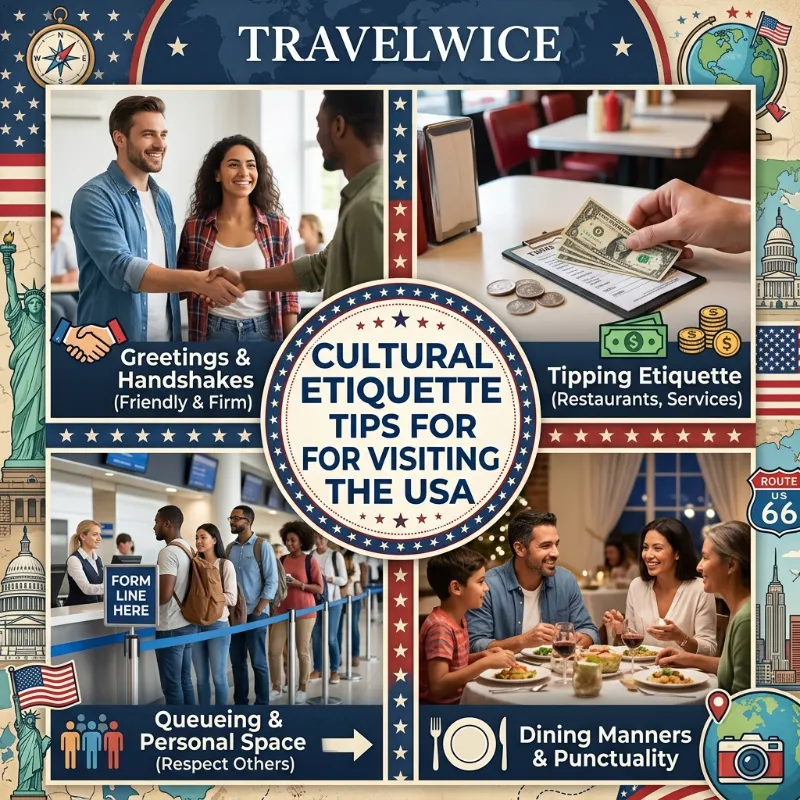
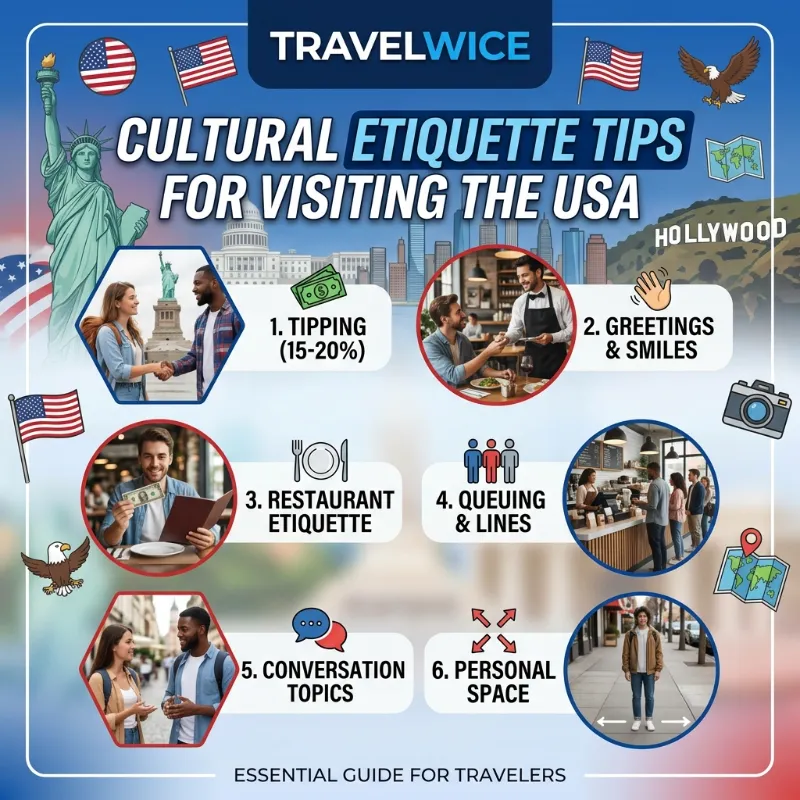
Americans tend to greet strangers with a quick “Hi” or “Hello.” In professional settings, eye contact plus a firm handshake is the standard. In casual settings, a smile and a nod go a long way too. Unlike in Japan or South Korea, Americans don’t expect a bow. Unlike in France or Italy, Americans reserve cheek kisses for close friends and family rather than new acquaintances.
Safety Tips for USA Travel Every Visitor Needs in 2026
First names come out fast. If someone introduces themselves as “Mike” instead of “Mr. Johnson,” it is polite, not rude, to call him Mike right away. This single habit trips up visitors from more formal cultures more than almost anything else on this list, because in much of Europe and Asia, using a first name too soon can feel disrespectful.
A few quick pointers on first meetings:
- Offer a firm handshake with eye contact in business or formal settings.
- Use first names once someone gives you theirs, even in professional emails.
- Save hugs and cheek kisses for people you already know well.
- Say “please,” “thank you,” and “excuse me” often, since Americans use these phrases more frequently than many visitors expect.
The Small Talk Rulebook
Here is where I really got it wrong on my first trip. A barista in Portland once asked, “How’s it going?” I assumed she wanted an actual answer about my jet lag and my missed connection in Denver. She did not. In American social etiquette, “How are you?” functions as a greeting, similar to saying hello. The expected reply is short and upbeat, something like “Good, thanks, how about you?”
Small talk topics usually stay light: weather, sports, travel plans, or a compliment about something nearby. Strangers generally avoid politics, religion, salary, and personal weight, and asking a new acquaintance how much their house or car cost counts as intrusive. Most Americans also see interrupting someone mid-sentence as impolite, so let people finish their thought before jumping in.
If small talk feels unnecessary to you, try to lean into it anyway. It signals friendliness more than it gathers information, and skipping it entirely can come across as cold, even if that is not your intention at all.
Personal Space and Physical Touch
Americans generally prefer more personal space than travelers from many parts of Europe, Asia, or South America. Research on proxemics from InterExchange notes that people in the United States, Canada, the UK, and Nordic countries have the largest personal-space requirements. People in South America, Europe, and Asia typically expect less distance. In everyday conversation, a comfortable gap is roughly 60 to 90 centimeters, or about an arm’s length.
This preference extends to touch. Handshakes are common, but back pats, arm touches, or unsolicited hugs with someone you just met can feel invasive to an American, even when they are meant warmly. Crowded spaces like subways, elevators, or concert venues are the obvious exception, since everyone understands there is simply no room to spare.
A short comparison helps illustrate the gap:
| Region | Typical Conversational Distance | Common Greeting |
|---|---|---|
| USA | 60 to 90 cm (2 to 3 feet) | Handshake or verbal hello |
| Southern Europe | 30 to 50 cm | Cheek kisses common |
| East Asia | 50 to 70 cm, minimal touch | Bow or nod |
| Middle East (same gender) | Often closer, more touch accepted | Handshake, sometimes cheek kisses |
USA Dining Etiquette for Tourists
Dining habits show cultural differences visiting the USA more clearly than almost anything else, and getting the basics right makes meals far more relaxed. Wait until the server has served everyone at the table before you start eating. Keep your elbows off the table during formal meals. Chewing with your mouth closed matters too, since talking with food in your mouth reads as impolite almost everywhere in the country.
Portion sizes tend to be generous compared to most of Europe, and doggy bags for leftovers are completely normal, so do not feel awkward asking your server to box up the rest of your meal. Fast, efficient service is the norm at casual restaurants. Servers who check in frequently are giving you good service, not rushing you out the door, even though it can feel that way at first.
A few dining habits worth knowing before your first meal out:
- Wait to be seated at most sit-down restaurants rather than choosing your own table.
- Splitting the bill is common and easy, since most restaurants can divide checks by card automatically.
- Refills on soda and coffee are often free at casual restaurants, so it is fine to ask.
- Servers usually bring water automatically, with ice, unless you ask otherwise.
For a deeper look at how meals differ by region and price range, our tipping etiquette in the USA guide breaks down exactly what to leave behind at the table.
Tipping: The Custom That Confuses Almost Everyone
Nothing rattles first-time visitors quite like American tipping. A 2024 survey of more than 1,300 international travelers found that 79 percent of visitors feel more pressure to tip in the US than in their home country. The gap is largest for guests arriving from Japan, South Korea, and Scandinavian countries, where tipping is rare or even considered awkward.
How Much Americans Tip Today
The numbers have shifted noticeably in the past few years. At full-service restaurants, Americans now treat 20 percent as the baseline for acceptable service, with 22 to 25 percent common for genuinely excellent service. Digital payment terminals at coffee shops and takeout counters increasingly default to suggested tips of 20, 25, or even 30 percent, a trend many now call “tipflation.” Even so, pickup order tipping rates dropped from 78 percent in 2022 to 62 percent in 2026. That drop shows real pushback, especially for counter service where a tip was never traditionally expected.
Tipping by Service Type
Here is a practical breakdown for your trip:
| Service | Typical Tip |
|---|---|
| Sit-down restaurant | 18 to 20 percent, more for excellent service |
| Bartender | $1 to $2 per drink, or 15 to 20 percent of the tab |
| Taxi or rideshare | 15 to 20 percent |
| Hotel housekeeping | $2 to $5 per night, left daily |
| Hotel bellhop | $2 to $5 per bag |
| Hairdresser or barber | 15 to 20 percent |
| Food delivery | 15 to 20 percent, more in bad weather |
A Few Tipping Exceptions
Etiquette technically calls for tipping on the pre-tax subtotal, though most Americans simply tip on the full total for convenience. The difference usually amounts to less than a dollar or two on an average bill. Most people don’t tip package couriers like UPS or FedEx at all, which surprises visitors who assume every delivery worker expects one.
Our full breakdown at tipping etiquette in the USA covers regional differences and unusual cases, including large group gratuities and buffet-style dining, so it is worth bookmarking before your trip.
Punctuality, Queuing, and Everyday Manners
Time matters more in the USA than in many cultures, particularly for business meetings, medical appointments, and interviews. Most Americans view arriving five to ten minutes early favorably. For a casual dinner party at someone’s home, though, arriving exactly on the dot can actually seem odd. Ten to fifteen minutes after the stated time is generally acceptable.
Americans take lines, or queues, seriously across the country. Cutting ahead, even accidentally, tends to draw irritated looks or a direct comment, so it pays to always check where a line ends before joining it. This applies everywhere from airport security to the checkout counter at a grocery store. Taxi lines outside busy restaurants in cities like New York follow the same unwritten rule: locals expect you to wait your turn even if a cab happens to stop closer to you than to the person who arrived first.
A short list of everyday manners that make daily interactions smoother:
- Say “excuse me” before squeezing past someone or interrupting a conversation.
- Hold the door open for the person behind you, and thank anyone who does the same for you.
- Keep your voice at a moderate volume on public transport and in restaurants.
- Silence your phone in theaters, and avoid answering calls during a movie or live performance.
If you plan to rely on buses, subways, or ride-hailing apps during your trip, our guide on public transport tips in the USA covers the unwritten rules for getting around politely in busy cities.
Dress Codes and Everyday Style
American dress codes lean casual by international standards, especially outside major cities. Jeans, sneakers, and t-shirts work in most restaurants. Only upscale fine dining establishments or certain clubs require jackets or dressier attire. Some churches, courtrooms, and formal business meetings still expect modest, polished clothing, though, so it helps to research your specific destination and itinerary ahead of time.
Sports team apparel is genuinely everywhere. Wearing a local team’s jersey, especially during football season in the autumn, gives you a quick and easy way to strike up a friendly conversation with a stranger. For more detail on what actually belongs in your suitcase, our earlier guide on what to pack for the USA walks through region-specific clothing choices for different seasons.
Communication Style: Direct but Friendly
American communication tends to be more direct than in cultures where speakers often imply meaning rather than state it outright. If someone says “No, thank you,” it typically means no, and repeating the offer several times can come across as pushy rather than polite. At work or in negotiations, people often state problems plainly instead of hinting around them. That directness can feel blunt to visitors from more indirect communication cultures, even though Americans don’t mean it as rudeness.
At the same time, Americans layer a lot of friendliness on top of that directness. Compliments are common and usually sincere, customer service staff tend to be upbeat, and casual humor pops up in situations that might feel formal elsewhere, such as a doctor’s waiting room or a work meeting. Read both signals together, the directness and the warmth, and you’ll get a much clearer picture of how a conversation is actually going.
Practical Firsthand Tips From the Road
A few lessons I only learned by making the mistake first, which might save you the trouble:
- In New York, if you are hailing a taxi and someone was already waiting further up the sidewalk, motion the driver toward them rather than hopping in yourself, since this “queue etiquette” is taken seriously in busy cities.
- At movie theaters, a light round of applause at the end of the film is common in some cities. Treat it as friendly rather than mandatory, so do not feel obligated if it is not your habit.
- Asking a cashier “how’s your day going?” while they ring you up is a small gesture that gets noticed and appreciated far more than staying silent.
- Splitting a check by app, such as Venmo or Zelle, is common among younger Americans, so do not be surprised if a group of new friends asks you to send your share digitally instead of handing over cash.
If you want to stretch your budget while adjusting to tipping culture, our guide on money-saving tips for USA travel pairs naturally with this etiquette advice, since knowing where costs add up helps you budget for gratuities more accurately.
A Quick Comparison: American Etiquette vs. Common Expectations Elsewhere
| Custom | In the USA | Common Elsewhere |
|---|---|---|
| Tipping | Expected, 18 to 25 percent | Often included or not expected (Japan, much of Europe) |
| Greeting strangers | Friendly, casual, first names fast | More formal titles common in many cultures |
| Punctuality for meetings | Strict, early is respected | More flexible in parts of Southern Europe and Latin America |
| Personal space | Wider gap, less touch | Closer distance common in Middle East, South America |
| Small talk | Frequent, light, surface-level | Can be seen as unnecessary or overly familiar elsewhere |
Safety, Etiquette, and Staying Comfortable
Good etiquette also overlaps with staying safe and aware. Knowing when to ask for help, understanding tipping so you are not caught off guard financially, and respecting local norms around personal space all reduce friction during your trip. For a broader look at staying secure while you travel, our guide on safety tips for USA travel rounds out the practical side of this etiquette advice.
It also helps to have the right tools on your phone before you land. Translation apps, tipping calculators, and transit planners all make it easier to navigate unfamiliar customs on the go, and our roundup of best travel apps for the USA covers the ones worth downloading before departure.
Regional Differences Worth Knowing
The USA is roughly the size of Europe, so etiquette shifts noticeably depending on where you land. In the Northeast, particularly New York and Boston, conversations move quickly, people walk fast, and small talk with strangers stays brief. Waiters and shopkeepers can seem curt at first, though this usually reflects pace rather than rudeness.
The South, including cities like Atlanta, Nashville, and New Orleans, tends toward warmer, slower small talk. Strangers may greet you with “y’all” or ask a few extra friendly questions before getting to business. In the Midwest, from Chicago to Minneapolis, locals are famous for “Midwest nice,” a mix of politeness and mild indirectness that can make it hard to tell when someone is truly bothered by something.
On the West Coast, particularly in California, dress codes loosen further, and punctuality can be a touch more relaxed outside of business meetings. Small talk often drifts toward outdoor activities, food, or technology. None of these differences run dramatic, but noticing them helps explain why one city can feel entirely different from another, even within the same country.
Holidays and Everyday Social Moments
Timing your trip around a major holiday changes the social rhythm considerably. Thanksgiving, in late November, centers on family meals and ranks among the busiest travel periods of the year, so expect crowded airports and higher hotel rates around it. The Fourth of July brings fireworks, barbecues, and a generally festive, casual mood nationwide, while Christmas and New Year’s Eve draw large crowds to cities like New York for public celebrations.
If you happen to be invited into someone’s home during your visit, bring a small gift such as wine, flowers, or a dessert as a thoughtful gesture, though hosts don’t strictly require it. Removing your shoes at the door depends entirely on the household, so it is worth watching what your host does or simply asking. Hosts always appreciate compliments about their home or cooking, and offering to help clear the table after a meal, even if your host declines, is a small courtesy that rarely goes unnoticed.
Common Etiquette Mistakes First-Time Visitors Make
A few missteps show up again and again among first-time visitors, and knowing them ahead of time can spare you an awkward moment or two:
- Assuming a smile or friendly small talk from a stranger signals a deep new friendship, when it is usually just everyday politeness.
- Forgetting to tip at a sit-down restaurant; servers and locals alike will notice immediately.
- Standing too close during a conversation, which can make the other person step back without explaining why.
- Asking a new acquaintance direct questions about salary, weight, or immigration status, all of which read as overly personal.
- Assuming that “let’s get together sometime” is a firm invitation rather than a polite, open-ended pleasantry.
None of these mistakes carry serious weight, and most Americans will happily explain local customs if you ask directly. Curiosity and a willingness to learn matter far more than getting every rule right on the first try.
Frequently Asked Questions
Is tipping really mandatory in the USA? Tipping isn’t legally required, but it functions as a strong social expectation almost everywhere service is provided, particularly at sit-down restaurants, bars, and salons. Skipping a tip for adequate or better service counts as rude rather than simply optional.
How close is too close when talking to someone? A distance of roughly two to three feet, or about an arm’s length, marks the general comfort zone in most parts of the country. Standing noticeably closer can make people step back or feel uneasy, even in a friendly conversation.
Do Americans really answer “How are you?” without meaning it? Yes, in most casual contexts it functions as a greeting rather than a genuine question. A short, upbeat response works best, and you can always follow up with real conversation once you know someone better.
Is it rude to talk about money or politics with new acquaintances? Generally, yes. People treat salary, house or car prices, weight, and political opinions as private topics with new acquaintances, so it is safer to stick to lighter subjects like travel, food, or sports.
What happens if service is genuinely bad? Do I still have to tip? Even for poor service, etiquette guides suggest tipping around 10 to 15 percent rather than leaving nothing at all, and raising the issue directly with a manager if the problem was serious.
Quick Etiquette Quiz
Test what you just learned before you land.
- What is the standard restaurant tip percentage in the USA in 2026? a) 5 to 10 percent b) 10 to 15 percent c) 18 to 20 percent (correct)
- How should you typically respond when someone asks, “How are you?” as a greeting? a) Give a detailed update on your day b) A short, positive reply like “Good, thanks!” (correct) c) Ignore the question and walk on
- What is the general comfortable conversational distance in the USA? a) 60 to 90 centimeters, roughly an arm’s length (correct) b) Less than 30 centimeters c) Over 2 meters
- True or false: It is normal to call someone by their first name shortly after meeting them. True (correct)
- True or false: Cutting in line, even accidentally, is generally seen as acceptable in the USA. False (correct)
Conclusion
Cultural etiquette tips for the USA come down to a handful of habits that, once you know them, become second nature within a day or two. Tip generously, respect personal space, keep small talk light and upbeat, and show up on time, and you will find that Americans are, on the whole, warm and welcoming toward visitors who make an honest effort to fit in. None of this requires perfection. A little awareness goes further than most travelers expect, and the small missteps you might make along the way usually get met with a smile rather than judgment. Safe travels, and enjoy the trip.
References
- Travel With Hello, United States Cultural Guide (link not verified — see note below)
- Penn State Harrisburg, Guide to American Culture and Etiquette
- Global Entry Spotter, The Global Etiquette Guide: Cultural Dos and Don’ts for USA-Based International Travelers (link not verified — see note below)
- Splitty, Tipping in the US: The 2026 Guide for International Visitors (link not verified — see note below)
- Autopilot Travel, The Complete Travel Tipping Guide for 2026 (link not verified — see note below)
- InterExchange, Proxemics and Communication Styles
- NBC News, Worldwide Guide to Restaurant Tipping