
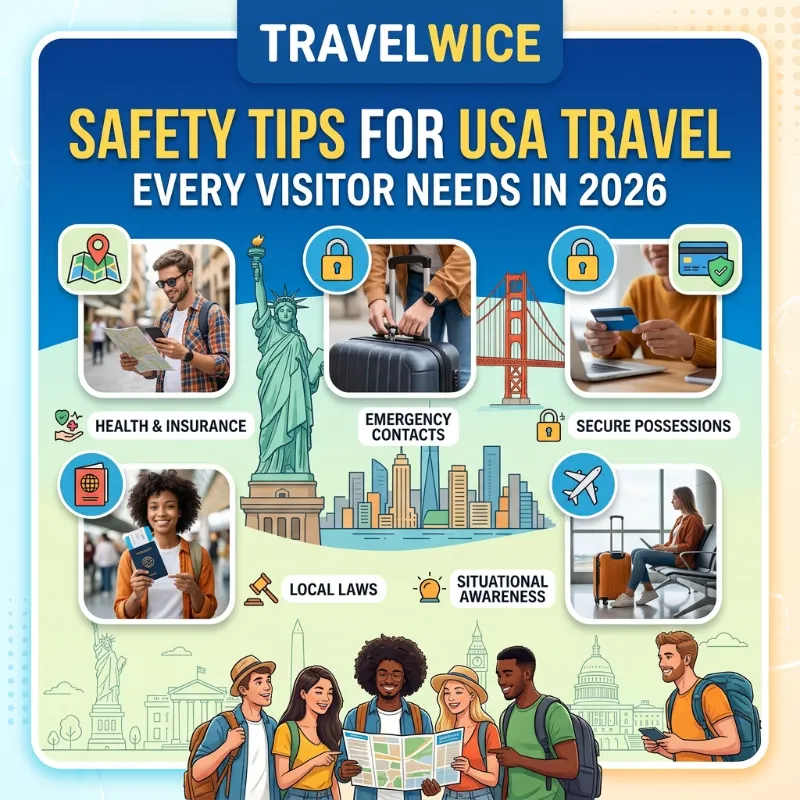
Landing at JFK or LAX for the first time can feel like stepping into a movie you have watched a hundred times. Except now you are the one navigating the yellow cabs, the subway maps, and the sheer size of it all. That mix of excitement and nerves is normal. It is exactly why good safety tips for USA travel matter more than a checklist of tourist attractions. Millions of visitors from the UK, Ireland, Germany, and across Europe arrive every month. The overwhelming majority go home with nothing worse than sore feet from walking too much. Still, a few smart habits make the difference between a smooth trip and a stressful one. This guide lays them out the way a well-traveled friend would, not a brochure.
TL;DR
-
The USA is broadly safe for tourists in 2026, but risk varies sharply by city, neighborhood, and time of day, so research your specific route before you go.
-
Petty theft, vehicle break-ins, and scams are far more common than violent crime against visitors. Focus your energy on prevention basics like bag security and hotel safes.
-
Save 911 for real emergencies, enroll in STEP before you fly, carry a REAL ID compliant document or passport, and buy travel insurance that covers US healthcare costs.
Key Takeaways
| Topic | What You Need to Know |
|---|---|
| Overall safety | Generally safe with normal precautions; risk is highly localized, not nationwide |
| Biggest real risk | Petty theft and car break-ins, not random violent crime against tourists |
| Emergency number | 911 for police, fire, or ambulance anywhere in the country |
| ID requirement | REAL ID compliant license or passport needed to fly domestically as of May 2025 |
| TSA fee for non-compliant ID | $45 ConfirmID verification fee since February 1, 2026 |
| Healthcare cost risk | A single ER visit can run into the thousands of dollars without insurance |
| Best prep step | Enroll in the State Department’s STEP program before departure |
Is the USA Safe for Tourists in 2026?
“Is USA safe for tourists” is one of the most searched questions among European visitors this year. The honest answer is that it remains safe for the vast majority of trips. The United States welcomes tens of millions of international arrivals annually. Most travelers experience nothing more dramatic than a crowded subway platform or a long line at security. That said, safety here is not a single national number. It changes block by block in a way that surprises a lot of first-time visitors from smaller, more uniform countries.
Cultural Etiquette Tips for Visiting the USA
Where to Find Official Guidance
For official, destination-specific guidance before you fly, it is worth checking the U.S. State Department’s travel advisories page. It explains advisory levels and also runs the Smart Traveler Enrollment Program. This system is built for outbound US citizens. Even so, the four-level framework it uses, from normal precautions to do not travel, gives a useful mental model. It shows how risk actually gets assessed by professionals rather than headlines.
What the Crime Numbers Actually Show
A few numbers help put things in perspective. Nationwide, violent crime reported to the FBI has been trending down from its pandemic-era peak. Property crime, including car break-ins and smash-and-grabs, remains the top concern in cities such as San Francisco, Seattle, and Chicago. Firearm ownership is high across the country. Mass shooting coverage understandably worries overseas readers. Yet these events remain statistically rare. They are almost never targeted at tourist zones specifically. The bigger, quieter risk most visitors actually face is a stolen phone from a restaurant table, or a bag left unattended for thirty seconds too long.
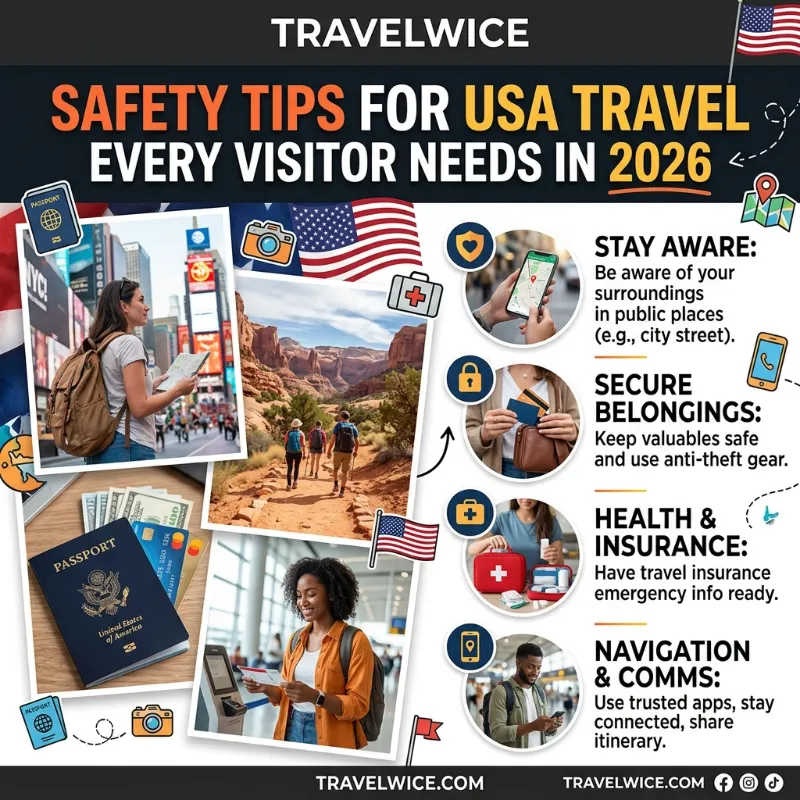
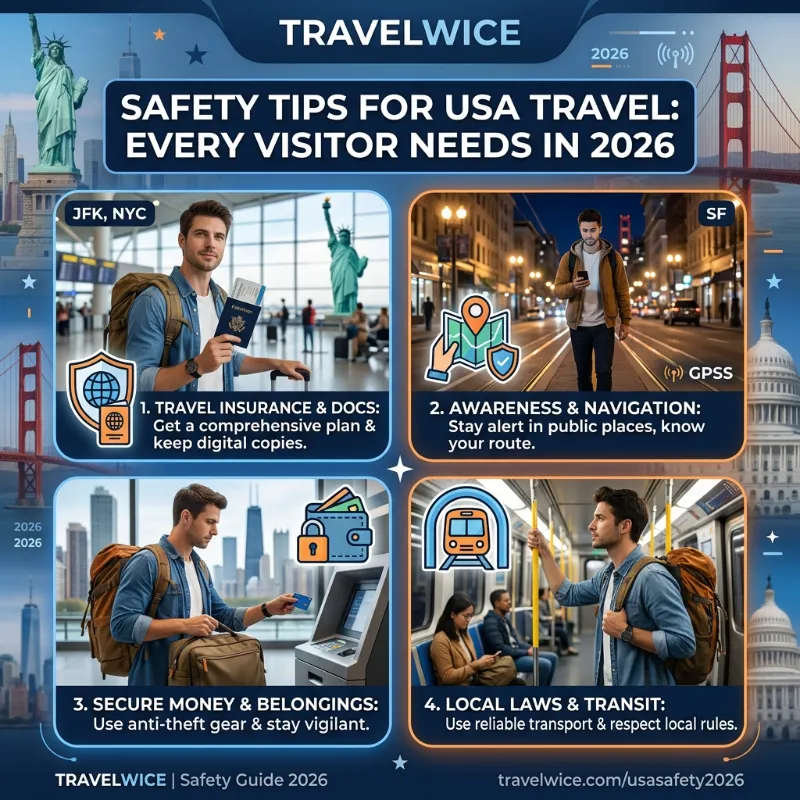
Practical first-day habit: keep your phone in a front pocket or zipped bag, not a back pocket. Treat a parked rental car like a display case. Thieves in several major cities specifically target visible luggage or shopping bags through car windows within minutes of a vehicle being left unattended.
Visa and ESTA Travel Tips for the USA (2026 Guide)
USA Travel Safety by Region
Because the country is roughly the size of Europe, USA travel safety by region is arguably more useful than any single national rating. Here is a realistic breakdown based on how each region actually feels on the ground.
| Region | General Vibe | What to Watch For |
|---|---|---|
| Northeast (NYC, Boston, DC) | Busy, well-policed tourist cores | Subway pickpocketing, tourist-trap taxis |
| South (Miami, New Orleans, Atlanta) | Warm, lively, nightlife-heavy | Late-night districts, hurricane season June to November |
| Midwest (Chicago, Minneapolis) | Friendly, grid layout, easy to navigate | Downtown car break-ins, harsh winter weather |
| West Coast (LA, San Francisco, Seattle) | Sprawling, car-dependent | Rental car smash-and-grabs, homelessness-related street activity |
| Mountain West and National Parks | Remote, stunning, low crime | Wildlife encounters, sudden weather shifts, cell signal gaps |
Small Cities Often Beat Their Reputation
Small and mid-sized cities consistently outperform their reputations. Carmel, Indiana, currently ranks as one of the country’s safest cities by cost of crime per resident. San Jose, California, recorded only around 5,185 violent crime reports in 2025 for a population approaching one million. That makes it the safest big city on several 2026 lists. Meanwhile, a handful of larger metros, including Memphis and parts of New Orleans, carry higher violent crime rates. They deserve a bit more street awareness after dark. None of this means avoid big cities. It means plan your evenings the way locals do. Stick to well-lit, busier streets. Use rideshare apps rather than wandering unfamiliar blocks at 2am.
If you are building a full itinerary and want help layering city-hopping with safety in mind, our USA travel tips for beginners guide walks through how to sequence a first trip. That way you are not jumping between extremes on back-to-back days.
First-Time USA Travel Checklist: What Not to Skip
A Real Trip, Broken Down
In October 2025, our team ran a fourteen-day loop from Chicago to Denver, stopping in Milwaukee, Minneapolis, and Rapid City along the way. The only genuinely tense moment happened in a Chicago parking garage near Millennium Park. A group loitering by the exit ramp was clearly sizing up cars with visible luggage. Moving the bags into the trunk before parking, rather than after, solved it instantly. Everywhere else, from small-town diners in South Dakota to downtown Denver at 9pm on a Friday, the trip was completely uneventful. That pattern, low risk almost everywhere paired with a handful of predictable pinch points, is exactly what the safety data above suggests. It is a far more useful mental model than a single national safety score.
It also helps to understand who tends to run into trouble. Consular case data consistently shows that most visitor incidents involve alcohol, nightlife districts after midnight, or unattended valuables. They rarely involve random targeting of tourists walking through daylight neighborhoods. Knowing this shifts your planning from generalized anxiety toward specific, manageable habits. That is really the whole point of this guide.
Before You Go: Entry Rules, ID, and Prep That Actually Matters
Preparation genuinely is half the battle. 2026 has brought a few real changes that catch travelers off guard.
Documents and Entry Requirements
- Check your ESTA or visa status early. Visa Waiver Program travelers, including most UK and EU passport holders, still need an approved ESTA before boarding. Fees and interview requirements have shifted this year, so apply at least a few weeks ahead rather than at the gate.
- Bring a REAL ID compliant document. Since May 7, 2025, adults need a REAL ID compliant driver’s license, a passport, or another TSA-approved document to clear domestic airport security. As of February 1, 2026, travelers without one face a $45 TSA ConfirmID identity verification fee. The process can take fifteen to thirty minutes, so simply pack your passport and skip the hassle entirely.
Packing and Digital Prep
- Pack with security in mind, not just style. A cross-body bag with a zip closure, a slim RFID-blocking wallet, and a spare charged phone battery cover most of the common theft scenarios. Our what to pack for USA guide breaks down a full checklist by season and region.
- Screenshot everything important. Hotel confirmations, your travel insurance policy number, and your home embassy’s local phone number should live in your photos app in case your signal drops.
- Photocopy your documents twice. Leave one paper copy with someone at home. Keep a second copy sealed away from your main bag, separate from your passport itself. If your passport is lost or stolen, this single habit can cut days off the replacement process at a US embassy or consulate.
- Understand your device privacy at the border. Border officers can, in rare cases, ask to inspect electronic devices. You are generally not required to unlock a device, though refusal can sometimes lead to further questioning or delays. Remove anything you would rather not discuss before you fly, rather than deleting it at the airport.
- Set up international data before landing. An eSIM or a local prepaid SIM, both widely available at major airports for around 25 to 45 USD (20 to 36 GBP), keeps your maps, translation, and rideshare apps working from the moment you land. This matters far more for safety than convenience.
For a second opinion from another team that covers this ground regularly, the United States safety travel guide from Travel With Hello is a solid companion resource, especially for driving-related advice if you are planning a road trip.
Solo Travel Safety Tips for USA
Solo travel safety tips for USA trips deserve their own section. The calculus changes when nobody has your back at 1am. The good news is that solo travel across America has become genuinely mainstream. Most of what keeps you safe is habit, not paranoia.
- Share your daily plan with someone at home, including hotel address, planned activities, and a rough return time, especially before day hikes or road trips into remote areas.
- Choose accommodation with 24-hour front desk staff. Read the most recent reviews, not just the star rating, since safety details age quickly.
- Keep your phone charged above 50 percent at all times. A portable power bank is one of the cheapest safety tools you can buy, at roughly 20 USD or 16 GBP.
- Split your money and cards across two locations rather than one wallet, so a single theft does not wipe you out.
- In national parks, download offline maps before you lose signal. Set a firm turnaround time for hikes. Never approach wildlife for a photo, since the National Park Service reports encounters increase sharply when visitors get within selfie distance of animals like bison and bears.
A useful travel apps stack does a lot of the heavy lifting here, from offline maps to location sharing with family. Check our best travel apps for USA roundup for the specific tools worth downloading before departure. Women traveling solo report feeling comfortable in the vast majority of tourist hubs. The same downtown-avoidance rules after dark apply regardless of gender. Trusting your instinct in an unfamiliar bar or party scene is never overcautious.
Everyday Safety Habits: Money, Scams, and Getting Around
Most incidents visitors actually run into are financial rather than physical. A little street smarts around money goes a long way.
Common Scams to Watch For
Common scams to know before you land include fake parking ticket demands from people posing as officials. Watch for “free” walking tour guides who pressure aggressive tipping at the end. Also watch for rideshare drivers who cancel a trip and ask you to pay cash outside the app. None of these are unique to America. They show up often enough in tourist-heavy areas like Times Square and the Las Vegas Strip that it is worth knowing the pattern in advance. If a deal or a demand feels rushed, slow down and verify it. Scammers rely on visitors not wanting to seem rude.
A short list of the scams reported most often by international visitors in 2025 and 2026:
- Costumed character photo fees in tourist plazas like Hollywood Boulevard or Times Square, where a friendly photo turns into an aggressive demand for 20 USD or more afterward.
- Fake charity clipboards, usually operated by someone claiming to represent a deaf, homeless, or veterans charity, designed to distract you while an accomplice checks your bag.
- Overpriced unlicensed taxis waiting just outside airport arrivals halls, often quoting a flat rate two to three times higher than a metered or rideshare fare.
- ATM skimmers on standalone machines inside convenience stores, rather than bank-branded ATMs. Sticking to bank lobby machines avoids most of this risk entirely.
- “Free” hop-on hop-off tickets sold on the street near major landmarks that turn out to be counterfeit or simply invalid at the boarding point.
None of these require special equipment to avoid. Just use a little healthy skepticism, and stick to licensed apps and official ticket counters rather than street vendors.
Tipping and Getting Around Town
Tipping culture also trips up a lot of European visitors, since it is not optional the way it often is at home. Getting it wrong can genuinely sour service interactions. Our full tipping etiquette in the USA breakdown covers exact percentages for restaurants, bars, and rideshares.
On transport, public buses and subways in cities like New York, Boston, and DC are safe during the day and busy periods. It still pays to stay alert late at night. Our public transport tips in USA guide covers ticketing and etiquette in more detail. Budget-wise, our money saving tips for USA travel guide also touches on avoiding overpriced tourist-zone taxis, which is as much a wallet issue as a safety one.
For a third, independently written perspective that dives deeper into car rental and roadside safety specifically, the traveling in the United States safety tips article from Spirit Exchange is worth a quick read before a driving-heavy itinerary.
Emergency Numbers USA Travel Guide
Every emergency numbers USA travel guide should live in your phone before you land, not after something goes wrong. Save these now.
| Situation | Number | Notes |
|---|---|---|
| Police, fire, ambulance | 911 | Works nationwide, free from any phone, even without a SIM |
| Non-emergency police | 311 (many cities) | Use for noise complaints, minor theft reports, non-urgent issues |
| Poison control | 1-800-222-1222 | Staffed 24 hours, useful for food, medication, or plant-related concerns |
| US State Department overseas citizens line | +1-202-501-4444 | For lost passports and consular emergencies while abroad |
| Your home embassy in Washington DC | Varies by country | Save this before departure; most embassies list an after-hours line |
One habit that costs nothing and helps enormously: enroll in the State Department’s Smart Traveler Enrollment Program if your home country offers an equivalent. At minimum, register your itinerary with your own embassy. It means someone official knows roughly where you are if a natural disaster, civil event, or personal emergency happens mid-trip.
Health, Insurance, and Weather Risks
Perhaps the single biggest financial risk to a visitor in America is not crime at all. It is an unplanned trip to the emergency room. The US healthcare system does not offer free treatment to visitors. A straightforward ER visit for something like a sprained ankle can easily run 1,500 to 3,000 USD (roughly 1,200 to 2,400 GBP) before any follow-up care. Comprehensive travel insurance that covers medical treatment and evacuation is not optional here. Treat it as part of your flight budget, not an add-on.
Weather Patterns Worth Planning Around
Weather also deserves real planning rather than an afterthought. Hurricane season runs from June through November along the Gulf Coast and Atlantic Southeast. Tornado activity peaks in the Midwest and South during spring. Wildfire smoke has become a recurring late-summer issue across parts of the West. None of this should scare you off a trip. But checking the National Weather Service forecast a few days before travel takes five minutes. This matters most for Florida, Louisiana, or coastal Carolina trips between August and October, and it can save an entire itinerary.
Choosing the Right Insurance Policy
When you compare policies, look specifically for medical coverage of at least 100,000 USD. Check for emergency evacuation coverage. Check for a clause covering pre-existing conditions if relevant to you. Annual multi-trip policies from UK and EU insurers often work out cheaper than single-trip US-specific plans, if you travel more than twice a year. It is worth comparing both before you commit. Keep a photo of your policy number and the insurer’s 24-hour emergency line saved offline. Hospital admissions staff will ask for it before treatment, in anything beyond a true life-threatening emergency.
Safety Considerations for Diverse Travelers
Safety in America is not experienced identically by every visitor, and pretending otherwise would not be honest or helpful. LGBTQ+ travelers should know that protections and public attitudes vary meaningfully by state. Organizations like IGLTA maintain updated, destination-specific guidance. It is worth a quick check before booking accommodation in more conservative regions. Travelers of color have reported a wider range of experiences depending on region and situation. The overwhelming majority of trips proceed without incident. Still, researching a specific city’s reputation and reading recent traveler reviews from people with a similar background adds a useful, practical layer of preparation.
Older travelers and those with mobility needs generally find major US cities well equipped. Accessible subway cars, curb cuts, and ADA-compliant hotel rooms are standard in most chains. Smaller towns and older buildings can lag behind. If accessibility is a priority, calling ahead to confirm specific room features beats relying on a website listing alone, since standards can vary even within the same hotel brand.
Frequently Asked Questions
Is the USA safe for tourists right now? Yes, for the large majority of visitors and destinations, standard precautions are enough. Risk concentrates in specific neighborhoods and situations. Research your exact itinerary rather than judging the whole nation by news headlines.
What is the single most useful safety tip for USA travel? Keep your phone and wallet secured and out of sight in crowded areas. Never leave visible bags or electronics inside a parked car, even briefly. Petty theft, not violent crime, is what actually affects most tourists.
Do I need travel insurance for a USA trip? Yes, strongly recommended. US emergency healthcare is expensive without coverage. A policy that includes medical treatment and evacuation is one of the cheapest forms of protection you can buy for a trip.
What is the emergency number in the USA? Dial 911 for any police, fire, or medical emergency anywhere in the country, including from a phone without an active SIM card.
Is it safe to travel solo in the USA as a woman? Most solo female travelers report positive experiences across major tourist destinations. Standard precautions apply. Stay in well-reviewed accommodation, avoid isolated areas late at night, and share your itinerary with someone at home.
Do I need a REAL ID to fly within the USA? Adults need a REAL ID compliant license, passport, or another TSA-accepted document to clear domestic airport security. Since February 1, 2026, travelers without compliant ID face a $45 TSA ConfirmID verification fee. A passport is the simplest option for international visitors.
Quick Safety Quiz
Test what you just learned before you pack your bags.
- What is the main emergency number in the United States? a) 112 b) 999 c) 911 — Correct answer: c) 911
- What is the biggest real safety risk for most tourists in the USA? a) Random violent crime b) Petty theft and car break-ins c) Wildlife attacks — Correct answer: b) Petty theft and car break-ins
- What identification do adults need to fly domestically within the USA in 2026? a) Any government photo ID b) A REAL ID compliant license or passport c) A birth certificate — Correct answer: b) A REAL ID compliant license or passport
- When is hurricane season along the US Gulf and Atlantic coasts? (True or False: It runs June through November) — Correct answer: True
- What should you do if a “free” walking tour guide pressures you for an unusually large tip? (Select all that apply) a) Pay whatever they demand immediately b) Politely decline and pay what you consider fair c) Report the behavior to the tour company or platform afterward — Correct answers: b and c
USA Travel Safety at a Glance (2026 Data Snapshot)
| Metric | 2026 Figure |
|---|---|
| Nationwide violent crime rate | Roughly 4.4 incidents per 1,000 people |
| Nationwide property crime rate | Roughly 22.9 incidents per 1,000 people |
| Safest ranked city (cost of crime basis) | Carmel, Indiana |
| Safest large city (population 300,000+) | San Jose, California |
| TSA ConfirmID fee (non-REAL ID travelers) | $45 per traveler |
| Average uninsured ER visit cost | 1,500 to 3,000 USD |
| Hurricane season | June 1 to November 30 |
Conclusion
None of this is meant to make you nervous about a country that, for the vast majority of visitors, delivers exactly the trip they hoped for. Safety tips for USA travel are really just common sense translated for an unfamiliar setting. Secure your belongings. Know your emergency numbers. Buy proper insurance. Research the specific neighborhoods on your itinerary rather than judging an entire country by its news cycle. Do that, and the version of America you experience will likely look a lot more like friendly diners, wide-open national parks, and genuinely helpful strangers than anything you have seen in a headline. Safe travels, and enjoy the trip.
References
- U.S. Department of State, Travel Advisories
- Travel With Hello, United States Safety Travel Guide
- Spirit Exchange, Traveling in the United States Safety Tips
- MoneyGeek, Safest and Most Dangerous Cities in America by Cost of Crime (2026)
- Islands.com, America’s Safest Cities in 2026
- TSA, REAL ID and ConfirmID Fee Announcement (February 2026)
- National Park Service, Solo Hiker and Wildlife Safety Guidance