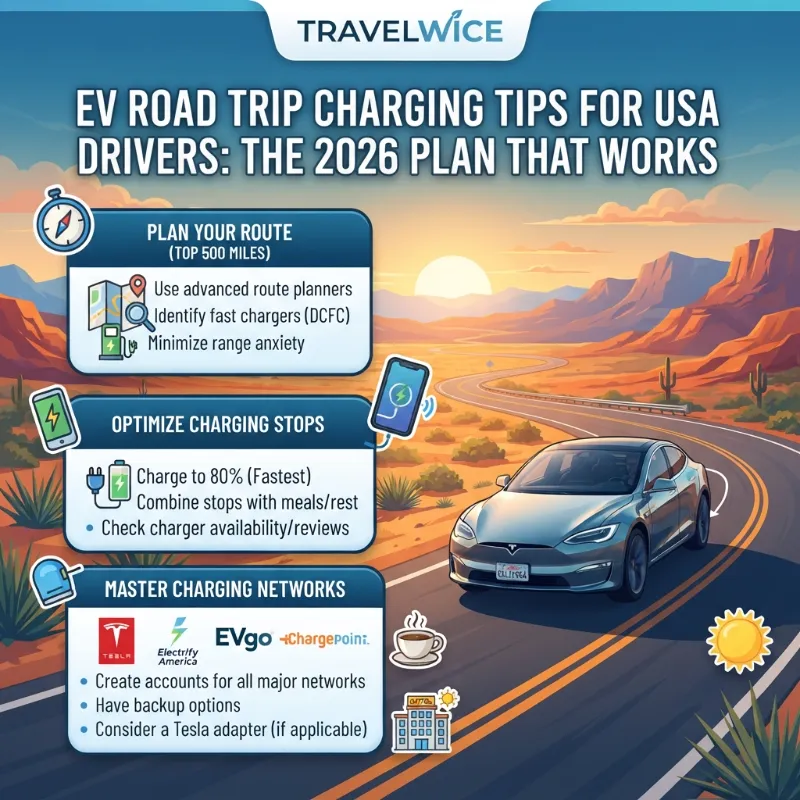

Picture this. You are 40 miles from the next fast charger, the battery shows 14%, and the sun is setting over a long stretch of Nevada desert. Sooner or later, most EV drivers feel that knot in the stomach. Luckily, a few smart habits can prevent it. In short, these EV road trip charging tips show how real drivers plan, charge, and recover when things go wrong.
TL;DR
- First, charge from about 10% to 80% on a road trip, because the battery charges fastest in that range.
- Next, plan every stop before you leave, then keep a backup charger within 30 miles of each one.
- Also, use one route planner app and one network app, and check live charger status before you arrive.
- Finally, expect 20 to 40 minutes per fast charging stop, and treat it as your meal or restroom break.
Key Takeaways at a Glance
| Topic | What to Do | Why It Helps |
|---|---|---|
| Charge window | Aim for 10% to 80% | Speeds drop sharply after 80% |
| Stop spacing | Plan stops every 150 to 200 miles | Leaves a safe buffer |
| Planner | Use a route app with live data | Avoids broken or busy chargers |
| Backup | Pick a second charger on every leg | Protects you from outages |
| Speed | Drive 65 to 70 mph | Cuts energy use on highways |
| Cold weather | Precondition the battery | Restores fast charging speed |
| Payment | Set up two or three network accounts | Avoids stuck screens and card errors |
Why EV Road Trip Charging Tips Matter More in 2026
The charging map has changed fast. For example, according to Department of Energy data reported by EV Infrastructure News, the US passed 250,000 public charging ports in June 2026, including more than 73,000 DC fast chargers. Because fast chargers make long trips possible, their growth matters most. Better still, they keep growing at a steady pace.
Road Trip Safety Tips USA: Every Driver Should Know These 15 Checks
Growth helps, but it does not remove the need for a plan. In fact, chargers still go offline, lines still form on holiday weekends, and some rural stretches stay thin. As a result, a good plan turns a stressful trip into a calm one.
Here is how the fast charging count has grown through 2026.
| Date (AFDC) | Public DC Fast Charging Ports |
|---|---|
| March 1, 2026 | 70,017 |
| May 1, 2026 | 72,514 |
| June 1, 2026 | 73,951 |
| July 28, 2026 | 75,293 |
Chart: DC fast charging ports in the US (each block is about 2,000 ports above 60,000)
Mar 1   ████▌ 70,017
May 1   ██████ 72,514
Jun 1   ███████ 73,951
Jul 28  ████████ 75,293
From March to late July, the count rose by more than 5,000 ports. In other words, the network adds roughly 1,000 or more new stalls each month, as EVChargingStations.com reports. Even better, only about 1.2% of ports were temporarily out of service in the May survey. However, a single dead charger on your route can still cost you an hour. Therefore, backup planning stays important.
Road Trip Planning Apps 2026 Compared: The Tools Worth Your Phone Space
Learn the Charging Basics Before You Leave
Charging well does not require an engineering degree. Still, you should know the three charger types and what they mean for your schedule.
| Charger Type | Typical Speed | Best Use | Time for 200 Miles of Range |
|---|---|---|---|
| Level 1 (120V outlet) | 3 to 5 miles per hour | Emergency only | 40+ hours |
| Level 2 (240V) | 20 to 30 miles per hour | Hotels, overnight stays | 7 to 10 hours |
| DC fast charging | Varies by car, often 150+ miles per hour at peak | Road trip stops | 20 to 40 minutes |
Speeds depend on your car, the charger, and the battery temperature. For instance, a charger rated at 350 kW will not charge a car that tops out at 100 kW any faster. So, check your owner’s manual for the peak charging rate.
The 10 to 80 Rule
Batteries charge fastest when they are low, and then they slow down as they fill. In fact, most cars take about as long to go from 80% to 100% as they do from 10% to 80%. Therefore, the last 20% wastes time on a road trip. Instead, leave at 80% and move on.
However, there is one exception. If the next charger sits 150 miles away, you may need to charge higher. In that case, run the numbers in your planner app and decide per stop.
Plugs and Adapters
Connector standards have shifted in North America. For example, many new cars now ship with the NACS port that Tesla popularized, while older non-Tesla cars use CCS. Adapters bridge the gap in many cases, but they are not universal. Therefore, check your exact model and year before you rely on one.
Also, keep a small kit in the trunk. For a helpful list, the team at Jaco Superior Products shares ideas in their EV road trip guide on charging, range anxiety, and what to carry. Meanwhile, our own road trip packing checklist covers the rest of your gear.
EV Charging Stations Road Trip USA: Which Networks to Trust
Not all networks work the same way. For instance, some have great coverage but spotty reliability, while others have fewer sites but excellent uptime. Because of this, knowing the big names helps you pick the right app before you leave home.
| Network | Approx. US DC Fast Ports | Best For |
|---|---|---|
| Tesla Supercharger | About 38,000 | Coverage and reliability on major highways |
| Electrify America | 5,610 | Non-Tesla cars, many highway sites |
| EVgo | 5,102 | Cities and busy corridors |
| ChargePoint | 4,591 | Mixed networks and shopping centers |
| Blink | 1,989 | Local backup stops |
Port counts come from AFDC data that Charged EVs and other trackers reported in 2026. As the table shows, Tesla’s count is the largest by far, at about 38,000 Supercharger ports.
Chart: Largest US fast charging networks (each block is about 1,000 ports)
Tesla             ██████████████████████████████████████ 38,000
Electrify America ██████ 5,610
EVgo              █████ 5,102
ChargePoint       █████ 4,591
Blink             ██ 1,989
Notice how one network dwarfs the rest. As a result, many drivers now plan around Superchargers first. Then they use other networks as backup.
Tesla Supercharger Road Trip USA: What Non-Tesla Drivers Should Know
A Tesla Supercharger road trip in the USA is still the simplest way to travel by EV. First, sites sit along nearly every major interstate. Also, stalls usually show up in groups of eight or more, which cuts wait times.
Best Road Trip Snacks Ideas for Long Drives
Many other brands now have access too. For example, Ford, GM, Rivian, Hyundai, and Kia owners can use Superchargers through the Tesla app, with either a native port or an adapter. However, always check the Tesla Supercharger site map to confirm that your car works at a given location. Since some sites are still Tesla only, the map marks which ones are open.
Here are a few tips for non-Tesla drivers at a Supercharger:
- First, download the Tesla app and add a payment method before you leave home.
- Next, back into the stall carefully, because cables are short.
- Then, park straight so the next driver can fit beside you.
- Finally, unplug as soon as you reach your target, since many sites add idle fees.
Electrify America, EVgo, and the Rest
Electrify America remains the largest non-Tesla network. In addition, it has hundreds of highway sites, and many now add NACS plugs next to the old CCS ones. Meanwhile, EVgo works well around cities and busy travel routes. Likewise, ChargePoint is common in shopping centers, so you can eat while you charge.
Road Trip Tips With Kids That Actually Work
Independent chargers also help. For instance, the Department of Energy station locator lists nearly every public charger in the country. Use it as a neutral backup when your favorite app shows an outage.
The Best EV Road Trip Planner App for Your Trip
A good planner saves hours of guessing. In particular, the best EV road trip planner app calculates your battery use, picks charging stops, and shows live charger status.
| App | Strength | Watch Out For |
|---|---|---|
| A Better Routeplanner | Detailed battery modeling by car model | More settings to learn |
| PlugShare | Huge charger database with driver reviews | Reviews vary in quality |
| Your car’s built-in navigation | Auto precondition and easy stops | May ignore non-brand networks |
| Google Maps | Easy to use, shows chargers on route | Less control over battery levels |
| Network apps (Tesla, EA, EVgo) | Live stall availability and payment | Only show their own sites |
Our recommendation is simple. First, use A Better Routeplanner to build the trip. Next, open PlugShare to check recent user comments on each charger. Finally, keep your car’s own navigation on during the drive, because it can warm the battery before you arrive.
Apps are just one part of a smooth drive, though. For more tools, our guide to road trip playlists and apps also covers ideas for long days behind the wheel.
EV Road Trip Range Anxiety Tips That Work
Range anxiety is the fear of running out of charge. Although it is common, it is mostly solvable with data and habits. In fact, these tips come from patterns that experienced drivers use again and again.
Know Your Real Range, Not the Sticker Range
The EPA range on the window sticker is a lab number. In real life, highway range is often lower, especially at 75 mph or in cold weather. For safety, plan on 80% of the rated range for highway driving. For example, treat a car rated at 300 miles like a 240 mile car.
Before you buy or rent, you can compare EPA ratings for any model on FuelEconomy.gov.
Slow Down a Little
Speed has a big effect on energy use because air resistance rises fast as you go faster. For instance, dropping from 75 mph to 68 mph can add noticeable miles to your range. Meanwhile, it usually costs only a few minutes over a long day. In most cases, charging stops cost more time than speed saves.
Road Trip Packing Checklist Essentials You Need in 2026
Use the Buffer Rule
Never plan to arrive at a charger with less than 10% battery. Instead, aim for 15% to 20% when you can. That way, the buffer covers detours, headwinds, and a broken charger that forces you to drive on.
Precondition in Cold Weather
Cold batteries charge slowly. As a result, if you arrive at a fast charger with a freezing battery, your speed may drop a lot. Fortunately, most modern EVs warm the battery when you set a fast charger as your destination in the car’s navigation. So, use that feature every time in winter.
Winter driving also cuts range because heating the cabin uses energy. In addition, cold air is denser. Overall, expect a drop of 20% to 30% on very cold days, and plan extra stops. Instead of heating the whole cabin, use heated seats and the steering wheel heater, because they use less power.
Have a Backup Charger on Every Leg
Pick a second charger within 30 miles of every planned stop. That way, if your first choice is full or broken, you simply drive on. In short, this one habit solves most range anxiety.
For more ideas, the team at UFODrive offers helpful advice in their post on top charging tips for a smooth EV road trip. Likewise, the EVA group shares a driver view in on the road this summer EV road trip tips.
Best Car Rental Tips USA: Save Money on Your Road Trip
How to Plan a Charging Route Step by Step
Follow this simple process for any trip. Whether you drive for a weekend or cross the country, it works well.
- First, check your real range by multiplying your rated range by 0.8 for highway driving.
- Next, enter your route in a planner with your start, end, and car model.
- Then, choose stops every 150 to 200 miles at sites with at least six stalls.
- After that, add a backup charger for each stop within 30 miles.
- Also, book hotels with Level 2 charging so you wake up to a full battery.
- Before you leave, set up your apps and payment methods at home, not at the charger.
- On the day of each drive, check live status in the morning, and then check again an hour before arrival.
- Finally, precondition the battery before each fast charge using your car’s navigation.
A Worked Example: Chicago to Nashville
Here is a sample plan to show how the numbers work. Because it uses assumed figures for a car with about 270 miles of real highway range, your own numbers will vary by model, speed, and weather.
The drive covers roughly 470 miles. With that in mind, here is how a calm plan could look.
| Leg | Distance | Battery on Arrival | Charge Time |
|---|---|---|---|
| Start to Stop 1 | About 170 miles | About 35% | About 30 minutes, charge to 80% |
| Stop 1 to Stop 2 | About 160 miles | About 20% | About 25 minutes, charge to 70% |
| Stop 2 to Nashville | About 140 miles | About 18% | Charge at hotel overnight |
In total, charging takes around 55 minutes. As a result, the EV plan lands closer to 8 hours and 5 minutes, while a gas car might take 7 hours and 10 minutes. However, that extra hour is mostly meals and breaks you would take anyway.
Notice how each stop leaves a clear buffer. For example, if Stop 1 were out of service, the driver could still reach a backup site about 25 miles further. Ultimately, that is the whole point of planning this way.
RV Road Trip Tips USA: A First-Time Renter’s Guide for 2026
What a Road Trip Charge Really Costs
Costs vary by network, state, and time of day. In many cases, drivers see fast charging prices between $0.30 and $0.60 per kWh, though some sites charge more. Therefore, always check the price in the app before you plug in.
| Charging Method | Typical Cost Pattern | Comment |
|---|---|---|
| Home charging | Lowest, often under $0.20 per kWh | Great before you leave |
| Hotel Level 2 | Free or low cost | Check when you book |
| Supercharger or DC fast | Varies by site and time | Cheaper off peak at some sites |
| Network without membership | Usually higher | A membership can pay off on long trips |
For a 270 mile trip, you might use around 75 kWh. At $0.45 per kWh, that comes to about $34. Meanwhile, a 30 mpg car at $3.50 per gallon would use about $31 for the same distance. As a result, long trips are close on cost, but EVs win when you charge at home or at low priced sites.
Charging Etiquette and Idle Fees
A few good habits keep everyone moving. First, move your car as soon as charging finishes. Also, skip the 100% charge at a busy site. Finally, leave the cable tidy, and never block a stall if you are not charging.
Many networks add idle fees when you stay plugged in after charging ends. Because these fees add up quickly, set an alert in your app. Also, if a charger fails, report it in the app. That small act helps the next driver.
Renting an EV for Your Trip
Not everyone owns an EV, and that is fine. In fact, rentals work well for trying one out. First, ask the company about the exact model and its real range. Then, ask what charging cards or apps come with the car.
For help comparing policies and avoiding extra fees, read our best car rental tips for the USA. Also, return the car with the battery level the rental company requires, because some charge a fee when it comes back low.
Group Travel Discount Tips for USA Vacations
Safety and Comfort While You Charge
Charging stops are also rest stops. Therefore, pick well lit sites near restaurants, restrooms, or shops when you can. This matters most at night.
Keep valuables out of sight, and stay alert at remote chargers. For a full list of tips, see our road trip safety tips for the USA, which covers breakdown plans, emergency gear, and night driving. Also, pack a tire inflator and a small first aid kit. Since EVs are heavy, tire care matters more than many people think.
Best Car Rental Tips USA: Save Money on Your Road Trip
Common Mistakes That Waste Time
Many first-time EV road trippers make the same errors. Fortunately, avoiding them can save you hours.
- Charging to 100% at every stop
- Arriving at a charger with a cold battery in winter
- Relying on one network or one app
- Skipping the backup charger plan
- Driving too fast to “make up time”
- Forgetting to set up payment before the trip
- Ignoring idle fees
If you fix only two, fix the first and the fourth, because they cause most delays.
Frequently Asked Questions
What are the best EV road trip charging tips for beginners?
First, plan your stops before you leave. Then, charge between 10% and 80%, keep a backup charger within 30 miles, and check live status before you arrive.
How many times should I charge on a long road trip?
Most EVs need a fast charge every 150 to 200 miles. As a result, a 500 mile day usually means two or three stops of 20 to 40 minutes each.
Can non-Tesla cars use Superchargers?
Yes, many can. In fact, several major brands now have access through the Tesla app. However, always confirm your model on Tesla’s map and check which sites are open to other brands.
Is it cheaper to charge at home or on the road?
Home charging is usually much cheaper. On the other hand, road trip fast charging costs more per kWh. Still, many hotels offer free or low cost Level 2 charging overnight.
What is the best EV road trip planner app?
A Better Routeplanner is a strong pick for detailed trip planning. Also, pair it with PlugShare for driver comments. Then, use your car’s navigation for battery warming.
How do I handle winter EV road trips?
First, precondition the battery. Next, expect 20% to 30% less range and add extra stops. Also, use heated seats, because they use less energy than heating the cabin.
Quick Quiz: Test Your EV Road Trip Knowledge
1. What battery range is best for fast charging on a road trip?
- A. 0% to 100%
- B. 10% to 80%
- C. 50% to 100%
2. How far apart should you plan fast charging stops?
- A. Every 50 miles
- B. At 150 to 200 miles
- C. Only at 400 miles
3. What should you do before a fast charge in winter?
- A. Turn off the car’s navigation
- B. Precondition the battery
- C. Charge to 100% first
4. Why should you pick a backup charger on every leg?
- A. In case your first choice is broken or full
- B. To get a cheaper price
- C. So you can drive faster
5. Which speed helps stretch range on the highway?
- A. 85 mph
- B. 75 mph
- C. 65 to 70 mph
Answers: 1. B | 2. B | 3. B | 4. A | 5. C
Conclusion
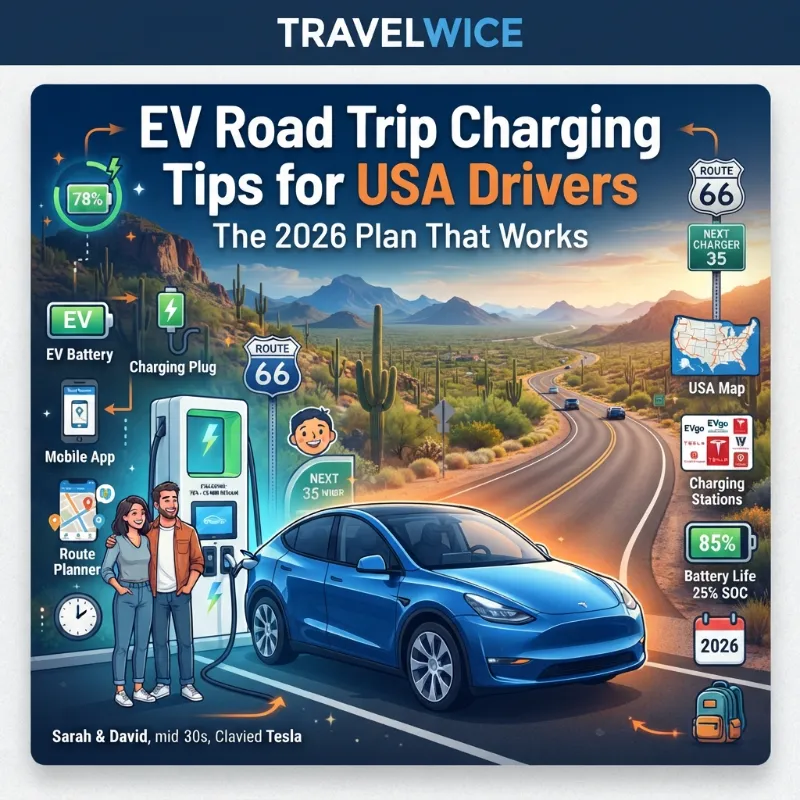
Great EV travel comes down to a few repeatable habits. First, charge from 10% to 80%, space your stops sensibly, and always know your next two chargers. Also, use a planner app, check live status, and keep a small buffer in the battery.
Thanks to steady growth, fast chargers now top 75,000 ports across the US. Still, a calm trip depends on your plan rather than luck. So, start with one short test drive, apply these EV road trip charging tips, and build up from there. For more planning help, visit our main road trip travel tips for the USA guide, or browse more at TravelWice.
References
- U.S. Department of Energy, Alternative Fuels Data Center, Station Locator: https://afdc.energy.gov/stations
- EV Infrastructure News, “US public EV charging network surpasses 250,000 charging ports” (June 17, 2026): https://www.evinfrastructurenews.com/ev-networks/us-public-ev-charging-network-surpasses-250-000-charging-ports
- EVChargingStations.com, “US Has 75,000+ Public DC Fast-Charging Stalls” (July 2026): https://evchargingstations.com/chargingnews/us-75000-dc-fast-charging/
- EVChargingStations.com, “Largest DC Fast-Charging Networks in the US: June 2026”: https://evchargingstations.com/chargingnews/dc-fast-charging-june-2026/
- Charged EVs, “Public DC fast EV charging rapidly expands in the US in Q1”: https://chargedevs.com/newswire/public-dc-fast-ev-charging-rapidly-expands-in-the-us-in-q1/
- Tesla Supercharger network: https://www.tesla.com/supercharger
- FuelEconomy.gov (U.S. EPA and DOE): https://www.fueleconomy.gov
- UFODrive, “Top Charging Tips for a Smooth EV Road Trip”: https://www.ufodrive.com/blog/top-charging-tips-for-a-smooth-ev-road-trip
- Jaco Superior Products, “EV Road Trip Guide: Charging, Range Anxiety, and What to Carry”: https://jacosuperiorproducts.com/blogs/news/ev-road-trip-guide-charging-range-anxiety-and-what-to-carry
- EVA, “On the Road This Summer: EV Road Trip Tips”: https://www.myeva.org/blog/on-the-road-this-summer-ev-road-trip-tips