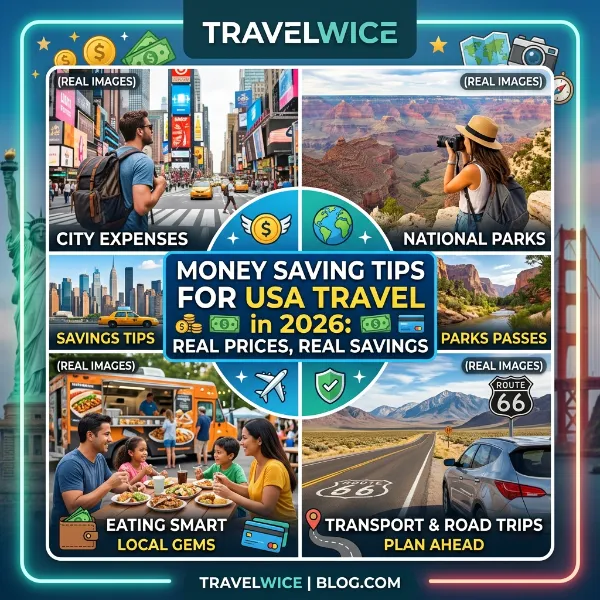

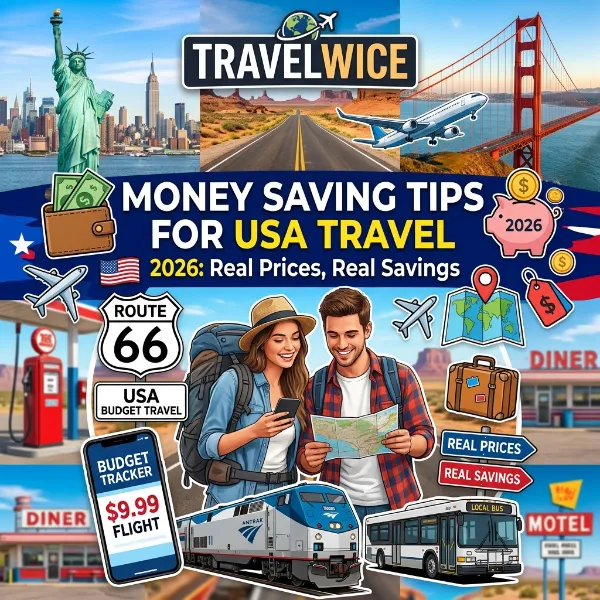
The United States is not cheap. Anyone who tells you otherwise has probably never priced a hotel room in Manhattan during peak season. But here is the good news: with the right money saving tips for USA travel, you can still see the Grand Canyon, walk the Vegas Strip, and eat your way through New Orleans without draining your savings account. Average US travel costs are running about 7% higher than last year, according to NerdWallet’s April 2026 Travel Price Index. The old advice your cousin gave you before her 2019 trip probably will not cut it anymore. This guide breaks down what things actually cost right now, plus the specific tricks that shave real dollars off your bill.
Key Takeaways
| Category | What You Need to Know | Typical Savings |
|---|---|---|
| Flights | Book Tuesdays; fares run about 14% below Sunday prices | Up to $50 to $100 per ticket |
| Hotels | Book during off-peak hours (early morning, weekends) | 5% to 8% off nightly rate |
| National Parks | Buy the $80 Annual Pass instead of paying per park | Pays off after 2 to 3 park visits |
| Food | Shop at warehouse clubs or ethnic grocery stores | 20% to 40% off groceries |
| Transport | Use public transit passes instead of rideshares | Often 50% or more per trip |
| Overall daily budget | Budget travelers spend $100 to $150/day; mid-range spend $200 to $350/day | Varies by city and season |
TL;DR: Flights are cheapest on Tuesdays. Hotels drop in price during off-peak booking windows. The single best value purchase for most itineraries is the $80 America the Beautiful Annual Pass. Cook a few of your own meals, use public transit over rideshares, and travel during shoulder season. Do this and your daily spend stays closer to $100 to $150 instead of $300-plus.
Why USA Travel Costs Feel Higher in 2026
If your last US trip was a few years ago, brace yourself. Hotels now average around $171 a night nationwide. A domestic flight averages roughly $290 to $390 round trip, depending on the route and season. Add in rising food prices and a tipping culture that expects 18% to 20% on every sit-down meal. It is easy to see why a simple week away can suddenly cost $1,800 or more per person.
There is also a new wrinkle for international visitors. As of January 1, 2026, the National Park Service introduced a $100 per-person surcharge for non-US residents at eleven of the most popular parks, including Zion and Bryce Canyon. That is on top of the standard entrance fee. This is one of those save money USA vacation tips that genuinely did not exist a couple of years ago, and now needs to be part of every international traveler’s planning.
Public Transport Tips in USA: How to Get Around Without Renting a Car
None of this means the trip is out of reach. It just means the old rules of thumb are outdated. A slightly smarter approach to planning matters more than ever. Before you land, it is worth reading up on general USA travel tips for beginners so the basics, like time zones, visa rules, and driving distances, do not catch you off guard.
USA Travel Budget Breakdown for 2026
Here is a realistic USA travel budget breakdown by travel style, based on current 2026 pricing across major destinations. These figures cover accommodation, food, local transport, and activities, but exclude international flights.
| Travel Style | Daily Budget (USD) | Daily Budget (GBP, approx.) | Daily Budget (EUR, approx.) | What It Gets You |
|---|---|---|---|---|
| Budget | $100 to $150 | £74 to £111 | €87 to €131 | Hostel or budget motel, groceries and street food, public transit, free attractions |
| Mid-range | $200 to $350 | £148 to £259 | €174 to €305 | 3-star hotel or private Airbnb, mix of restaurants, some paid tours, rental car days |
| Luxury | $500 to $925+ | £370 to £685+ | €435 to €805+ | 4 to 5-star hotel, fine dining, private transfers, premium experiences |
Exchange rates fluctuate daily, so treat the GBP and EUR columns as a rough guide rather than gospel. At the time of writing, 1 USD converts to roughly 0.74 GBP and 0.87 EUR. It is always worth checking a live currency converter before you finalize your budget.
Cultural Etiquette Tips for Visiting the USA
Here is a useful way to picture this. A solo traveler on a budget trip visiting New York, Los Angeles, and Miami over ten days might land somewhere around $1,200 to $1,500 total. The same route done mid-range could easily hit $3,000 to $3,500. The gap between those two numbers is almost entirely accommodation and dining choices, which happens to be exactly where most of the tips below focus.
Visa and ESTA Travel Tips for the USA (2026 Guide)
Money Saving Tips for USA Travel That Actually Move the Needle
These are the strategies that make the biggest dent in your total spend, organized by category so you can skip to whatever is eating your budget the most.
Book Smart: Flights and Timing
Flight timing genuinely matters more than most travelers assume. According to Expedia’s 2026 Air Hacks Report, Tuesday is the cheapest day to fly domestically in the US in 2026. Fares average 14% below Sunday’s prices, which are typically the most expensive. On top of that, flying during shoulder season, generally spring and fall rather than summer or the December holidays, keeps both airfares and hotel rates noticeably lower.
A few habits worth building into your routine:
- Set fare alerts on Google Flights and let the tool notify you when prices drop on your route.
- Book domestic flights roughly six to eight weeks ahead for the best mix of price and flexibility.
- Compare the total cost of flying between cities against renting a car for road segments under 500 miles. Driving is often cheaper for groups of two or more, according to recent vacation cost research.
- Check whether switching your departure airport, even to one an hour further away, unlocks a meaningfully cheaper fare.
If you are figuring out your route between cities once you land, our guide on the best travel apps for USA trips covers the tools that make last-minute fare and route comparisons painless.
First-Time USA Travel Checklist: What Not to Skip
Where to Sleep for Less
Accommodation is usually the single biggest line item in any USA travel budget breakdown, so this is where planning pays off fastest. A travel industry CEO recently pointed out that hotel pricing systems are dynamic. Booking during non-peak hours, think 6am or midnight on a weekend, can save 5% to 8% compared to booking during high-traffic browsing times. Tuesday mornings tend to be especially good, since many hotel pricing teams update their systems and release new deals right after reviewing the weekend’s bookings.
Beyond timing, consider these accommodation strategies:
- Stay just outside popular areas. A hotel near Yellowstone can run hundreds of dollars a night, while lodging in the nearby town of Cody, Wyoming, is often a fraction of the price.
- Mix accommodation types across a trip. Splurge on one or two nights somewhere memorable, then balance it with budget motels or an Airbnb for the rest.
- Join a hotel loyalty program even if you only travel a few times a year. Free cancellation and member-only rates add up over a trip.
- Look at vacation rentals for stays of four nights or longer. Cleaning fees get diluted across more nights, and kitchens cut your food costs too.
Eating Without Draining Your Wallet
Food is where a lot of travelers accidentally blow their budget. Restaurant prices in the US, once you add the expected 18% to 20% tip, add up fast. Budget-conscious meals at fast-casual spots or food trucks generally run $10 to $25. A sit-down dinner with tip can easily clear $40 to $50 per person.
One tip that experienced US travelers swear by: buy a short-term membership at a warehouse club like Costco or Sam’s Club if you are staying somewhere for a week or more. The membership fee, usually around $60, often pays for itself after a single big grocery run. Ethnic grocery stores, whether Indian, Asian, or Latino markets, also tend to undercut mainstream supermarkets by 20% to 40% on produce, spices, and grains. This is a genuinely underused save money USA vacation tips trick.
A simple, repeatable routine that keeps food costs down without feeling like deprivation:
- Cook breakfast and one other meal a day when your accommodation has a kitchen.
- Treat one “food city” meal, like BBQ in Memphis or beignets in New Orleans, as a planned splurge rather than an everyday habit.
- Order lunch specials instead of dinner menus at restaurants you want to try, since midday pricing is almost always lower.
Getting Around Cheaply
Rideshare apps are convenient, but they are also one of the fastest ways to quietly overspend in US cities. Most major metro areas run their own public transit systems. A weekly or day pass usually costs less than two or three rideshare trips combined. Our breakdown of public transport tips in the USA walks through how the subway, bus, and light rail systems work city by city, which is worth a read before you land.
Best Travel Apps for a USA Trip in 2026
For road trips, a fuel-tracking app like GasBuddy can steer you toward cheaper gas stations nearby. This matters because prices right off a highway exit or inside a national park are often noticeably marked up. It is also worth checking your route for toll roads ahead of time, particularly on the East Coast, since those small charges add up over a multi-day drive.
USA Travel Discounts and Passes You Should Know
This is genuinely one of the highest-leverage categories for USA travel discounts and passes, and it changed meaningfully at the start of 2026.
The Annual Pass for US Residents
The America the Beautiful Annual Pass remains $80 for US citizens and permanent residents. It covers entry to every fee-charging national park and federal recreation site for a full year. If you plan to visit more than two or three parks, this pass pays for itself almost immediately, since a single park entrance fee already runs $20 to $35 per vehicle.
The New Pass for Non-Residents
For non-US residents, the picture changed this year. A new $250 Non-Resident Annual Pass launched on January 1, 2026. It is now the only way to avoid a fresh $100 per-person surcharge at eleven high-visitation parks, including Zion, Bryce Canyon, and several others. You can check the exact list and current pricing directly on the National Park Service passes page, since park-specific rules can shift. Worth noting too: starting in 2026, the traditional fee-free entrance days, like Veterans Day and the NPS Birthday on August 25, apply only to US citizens and residents. International visitors should plan around standard fees on those dates.
Safety Tips for USA Travel Every Visitor Needs in 2026
City Sightseeing Passes
Beyond national parks, city sightseeing passes such as CityPASS or Go City can be worth it if you plan to hit three or more paid attractions in one city. They typically bundle admission at a meaningful discount compared to buying tickets individually. Always add up the individual ticket prices first though, since these passes only save money if you will realistically use most of what is included.
Save Money USA Vacation Tips From Real Travelers
Numbers on a page only tell half the story, so it helps to look at how real travelers actually pulled off a budget-friendly US trip.
A Three-Month Road Trip Under $5,000
One travel blogger documented spending under $5,000 total for a three-month road trip covering roughly 25 states with her sister, driving from Virginia to the West Coast in a Volkswagen. Their biggest lever was not flights or discounts. It was accommodation. They relied heavily on Couchsurfing hosts and national park campgrounds instead of hotels. This became both their largest saving and, by their own account, the most memorable part of the trip. You can read the full breakdown in this detailed USA road trip savings guide.
That same trip used the $80 annual national park pass after realizing they would visit more than three parks. They tracked gas prices with GasBuddy along the way, and split every cost using a shared spreadsheet and Venmo, which kept the money conversation simple between two travelers on a long trip. It is a good reminder that some of the best money-saving strategies are less about finding secret discount codes. They are more about choosing a slower, more local style of travel in the first place. Other seasoned travel writers echo similar themes. Practical roundups like this collection of travel money-saving strategies and this broader list of ways to cut travel costs reinforce that timing, accommodation choice, and food habits consistently matter more than any single coupon or app.
A Food-and-Music Weekend in New Orleans
Another example worth mentioning: a couple traveling from Dallas to New Orleans for a four-night food and music trip in spring 2026 spent close to $750 per day between the two of them once dining and live music tickets were factored in. This shows how quickly a “foodie” itinerary in a non-budget city can add up if you do not plan meals deliberately. The lesson is not to avoid food cities, but to budget for them honestly rather than assuming a flat daily average will hold everywhere you go.

Common Mistakes That Quietly Drain a USA Travel Budget
Even careful planners fall into a few predictable traps. Watch for these:
- Forgetting the tip math. Budgeting 15% instead of the current 18% to 20% norm leaves a gap that shows up fast across a multi-day trip.
- Skipping the packing list. Buying items at inflated tourist prices happens often. A quick look at what to pack for the USA before you leave home avoids last-minute purchases at 3x the normal price.
- Not knowing local tipping norms before arrival. Etiquette varies by service type, and our guide to tipping etiquette in the USA breaks down exactly what is expected where.
- Booking rideshares by default instead of checking transit options first. In cities like New York, Chicago, or San Francisco, this single habit change can cut daily transport costs by half or more.
- Ignoring resort fees and parking fees at check-in. These are rarely shown in the headline hotel price. A 15% buffer for taxes and hidden fees is a smart standard to plan around.
- Assuming free park entrance days apply to everyone. As of 2026, they apply only to US citizens and residents. International visitors need to check standard pricing on those dates instead.
Frequently Asked Questions
What is the cheapest way to travel around the USA in 2026? A mix of public transit within cities and occasional short domestic flights booked on Tuesdays tends to be cheapest overall. For multi-city routes under 500 miles, driving is usually more cost-effective than flying, especially for two or more travelers splitting fuel.
How much should I budget per day for a USA trip? Plan for $100 to $150 per day if you are traveling on a tight budget, $200 to $350 per day for a comfortable mid-range trip, and $500 or more per day for a luxury experience. Major cities like New York and San Francisco tend to run 20% to 30% above the national average.
Is the America the Beautiful Pass worth it? Yes, almost always, if you plan to visit more than two or three national parks in a year. At $80 for residents, it pays for itself quickly against individual entrance fees of $20 to $35 per vehicle. It also covers standard entry at over 2,000 federal recreation sites.
Do non-US residents pay more to enter national parks now? Yes. As of January 1, 2026, non-US residents aged 16 and older pay a $100 surcharge at eleven high-visitation parks unless they hold the $250 Non-Resident Annual Pass, which covers the surcharge for the pass holder and their travel party.
What is the best time of year to save money traveling in the USA? Shoulder season, generally April to May and September to October, tends to offer the best balance of good weather and lower prices on flights, hotels, and attractions compared to peak summer or the winter holidays.
How much should I tip in the USA to stay within budget? Plan for 18% to 20% at sit-down restaurants as the current standard, plus small cash tips for hotel housekeeping and tour guides. Building this into your daily food budget from the start avoids awkward surprises at checkout.
Quiz: Test Your USA Travel Money Smarts
1. Which day of the week typically has the cheapest domestic flights in the US in 2026? A) Sunday B) Tuesday C) Friday
Correct answer: B) Tuesday. Fares average about 14% below Sunday prices, according to Expedia’s Air Hacks Report.
2. How much does the America the Beautiful Resident Annual Pass cost in 2026? A) $50 B) $80 C) $150
Correct answer: B) $80. It has stayed the same for US citizens and permanent residents even as the non-resident pass increased.
3. What new fee applies to non-US residents at eleven national parks starting in 2026? A) A $100 per-person surcharge B) A $30 parking fee C) A $15 booking fee
Correct answer: A) A $100 per-person surcharge, unless the visitor holds the $250 Non-Resident Annual Pass.
4. According to recent hotel booking research, when is the best time to book a hotel for a lower price? A) Friday afternoon B) During non-peak hours like early morning or midnight on weekends C) The same day you check in
Correct answer: B) During non-peak hours. This can save 5% to 8% compared to peak browsing times.
5. What is the standard tip percentage expected at sit-down US restaurants in 2026? A) 10% to 12% B) 18% to 20% C) 25% to 30%
Correct answer: B) 18% to 20%. This has become the baseline for satisfactory service at most sit-down restaurants.
Conclusion
Traveling the USA on a budget in 2026 is absolutely doable. It does require updated numbers and a bit of strategy rather than outdated advice from a few years back. Book flights on Tuesdays, sleep smart by mixing accommodation types and timing your bookings, lean on the $80 national park pass if parks are on your list, and cook a few of your own meals along the way. None of these tips require sacrificing the trip you actually want. They just require spending on purpose instead of by accident, which, in the end, is what good travel planning has always come down to.
References
- NerdWallet, Money-Saving Travel Tips
- National Park Service, Entrance Passes
- Caroline Rose Travel, 13 Ways to Save a Lot of Money on a USA Road Trip (link not verified — confirm URL before publishing)
- Oceans Luxury Vacations, Money Saving Tips for Travel (link not verified — confirm URL before publishing)
- Global Debauchery, 30 Ways to Save Money on Travel (link