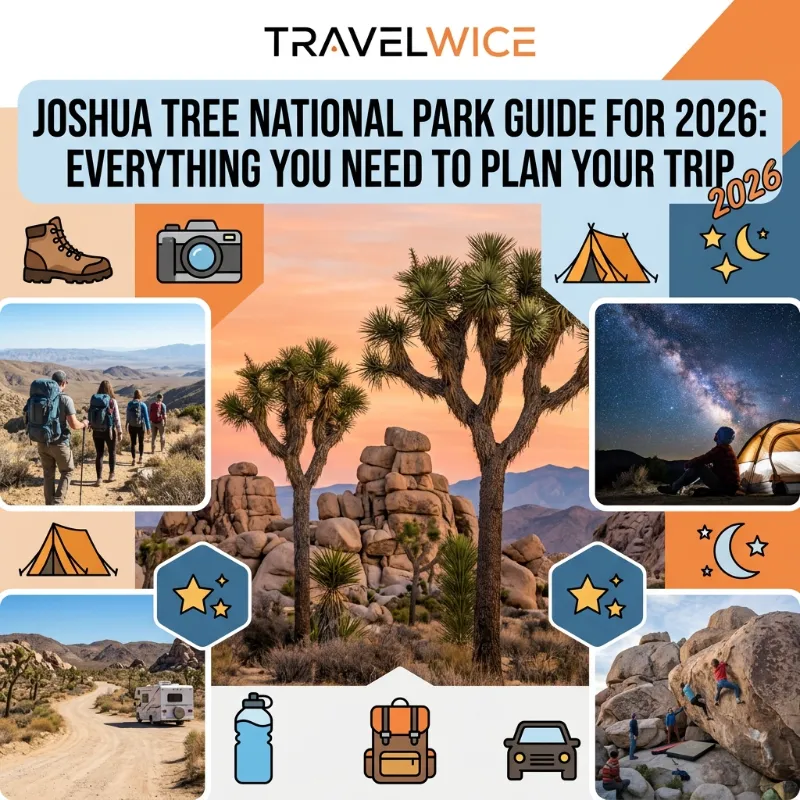

The first time you round a bend on Park Boulevard and see a field of Joshua trees rising against a pile of pink granite, you understand why photographers, climbers and burned out city dwellers keep coming back to this stretch of the Mojave. This Joshua Tree National Park guide pulls together the timing, trail and stargazing details you actually need for a 2026 trip, based on current park pricing, real trail data and lessons learned from multiple visits across every season. Whether you have one packed day or a long weekend, the goal here is simple: help you skip the guesswork and get straight to the good part.
Key Takeaways
| What You Need to Know | Quick Answer |
|---|---|
| Best time to visit | October to April, with October and March as the sweet spots |
| Entrance fee | $30 per vehicle (7 days), $55 annual park pass |
| Ideal trip length | 1 to 3 days, though a single day works if planned well |
| Must do hike | Ryan Mountain Trail, 3 miles round trip, 360 degree summit view |
| Best stargazing spots | Quail Springs, Hidden Valley, Cap Rock, Ryan Mountain and Pinto Basin |
| Nearest cities | 140 miles from Los Angeles, 175 miles from San Diego |
| Cell service | Very limited to none inside the park |
TL;DR
- Aim for October through April, since summer highs regularly cross 100°F and can turn a hike dangerous.
- One day is enough for the highlights, but two or three days lets you actually breathe and hike the longer trails.
- Book campsites months ahead for spring weekends, and bring every drop of water and every calorie you plan to use, because the park sells none of it.
Joshua Tree National Park at a Glance
Before diving into logistics, it helps to understand what you are actually walking into. Joshua Tree straddles two deserts, the Mojave and the Colorado, and that meeting point is exactly why the scenery shifts so dramatically as you drive across the park.
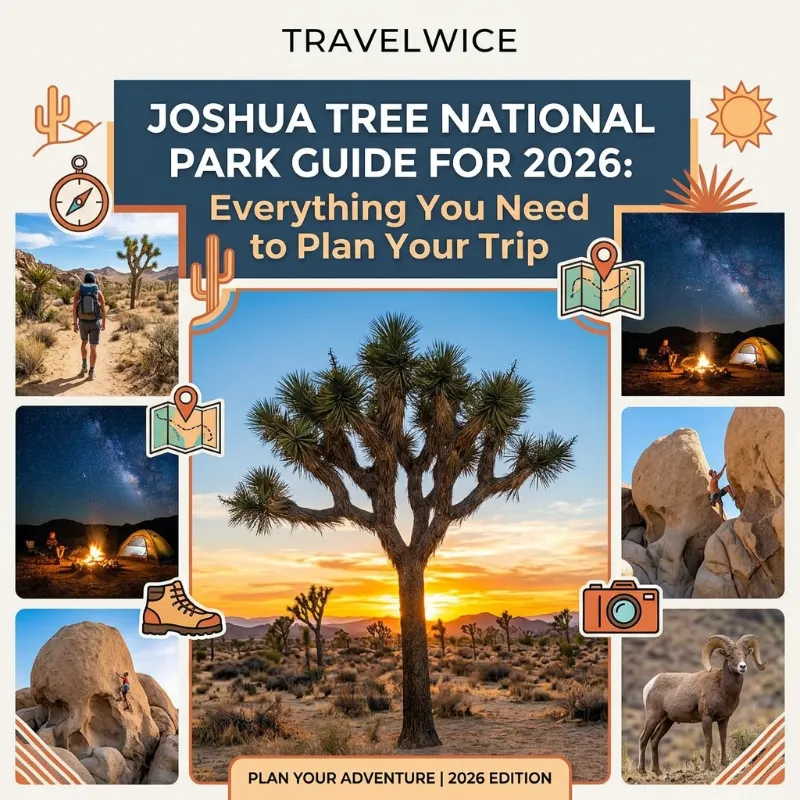
According to the National Park Service, the park covers roughly 800,000 acres and draws close to three million visitors a year, making it one of the busiest desert parks in the country (NPS Plan Your Visit). There are no gas stations, restaurants or hotels inside the boundary, and water is only available at a handful of visitor centers, so you plan your supplies the way you would for a backcountry trip, not a normal day out.
| Fact | Detail |
|---|---|
| Location | Southern California, about 140 miles east of Los Angeles |
| Size | Roughly 800,000 acres (1,235 square miles) |
| Established | National monument in 1936, national park status in 1994 |
| Entrances | West Entrance (near the town of Joshua Tree), North Entrance (Twentynine Palms) and South Entrance (Cottonwood, off I-10) |
| Entrance fee | $30 per vehicle, $25 per motorcycle, $15 per person on foot or bike, valid for 7 days |
| Annual pass | $55, or use the $80 America the Beautiful Pass for all federal lands |
| Hours | Open 24 hours a day, every day of the year |
If you are folding this trip into a wider California road trip, our California travel guide for 2026 breaks down how to string Joshua Tree together with the coast and the Sierra without wasting a single driving day.
Why the Joshua Tree Itself Looks So Strange
Before you plan a single hike, it helps to know a bit about the plant this whole park is named after, since it genuinely shapes how the landscape looks and feels. The Joshua tree, or Yucca brevifolia, is not actually a tree at all but a member of the yucca family, and its twisted, upraised limbs reportedly earned the name from Mormon settlers in the 1800s who thought the branches resembled the biblical figure Joshua reaching toward the sky.
These plants grow painfully slowly, often less than three inches a year, which means the tallest specimens you see towering over the trail can be well over a century old. Climate researchers have flagged rising desert temperatures as a real threat to the species’ long-term range within the park, so seeing a mature Joshua tree forest today is genuinely a snapshot worth appreciating rather than something to take for granted.
The rock formations scattered throughout the park are just as much a part of the story. Most of what you are climbing over or photographing is monzogranite, a coarse granite that formed underground roughly 100 million years ago and was gradually exposed as erosion stripped away the softer rock above it. That slow weathering process is exactly what produced the rounded, stacked boulder piles around Jumbo Rocks and Hidden Valley, and understanding it makes the landscape feel a little less alien and a little more like a very long, very patient geology lesson.
Lake Tahoe Travel Guide 2026 What to Know Before You Go
The Best Time to Visit Joshua Tree
This is the single most common question we get, and honestly, it deserves a real answer instead of a vague “anytime is great.” Because the park sits in the high desert, temperature swings between seasons are extreme, and picking the wrong month can turn a dream trip into a genuinely uncomfortable one.
Spring, running roughly from March through May, is the showstopper. Highs sit between 74°F and 86°F, wildflowers bloom across the desert floor in good rain years, and the light for photography is hard to beat. However, this is also the busiest season, so campgrounds fill up weeks in advance and trailhead parking lots overflow by mid-morning on weekends.
Summer, from June through September, is brutal. Daytime highs regularly climb past 100°F, and midday hiking becomes genuinely dangerous without serious heat precautions. That said, if stargazing is your priority, summer nights offer clear, dry skies with far fewer crowds, so an early or late-in-the-day visit built entirely around sunset and sunrise can still work.
Fall, especially October and the first half of November, is our personal pick for the best all-around window. Highs settle into the mid-70s to upper 80s, nights turn crisp, and the golden late-day light across the boulders is stunning. Crowds thin out noticeably compared to spring, so you get better parking, quieter trails and a much calmer overall pace.
Winter brings cooler days in the mid-50s to mid-60s and genuinely cold nights that can dip below freezing, especially at higher elevations inside the park. It is a fantastic season for solitude and clear-headed hiking, just pack layers and a proper sleeping bag if you are camping.
| Season | Typical Highs | Crowd Level | Best For |
|---|---|---|---|
| Spring (Mar to May) | 74°F to 86°F | Heaviest | Wildflowers, hiking, photography |
| Summer (Jun to Sep) | 95°F to 105°F+ | Lightest | Stargazing only, early or late hours |
| Fall (Oct to Nov) | 75°F to 88°F | Moderate | Best overall balance |
| Winter (Dec to Feb) | 55°F to 65°F | Light to moderate | Solitude, cool weather hiking |
For a wider view of timing across the whole state, our guide on the best time to visit California is a useful companion, since it helps you decide whether to pair Joshua Tree with a coastal leg or a mountain leg depending on the month.
Your Joshua Tree Itinerary for 1 Day
Plenty of visitors only have a single day to spend here, often as a stop between Los Angeles and Palm Springs or Las Vegas, and honestly, a well-planned Joshua Tree itinerary for 1 day can still deliver the park’s greatest hits. The key is starting early and picking stops that do not eat your whole afternoon.
Here is a realistic, tested plan for entering through the West Entrance near the town of Joshua Tree.
- 7:00 to 8:00 AM: Arrive early. Fuel up and grab breakfast in the town of Joshua Tree before entering, since there are no services once you cross into the park. Early arrival also means an actual parking spot at the popular stops.
- 8:00 to 9:00 AM: Hidden Valley Nature Trail. This easy one-mile loop winds through a boulder-ringed valley and gives you a quick, complete sample of the park’s geology and Joshua trees.
- 9:15 to 10:15 AM: Barker Dam Trail. A gentle 1.1-mile loop that passes an old cattlemen’s dam and, in wetter months, a reflective pool that makes for one of the park’s best photo spots.
- 10:30 AM to 12:00 PM: Skull Rock and Jumbo Rocks. Walk the short Skull Rock loop, then wander through the Jumbo Rocks area, where house-sized boulders create a natural playground worth exploring on foot.
- 12:00 to 1:00 PM: Lunch and Cholla Cactus Garden. Eat a packed lunch at a picnic area, then drive south to the Cholla Cactus Garden for a quick 0.25-mile loop through a field of glowing “teddy bear” cholla, best photographed in soft afternoon light.
- 1:30 to 3:30 PM: Ryan Mountain (optional, weather permitting). If you still have energy and it is not peak summer heat, this 3-mile round trip climbs roughly 1,000 feet to the best panoramic view in the park.
- 5:00 to 6:00 PM: Keys View at sunset. Finish your day at Keys View, a short paved walk that overlooks the Coachella Valley, the San Andreas Fault and, on a clear day, all the way to Mexico.
If you can stretch this into two or three days, you will have room for longer hikes like Lost Palms Oasis and a proper night of stargazing, so consider pairing your trip with a stay in nearby Palm Springs or a night of camping inside the park itself.
Best Time to Visit California by Region A Local’s Month-by-Month Guide
Joshua Tree Hiking Trails Guide
Hiking is really the heart of a Joshua Tree visit, and the range here goes from ten-minute strolls to full-day treks. This Joshua Tree hiking trails guide focuses on the routes that deliver the most reward for the effort, based on distance, elevation and what you actually see along the way.
| Trail | Distance | Difficulty | Time | Highlight |
|---|---|---|---|---|
| Hidden Valley Trail | 1.0 mi loop | Easy | 30 to 45 min | Boulder-ringed valley, classic climbing scenery |
| Barker Dam Trail | 1.1 mi loop | Easy | 30 to 45 min | Historic dam, seasonal reflecting pool |
| Skull Rock Trail | 1.7 mi loop | Easy | 45 min | Namesake rock formation, easy family hike |
| Cholla Cactus Garden | 0.25 mi loop | Easy | 15 min | Dense field of glowing cholla cactus |
| Ryan Mountain Trail | 3.0 mi RT | Moderate to hard | 2 to 3 hrs | 360 degree summit view, highest accessible peak |
| Lost Horse Mine Trail | 4.0 mi RT | Moderate | 2 to 3 hrs | Well-preserved 1890s gold mine ruins |
| 49 Palms Oasis Trail | 3.0 mi RT | Moderate | 2 to 3 hrs | Rare native fan palm oasis |
| Lost Palms Oasis Trail | 7.2 mi RT | Strenuous | 4 to 5 hrs | Largest palm oasis in the park |
| Boy Scout Trail | 8.0 mi one way | Hard | 5 to 7 hrs | Backcountry route through Wonderland of Rocks |
If you only have time for one hike, make it Ryan Mountain. The climb involves a steady set of stone and dirt steps, and the summit rewards you with a view stretching across both the Mojave and Colorado deserts at once, arguably the single best vantage point in the entire park.
For anyone chasing solitude, the Lost Palms Oasis Trail near Cottonwood Spring rarely sees the crowds that pile up around Hidden Valley, and the destination, a canyon full of native fan palms, feels like a genuine desert secret. Fellow travel writers at Desk to Dirtbag have written about how much of Joshua Tree’s character comes from its climbing community around Hidden Valley Campground, and that same laid-back, dirtbag energy carries over onto the quieter trails too.
Bring more water than you think you need on every hike here, roughly one liter per hour of activity in cooler months and considerably more in the heat, since there is no reliable water source anywhere on the trail system.
Joshua Tree Stargazing Tips for Clear Desert Nights
Ask anyone who has camped here and they will tell you the night sky steals the show almost as much as the trees do. Joshua Tree is a designated International Dark Sky Park, and on a clear, moonless night you can genuinely see the core of the Milky Way with the naked eye.
The National Park Service designates four official stargazing areas: the parking lots at Quail Springs, Hidden Valley, Cap Rock and Ryan Mountain (NPS Stargazing Guide). Beyond those, the Pinto Basin area on the park’s eastern side has the darkest skies of all, since it sits farthest from the light pollution drifting in from Palm Springs and the Coachella Valley.
A few Joshua Tree stargazing tips worth actually following:
- Check the moon phase before you go. A new moon gives you the darkest sky and the clearest view of the Milky Way, while a full moon washes out fainter stars almost completely.
- Bring a red-light flashlight. A red-tinted beam protects your night vision far better than a standard white flashlight, and rangers specifically recommend one.
- Stay within 20 feet of your vehicle if you are not camping, both for safety and because NPS guidance discourages wandering off trail in the dark.
- Dress warmer than you expect. Desert nights drop fast, sometimes 30 to 40 degrees below the daytime high, so pack a proper layer even after a hot afternoon.
- Time it around events. The park’s Night Sky Festival happens each October and pairs astronomy talks with genuinely excellent viewing conditions.
Travel blogger Saltwater Vibes has documented similar advice from personal trips, noting how much the experience improves once you get away from the main road and let your eyes properly adjust to the dark, usually after about 20 minutes without checking your phone.
Where to Stay: Camping vs Nearby Towns
You have two realistic choices here: camp inside the park or base yourself in one of the small towns just outside it. Both work well, and the right pick really comes down to how much comfort you need after a long day of hiking.
Camping inside the park puts you steps away from prime stargazing and lets you catch sunrise without a drive. Popular options include Jumbo Rocks, Hidden Valley and Black Rock, though reservable sites through the National Park Service booking system fill up months ahead for spring weekends, so plan early. Prices for most campgrounds sit around $25 to $35 per night as of the park’s most recent fee update.
Staying outside the park in Joshua Tree, Yucca Valley or Twentynine Palms gives you access to restaurants, real showers and a wider range of lodging, from budget motels to design-forward Airbnbs with hot tubs. This route also makes sense if you plan to pair your trip with nearby Palm Springs for a spa day or two.
If you go the camping route, book through the National Park Service’s official reservation system as early as your dates allow, since Jumbo Rocks and Hidden Valley routinely sell out for spring and fall weekends within minutes of opening. First-come, first-served sites like White Tank and Belle exist for spontaneous trips, but arriving by early afternoon on a Friday is basically mandatory if you want a shot at a spot during peak season.
A Quick Note on Photography
Because so much of Joshua Tree’s appeal is visual, it is worth planning your hikes around light rather than just distance. The hour right after sunrise and the hour before sunset, often called golden hour, turns the granite boulders a deep orange and makes the Joshua trees themselves look almost backlit and glowing. Keys View and Cholla Cactus Garden are consistently the two most photographed spots in the park for exactly this reason, and both are easy enough to reach that you can fit them into even a rushed one-day itinerary.
Combine Joshua Tree With More of California
Because Joshua Tree sits within a few hours of some of California’s biggest draws, it rarely stands alone on an itinerary. Plenty of visitors treat it as one stop on a longer loop that includes Los Angeles, San Diego or even a run north toward the Sierra.
If you are flying into LAX first, our guide to things to do in Los Angeles covers how to spend a day or two in the city before heading east into the desert. Coming from the south, our things to do in San Diego guide pairs well with a Joshua Tree add-on, since the drive between the two takes under three hours.
For travelers building a bigger California loop, consider bookending the desert with something completely different. Our Yosemite National Park travel guide and our Big Sur road trip guide both make excellent contrasts to Joshua Tree’s stark desert landscape, while a detour through Napa Valley wine country or a stop at Lake Tahoe rounds out a two-week trip nicely if you have the time. Finally, if San Francisco fits your route, our things to do in San Francisco guide helps you plan the northern leg of the journey.
Practical Tips From Actual Trips
A handful of lessons tend to repeat themselves on every Joshua Tree trip, and they are worth hearing before you go rather than learning the hard way.
- Fill your gas tank before entering, since there are no fuel stations anywhere inside the park boundary.
- Download offline maps in advance, because cell service disappears almost entirely once you cross into the park.
- Pack more water than feels necessary, at least one gallon per person per day, and double that in summer.
- Watch for wildlife on the road at dawn and dusk, especially coyotes and the occasional desert bighorn sheep near Barker Dam.
- Respect the desert tortoise speed limits posted throughout the park, since these animals are federally protected and slow-moving.
Quick Joshua Tree National Park Guide Checklist
Before you head out the door, run through this short list so nothing gets left behind:
- Full tank of gas and cash or card for the entrance fee.
- At least one gallon of water per person, plus extra for hiking.
- Sun protection: hat, sunglasses and sunscreen, even in cooler months.
- A downloaded offline map, since you will lose signal almost immediately.
- Layers for the temperature swing between midday heat and nighttime cold.
Test Your Joshua Tree Knowledge
Try this short quiz before you go, just for fun, to see how much of this Joshua Tree National Park guide actually stuck.
1. What is the standard entrance fee for a private vehicle? A) $15 B) $30 C) $55 D) $70
2. Which season generally offers the best overall balance of weather and crowds? A) Summer B) Winter C) Fall D) Monsoon season
3. Which of the following are official NPS-designated stargazing areas? (Select all that apply) A) Quail Springs B) Hidden Valley C) The West Entrance parking lot D) Cap Rock
4. Which hike leads to the highest accessible summit in the park? A) Barker Dam Trail B) Ryan Mountain Trail C) Cholla Cactus Garden D) Skull Rock Trail
5. Which of these items should you pack for almost any Joshua Tree visit? (Select all that apply) A) Extra water B) Offline maps C) Snow chains D) Sun protection
Correct answers: 1) B, 2) C, 3) A, B and D, 4) B, 5) A, B and D
Frequently Asked Questions
How many days do you need in Joshua Tree National Park? One day covers the highlights, but two to three days gives you time for longer hikes, a proper night of stargazing and a slower pace overall.
Is Joshua Tree National Park worth visiting? Yes, especially if you enjoy hiking, rock formations or dark skies. The mix of otherworldly scenery and easy access from Los Angeles or Palm Springs makes it one of the more rewarding day trips in Southern California.
What is the best month to visit Joshua Tree? October tends to edge out the rest of the year, thanks to comfortable daytime highs, cool nights and noticeably thinner crowds compared to spring.
Can you see stars in Joshua Tree year round? Yes, though a clear, moonless night gives you the best results. Summer nights are actually among the clearest, even though daytime heat rules out most other activities.
Is there cell service inside the park? Reception is extremely limited to nonexistent throughout most of the park, so download maps and let someone know your plans before you head in.
Are pets allowed on Joshua Tree trails? Pets are allowed in developed areas and campgrounds but not on hiking trails, largely to protect native wildlife like the desert tortoise.
Final Thoughts on This Joshua Tree National Park Guide
Joshua Tree rewards a little planning far more than most parks do. Get the timing right, pick two or three hikes that match your energy level, and save one evening for the sky, and you will walk away with the kind of trip that photos genuinely cannot capture. Whether you are squeezing in a single day between Los Angeles and Palm Springs or building a full desert weekend around it, the park delivers on nearly every front, provided you come prepared for its heat, its silence and its complete lack of cell signal.
References
- National Park Service, Joshua Tree National Park, Plan Your Visit
- National Park Service, Stargazing at Joshua Tree
- National Park Service, Fees and Passes
- Saltwater Vibes, Joshua Tree Travel Guide
- Desk to Dirtbag, Guide to Joshua Tree National Park