
So you finally booked that ticket to America. Good for you. 2026 might be the most exciting year to land on US soil in a decade. The FIFA World Cup is rolling through several host cities, and airports are already bracing for record crowds. Before you get swept up in the excitement, you need a few solid usa travel tips for beginners. This country does not work quite like the one you left behind. A visa system that changed its price twice in the last twelve months. A tipping culture that catches almost every newcomer off guard. These small details separate a smooth trip from a stressful one.
Tipping Etiquette in the USA A Full Guide
This guide comes from years of watching first-timers make the same avoidable errors. It also draws on firsthand travel through more than a dozen states. Below, you will find the exact numbers, prices, and rules that matter right now. Not recycled advice from five years ago.
Key Takeaways at a Glance
| Topic | What You Need to Know |
|---|---|
| Entry document | ESTA costs $40.27 (as of January 2026), valid 2 years, allows stays up to 90 days |
| Daily budget | $75 to $100/day (budget), $100 to $180/day (mid-range), $200+/day (comfortable) |
| Tipping | 15 to 20% at restaurants, $1 to $2 per drink at bars, 15 to 20% for rideshares |
| Best time to visit | Spring (April to May) and fall (September to October) for mild weather and fewer crowds |
| Biggest first-timer mistake | Underestimating distances between cities and overpacking the itinerary |
| Currency exchange (2026) | Roughly £1 = $1.35 and €1 = $1.16, though rates shift weekly |
TL;DR
Apply for your ESTA early. It costs $40.27 right now and lasts two years.Budget realistically. Even a modest trip runs $75 to $100 a day.Tipping is not optional in restaurants and bars. Skipping it is genuinely rude here.Distances are enormous. Pick two or three regions instead of the whole country.
What to Know Before Visiting USA: Entry Rules and Paperwork
If you only remember one section, make it this one. Getting the paperwork wrong is the fastest way to ruin a trip before it starts. Most travelers from the UK and the EU enter under the Visa Waiver Program. That means applying online for an ESTA rather than a full visa. As of January 1, 2026, that ESTA costs $40.27. It stays valid for two years, or until your passport expires, whichever comes first, according to US Customs and Border Protection.
Why the Fees Keep Changing
That fee jumped sharply in 2025. It nearly doubled from its old rate of $21 after new legislation restructured how the system is funded. It now also includes a small annual inflation adjustment. Travelers arriving by land from Canada or Mexico fill out an I-94 form too, which now costs $30 instead of the old $6. None of these fees are large alone. Together, though, they add up. Factor an extra $50 to $70 per traveler into your pre-trip budget.
Money Saving Tips for USA Travel in 2026: Real Prices, Real Savings
Getting the Paperwork Right
A few practical points that trip people up constantly:
- Apply for your ESTA as soon as you book flights, not the week before. Processing can occasionally stretch beyond the usual couple of hours.
- Carry proof of onward travel, a hotel booking, and evidence of funds. The immigration officer at the airport still has the final say on entry, ESTA or not.
- Double check whether your home country sits within the 42 nations covered by the Visa Waiver Program. Travelers outside that list need a full US visa instead.
If you want the official rundown of entry requirements, the US State Department’s travel page is worth a bookmark. The official ESTA application portal is the only place you should ever pay that fee. Skip any third-party site that charges more.
Cultural Etiquette Tips for Visiting the USA
USA Travel Checklist for Beginners
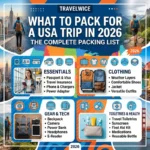
Once your paperwork sorts itself out, build a proper packing and prep list. Nothing wrecks a first trip faster than realizing at the airport that a plug adapter got left at home. Use this as your baseline, then adjust for your specific route.
Documents and money:
- Passport valid for at least six months beyond your travel dates
- Printed and digital copies of your ESTA or visa approval
- Travel insurance policy number and emergency contact saved to your phone
- A debit or credit card with no foreign transaction fees
- Some cash in small bills, since tipping is often expected in cash
Practical gear:
- Type A plug adapter, since the US runs on 120V with a two or three pin outlet
- Comfortable walking shoes, because American cities favor driving over strolling
- Layers of clothing, since indoor air conditioning runs colder than most Europeans expect
- An eSIM or local SIM card for data, since navigation apps and rideshares depend on it
Before you fly:
- Apply for Global Entry if you plan to visit more than once. It costs $100 for five years and speeds up airport immigration lines.
- Check hurricane season, which runs June through November, if your route touches Florida or the Gulf Coast.
- Book national park lodges months ahead. Popular spots like Yosemite can sell out a year in advance.
For a longer, printable version of this list, our team keeps an updated packing breakdown over at /usa-packing-list. It covers seasonal variations by region.
First Time Visiting USA Tips: The Cultural Stuff Nobody Warns You About
Here is where most guides get lazy and just say “be respectful of local culture.” That honestly tells you nothing. Real first time visiting usa tips need specifics. So here are the things that actually surprise British and European travelers.
What to Pack for a USA Trip in 2026 The Complete Packing List
How Americans Communicate
Americans are direct and often loud in a friendly way. They also strike up conversation with total strangers easily. Do not read this as rudeness or aggression, since it usually is not meant that way. Small talk with a barista or a rideshare driver is completely normal. Staying silent can actually come across as cold.
Measurements will throw you off immediately. Distances appear in miles, weight in pounds, and temperature in Fahrenheit. A forecast reading “95 degrees” is not a typo. It is a genuinely hot day. Portion sizes at restaurants are also famously large, often enough for two smaller meals. Sharing a plate is completely acceptable, and nobody will judge you for it.
Public Transport Tips in USA: How to Get Around Without Renting a Car
The Tipping Culture You Need to Understand
Tipping deserves its own section, because it genuinely confuses almost every first-time visitor. Many service workers, particularly restaurant servers, are legally paid below standard minimum wage. Tips are assumed to make up the difference. Skipping a tip is not a minor faux pas. It directly affects someone’s paycheck. Here is the breakdown that matters:
| Service | Typical Tip |
|---|---|
| Sit-down restaurant | 15 to 20% of the bill |
| Bartender | $1 to $2 per drink |
| Taxi or rideshare driver | 15 to 20% of the fare |
| Hotel porter | $2 per bag |
| Hairdresser | 15 to 20% |
Also worth knowing before you visit USA: prices on shelves and menus almost always exclude sales tax. Tax varies by state and gets added at the register. A $20 item might ring up closer to $21.50, depending on where you are. Never assume the sticker price is final.
Visa and ESTA Travel Tips for the USA (2026 Guide)
USA Travel Mistakes to Avoid on Your First Trip
Every seasoned traveler has a story about a mistake made on their first US trip. Honestly, most of these usa travel mistakes to avoid are entirely predictable once you know what to look for.
Planning and Logistics Errors
Underestimating the size of the country. New York, Los Angeles, and Miami sound like a reasonable week-long loop on paper. They actually sit thousands of miles apart. A flight between New York and Los Angeles takes around six hours and costs roughly $150 to $400. The equivalent train ride takes three full days and can cost $800 or more for a sleeper berth. Pick one or two regions per trip instead.
First-Time USA Travel Checklist: What Not to Skip
Skipping travel insurance. Healthcare in the United States is excellent but brutally expensive without coverage. There are documented cases of tourists facing hospital bills well over $100,000 after a single accident. Even a short ambulance ride can run into four figures. Do not board that flight without a policy, no matter how healthy you feel.
Overpacking the itinerary. Cramming five cities into seven days usually means spending more time in transit than actually enjoying anywhere. Build in slower days, especially around national parks. It tends to produce far better memories than a packed checklist.
Best Travel Apps for a USA Trip in 2026
Ignoring regional natural disaster risks. Hurricane season runs June through November along the Gulf Coast and Atlantic seaboard. The central states see over a thousand tornadoes annually during spring and early summer. Neither should scare you off. Checking seasonal risk for your specific route is simple due diligence.
Everyday Habits That Trip People Up
Assuming public transport works everywhere. Big cities like New York, Chicago, and Boston have solid subway systems. Plenty of national parks and smaller towns essentially require a rental car to get around. Research your specific destination first.
Not researching tipping in advance. As covered above, this embarrassment repeats itself constantly among European visitors. They simply are not used to a tip-dependent service industry.
Forgetting that prices exclude tax. Sticker shock at the register is one of the most common small frustrations first-timers report. The displayed price rarely matches what actually gets charged.
Safety Tips for USA Travel Every Visitor Needs in 2026
Booking the cheapest flight with a tight connection. US domestic connections can involve long walks between terminals. A missed connection on a short trip can eat an entire day. Build in extra buffer time, especially at major hubs.
For more region-specific pitfalls, our detailed breakdown at /first-trip-usa-mistakes covers city-by-city gotchas we have collected from readers over the years.
Money, Budgets, and What Things Actually Cost in 2026
Budgeting for the US confuses a lot of first-time visitors, because prices vary wildly by city and region. As a rough guide based on current 2026 pricing, here is what different travel styles actually cost per day, per person, excluding flights.
| Travel Style | Daily Budget (USD) | What It Typically Includes |
|---|---|---|
| Backpacker | $75 to $100 | Hostel bed, public transport, cheap eats, free activities |
| Mid-range | $100 to $180 | Budget hotel or Airbnb, one paid activity, casual restaurants |
| Comfortable | $200 to $300+ | Nicer hotel, rental car, mix of paid tours and dining out |
A few concrete price anchors worth remembering. A hostel bed generally runs $30 to $50 a night. A modest hotel room averages $100 to $150, depending on the city. A casual sit-down meal for one costs $20 to $30 before tip. National park lodges are pricier, often starting around $200 a night, but the locations are usually worth it.
For currency, exchange rates shift weekly. As of mid-2026, roughly £1 converts to about $1.35 and €1 to about $1.16. Always check a live rate before you travel rather than trusting a figure from a blog post. Even small swings affect a multi-week trip’s total cost.
Carrying two different cards is smart, since not every ATM or terminal cooperates with every bank. Contactless payment is now common in most cities. Smaller towns and older establishments may still expect a chip card or cash.
Best Time to Visit the USA and What the Weather Actually Looks Like
Because the country spans nearly every climate zone on earth, “best time to visit” genuinely depends on your route. Spring, roughly April through May, and fall, September through October, tend to offer the mildest weather. Crowds are thinner too across most of the mainland. Summer brings peak crowds and peak prices almost everywhere. Places like Las Vegas also see genuinely brutal heat, with highs regularly clearing 100°F (38°C).
| City | Average Summer High | Average Winter High |
|---|---|---|
| New York City | 77°F (25°C) | 36°F (2°C) |
| Los Angeles | 72°F (22°C) | 55°F (13°C) |
| Las Vegas | 93°F (34°C) | 46°F (8°C) |
| Orlando | 82°F (28°C) | 59°F (15°C) |
| Anchorage, Alaska | 82°F (26°C) | 18°F (-8°C) |
If your trip includes 2026’s World Cup host cities, expect hotel prices to spike around match dates. Book accommodation well ahead if your travel window overlaps with the tournament schedule.
Getting Around: Transport Realities for First-Timers
Renting a car makes sense the moment your itinerary includes national parks or smaller towns. It also helps anywhere outside a handful of major cities with strong public transport. Companies allow different pickup and drop-off cities, which is handy for road trips, though it usually comes with an extra fee.
Within big cities, subways and buses are cheap and generally reliable. This is especially true in New York, Chicago, Boston, and Washington DC. Rideshare apps like Uber and Lyft are everywhere too. They tend to be the easiest option for shorter hops, especially late at night.
For longer distances, domestic flights are usually cheaper and dramatically faster than trains or buses. Amtrak trains are scenic and comfortable but slow for cross-country routes. Long-distance buses remain the cheapest option, but comfort is a real trade-off. Whatever you choose, book at least a few weeks ahead for the best fares.
Safety, Health, and a Word on Insurance
The US carries a reputation for higher crime rates than much of Western Europe. The reality for tourists sticking to typical visitor areas is far calmer than headlines suggest. Basic common sense covers most of what you need. Stay aware in busy areas, avoid poorly lit streets at night, and keep valuables out of sight in parked cars.
Healthcare is where real caution matters. Even a routine doctor’s visit without insurance can run $50 to $100 before tests. Anything serious escalates fast from there. Comprehensive travel insurance is genuinely non-negotiable, not just a nice extra. Double check that your policy covers activities like hiking or skiing if those are on your itinerary.
Tap water is safe to drink across the vast majority of the country. There is no need to stockpile bottled water unless you are heading somewhere genuinely remote.
USA Travel Planning Guide 2026: Building Your First Itinerary
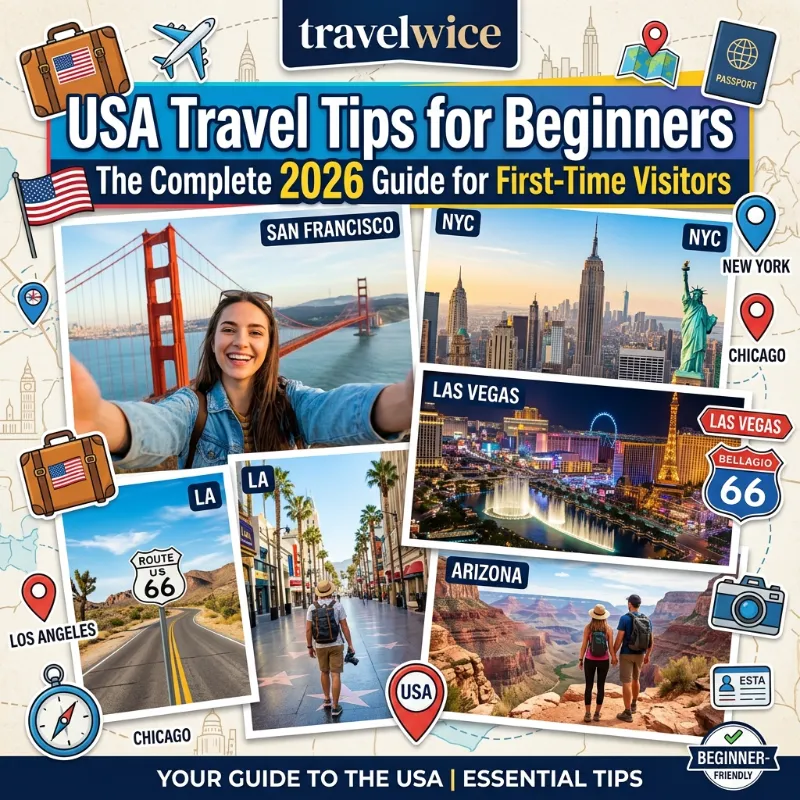
For a solid first trip, most experienced travelers recommend anchoring your plan around one or two regions. Avoid a coast-to-coast sprint. A few combinations consistently work well for beginners:
- East Coast classic: New York, Boston, Philadelphia, and Washington DC, all connected by train. Ideal for history and city lovers who do not want to rent a car.
- California loop: Los Angeles and San Francisco, paired with a national park like Yosemite. Best for travelers who want beaches, cities, and nature in one trip.
- Southwest adventure: Las Vegas as a base for the Grand Canyon, Zion, and Bryce Canyon. A strong pick if you want dramatic scenery and do not mind driving.
Whichever route you choose, build in at least one full rest day per week of travel. Jet lag and the sheer scale of American cities can wear people down faster than expected. Our full regional breakdown over at /best-usa-itineraries goes deeper into each route with day-by-day suggestions.
For more inspiration from travelers who have covered serious ground across the country, Travelling Tabby’s USA guide offers a genuinely detailed regional breakdown. Almatar’s beginner guide covers destination selection well. CCUSA’s first-timer blog adds a useful perspective from someone experiencing the country for the first time.
Food, Portions, and Dining Etiquette
American food culture surprises a lot of first-time visitors, mostly because of scale. Portion sizes at casual restaurants are often big enough for two smaller European meals. Splitting a plate is normal, and nobody bats an eye. Breakfast tends to be hearty too, with eggs, bacon, hash browns, and pancakes as a fairly standard combination.
Regional food is worth planning around, not treating as an afterthought. A trip through the Northeast without trying a Philadelphia cheesesteak feels like a missed opportunity. The same goes for deep dish pizza in Chicago or fresh seafood on the Pacific coast. Street food and fast-casual chains generally run around $10 to $15 per meal. Sit-down chain restaurants land closer to $20 to $30 once tax and tip are added.
A quick etiquette note that surprises many Europeans: refills on soda and coffee are often free at casual restaurants. Asking for a to-go box for leftovers is completely normal. Servers checking in frequently during your meal is standard practice, not a sign they want you to leave.
Staying Connected: Wifi, SIM Cards, and Useful Apps
Connectivity matters more in the US than in most countries you may have visited. So much daily logistics runs through your phone here. Booking rideshares, checking wait times, and navigating between attractions all assume you have working data the moment you land.
An eSIM purchased before departure tends to be the smoothest option. It activates the moment you land, with no need to hunt down a physical SIM card at the airport. Most major carriers also offer short-term international plans, though these are usually pricier than a local prepaid option.
A handful of apps genuinely make a first US trip easier:
- A rideshare app such as Uber or Lyft for city transport and airport transfers
- Google Maps or Apple Maps for driving directions and public transport routing
- A currency converter, since mental math on tipping and sales tax gets tiring fast
- Yelp or Google reviews for finding reliable local restaurants outside tourist zones
Public wifi is widely available in cafes, hotels, and most airports. It is rarely fast enough for anything beyond basic browsing, so treat it as a backup, not your main connection.
Frequently Asked Questions
Do I need a visa to visit the USA? Travelers from 42 Visa Waiver Program countries, including the UK and most of the EU, only need an ESTA rather than a full visa. This applies if the stay is under 90 days. Everyone else needs a standard tourist visa through a US embassy.
How much does an ESTA cost in 2026? As of January 2026, the ESTA fee sits at $40.27, up slightly from $40 due to an annual inflation adjustment. It remains valid for two years or until your passport expires.
Is tipping really mandatory in the USA? It is not legally required, but socially it functions almost like a mandatory charge. Restaurants and bars expect 15 to 20% as the norm. Skipping it is considered genuinely impolite, not a personal choice.
What is the best time to visit the USA for a first trip? Spring and fall generally offer the best balance of mild weather, thinner crowds, and reasonable prices. Your ideal window depends heavily on which region you plan to visit.
Do I need travel insurance for a US trip? Yes, and this is not optional advice. Healthcare costs without insurance can reach tens of thousands of dollars for even moderately serious incidents. A solid policy should be one of the first things you arrange after booking flights.
How big a budget do I need per day? Realistic daily budgets range from $75 to $100 for a backpacker style trip. Comfortable travel with a rental car and nicer accommodation runs $200 or more.
Test What You Just Learned
1. How much does an ESTA cost as of January 2026? A) $21.00 B) $40.27 C) $65.00 Correct answer: B
2. What percentage should you typically tip at a sit-down restaurant? A) 5 to 10% B) 15 to 20% C) No tip needed Correct answer: B
3. Which months make up hurricane season along the Gulf Coast? A) December to February B) June to November C) March to May Correct answer: B
4. How long is a US ESTA typically valid? A) 6 months B) 1 year C) 2 years Correct answer: C
5. What is generally the cheapest way to travel long distances within the USA? A) Domestic flights B) Long-distance buses C) Amtrak trains Correct answer: A
Conclusion
Planning a first trip to the United States can feel overwhelming, since the country varies so much from region to region. Most of the stress disappears once you sort out the paperwork and set a realistic budget. Accept that tipping is simply part of the deal. Keep your itinerary focused rather than trying to cover the entire map. Pack proper travel insurance, and double check seasonal weather risks for wherever you are headed. Follow these usa travel tips for beginners, and your first American adventure should run a whole lot smoother than most people’s does.
If you are still narrowing down where to go, browse more destination guides over at TravelWice before you lock in your itinerary.
References
- US Customs and Border Protection, Electronic System for Travel Authorization (ESTA) official portal: https://esta.cbp.dhs.gov/
- US Department of State, International Travel Checklist: https://travel.state.gov/content/travel/en/international-travel/before-you-go/helpfultravelresources.html
- National Park Service, official park planning resources: https://www.nps.gov/planyourvisit/index.htm
- Travelling Tabby, USA Travel Guide: https://www.travellingtabby.com/usa/
- Almatar, Top Tips for Traveling to the USA for Beginners: https://almatar.com/blog/top-tips-for-traveling-to-the-usa-for-beginners/
- CCUSA, First-Time USA Travel Blog: https://exploretheus.ccusa.com/laynis-usa-travel-blog/