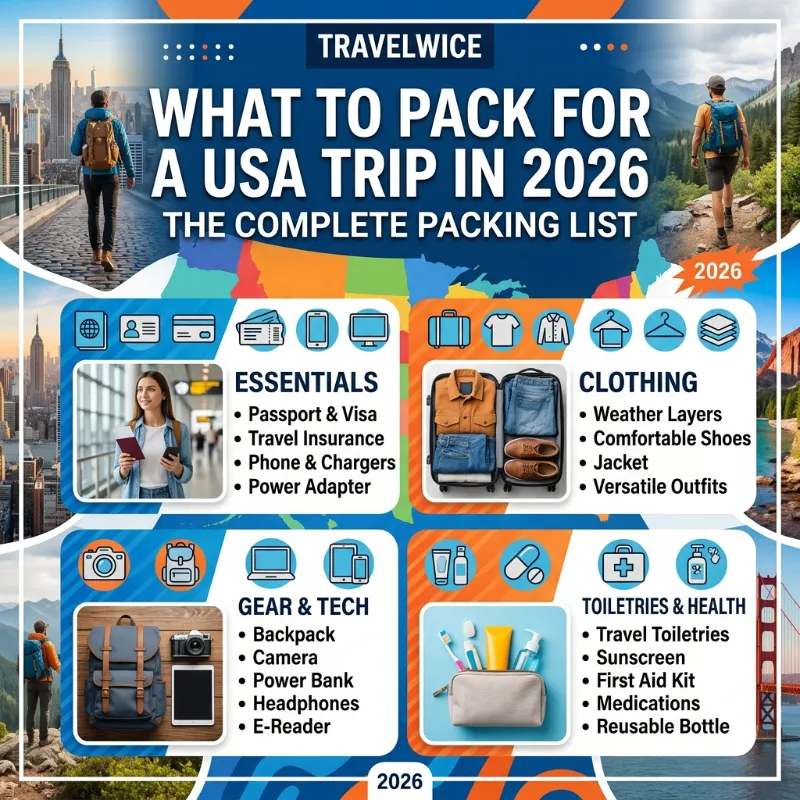

I have watched a friend shiver through a July evening in San Francisco because she packed only shorts and t-shirts, convinced summer meant summer everywhere. She was wrong, and so is almost every first-time visitor who treats America like one climate instead of a dozen. Figuring out what to pack for USA travel in 2026 is less about a magic checklist and more about understanding a country that can swing from desert heat to mountain snow within a single afternoon.
USA Travel Tips for Beginners The Complete 2026 Guide for First-Time Visitors
This guide pulls together what actually works, based on real trips, current TSA and ESTA rules for 2026, and the mistakes I still see travelers make every single week. By the end, you will have a full usa packing list essentials rundown, a seasonal breakdown, a printable-style checklist you can copy into your own usa trip packing checklist pdf, and answers to the questions people ask most before they fly out.
Safety Tips for USA Travel Every Visitor Needs in 2026
Key Takeaways Table
| Category | What You Need to Know |
|---|---|
| Documents | Passport valid 6+ months, ESTA (now USD 40) or visa, travel insurance, printed confirmations |
| Climate | The USA spans desert, tropical, alpine and continental zones, so layering beats overpacking |
| Electronics | Type A/B plug, 120V, so UK/EU/Australian travelers need an adapter |
| Airport rules | TSA 3-1-1 liquid rule still applies in 2026, no changes despite rumors |
| Money | Cards are accepted almost everywhere, but carry small cash for tips (18 to 22 percent at restaurants) |
| Road trips | Add a cooler, offline maps, and a basic emergency kit if driving between states |
| Packing style | Pack for the coldest and warmest moment of your itinerary, not just the season on paper |
TL;DR
Pack layers, not a single “summer” or “winter” wardrobe, because indoor air conditioning and regional weather swings catch almost everyone off guard.Bring your ESTA approval (USD 40 as of the current fee schedule), a card with no foreign transaction fees, and printed copies of your documents.Follow the TSA 3-1-1 rule for carry-on liquids, and budget for tipping since it is expected almost everywhere you eat or drink.
Why Packing for the USA Is Different From Anywhere Else
America is not one destination, it is fifty of them stitched together, and that is exactly why so many travelers get their usa trip packing checklist wrong. You could land in New York during a cold snap and fly into Miami’s humidity a few hours later. You could drive from the Arizona desert to a pine forest by dinnertime. This range is precisely why a rigid packing list rarely works and a flexible, layered approach always does.
I have tested this on three separate USA trips since 2023, once in February through New England, once in July down the West Coast, and once over Thanksgiving week bouncing between Chicago and Texas. Every single time, the people who struggled were the ones who packed for a single expected temperature instead of a range. For more first-time context, our beginner’s guide to the USA covers the broader logistics side of a first visit, while this article focuses purely on what goes in your bag.
Money Saving Tips for USA Travel in 2026: Real Prices, Real Savings
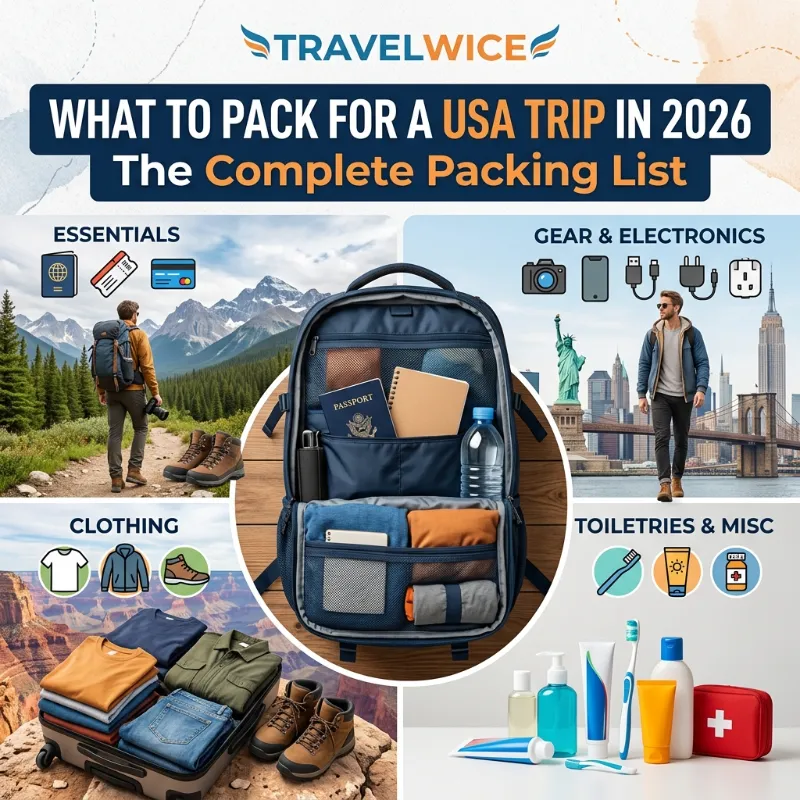
USA Packing List Essentials: Documents and Money First
Before clothes or gadgets, sort your paperwork, because this is the part that can actually stop your trip before it starts. Most European, UK, and other Visa Waiver Program travelers now pay USD 40 for their ESTA authorization, following the fee increase introduced under the recent funding changes, so budget for that ahead of booking flights. As of 2026, the Visa Waiver Program still covers 42 countries and territories, and approval is generally tied electronically to your passport rather than a paper stamp.
- Passport: valid for at least six months beyond your planned return date.
- ESTA or visa: apply at least 72 hours before departure, though most approvals land within minutes.
- Travel insurance: carry your policy number and emergency contact digitally and on paper, since US healthcare without insurance is genuinely expensive.
- Flight and hotel confirmations: border officers sometimes ask for a return ticket, so keep these easy to pull up.
- Payment card with no foreign transaction fees: this alone can save you a surprising amount over a two-week trip.
If you are renting a car, check whether your home country license works directly or whether you need an International Driving Permit, because rules vary by state. This single detail trips up more UK and European drivers than almost anything else on the list.
Tipping Etiquette in the USA A Full Guide
Seasonal Packing List USA Travel: What Changes by Time of Year
The single biggest packing mistake I see, and one I made myself on an early trip to Boston, is trusting the calendar instead of the region. According to National Oceanic and Atmospheric Administration data, the contiguous United States averages around 53°F (11.8°C) annually, but that number hides wild regional swings, from scorching desert summers over 100°F (37.8°C) to Pacific Northwest winters that rarely dip much below 45°F (7°C).
| Season | What to Expect | What to Pack |
|---|---|---|
| Spring (Mar to May) | Unpredictable, can swing from 45°F to 66°F in a week | Waterproof layers, light sweaters, a compact umbrella |
| Summer (Jun to Aug) | Hot almost everywhere, humid in the East and South | Breathable fabrics, sun protection, a light jacket for aggressive air conditioning indoors |
| Fall (Sep to Nov) | Crisp and colorful in the Northeast, still warm in the South | Mid-weight layers, a versatile jacket, comfortable walking shoes |
| Winter (Dec to Feb) | Freezing in the North and Midwest, mild in the South | Insulated coat, thermals, gloves, and waterproof boots if heading north |
A useful, if slightly odd, detail from my own trips: restaurants, malls, and even airports run their air conditioning aggressively, so even a July trip to Texas or Florida usually needs a light layer for indoors. This is a pattern several other USA packing list essentials guides mention too, and it holds true every single time I have traveled there in summer.
Public Transport Tips in USA: How to Get Around Without Renting a Car
Clothing and Footwear: Pack Smart, Not Heavy
The temptation is always to overpack “just in case,” but the better strategy is a small, adaptable wardrobe you can layer up or down. American laundromats and laundry services in hotels are widely available and inexpensive, usually between USD 3 and 8 per load, so you genuinely do not need ten days of outfits for a ten-day trip.
- Two or three versatile tops that mix and match easily.
- One warm mid-layer, such as a fleece or lightweight sweater, even in summer.
- A waterproof, packable outer layer for sudden rain or wind.
- Comfortable walking shoes, broken in before you travel, plus one smarter pair if you plan on a nicer dinner.
- Swimwear, if your itinerary includes coastal cities, lakes, or hotel pools.
Jetpac Global’s own USA packing checklist makes a similar point about layering being more useful than volume, and it is advice that consistently holds up on the ground.
Visa and ESTA Travel Tips for the USA (2026 Guide)
What to Pack for a USA Road Trip
Road trips deserve their own section because the packing logic shifts once you are covering long distances by car rather than staying in one city. If your route runs through national parks, deserts, or rural stretches, cell coverage can disappear for hours, so preparation matters more than it does on a city break.
- A filtered water bottle, since gas stations are not always close together on rural routes.
- Offline maps downloaded before you leave any city with reliable signal.
- A small cooler and snacks for long highway stretches between meals.
- A basic emergency kit including a flashlight, phone charger cable, and a physical paper map as backup.
- The America the Beautiful annual pass, currently priced at USD 80, which pays for itself after visiting three or four national parks.
Packing rules like the “5-4-3-2-1” method popularized by several road trip guides can help simplify decisions, but they work best when adjusted to your actual route and season rather than followed rigidly. Authentik USA’s travel checklist for the USA is a solid additional reference if you are building a longer, multi-state itinerary.
Cultural Etiquette Tips for Visiting the USA
Electronics, Connectivity, and Tech Essentials
The USA runs on 120V power with Type A and Type B plug sockets, so anyone traveling from the UK, mainland Europe, or most of Asia and Australia will need a plug adapter, and often a voltage converter for higher-wattage appliances like hair dryers. Do not assume your hotel will have spares, because many mid-range hotels simply do not stock them.
- Universal travel adapter, ideally one with USB-A and USB-C ports built in.
- Portable power bank, since long days of navigation and photos drain phones fast.
- An eSIM or local SIM for data, which is often cheaper and more reliable than roaming plans from home. Holafly’s guide on eSIMs and packing for the USA breaks down current data plan options if you want to compare before you land.
- A lightweight laptop or tablet only if you actually need it, since most travelers use it far less than expected.
Toiletries and Health Essentials
Pack a compact toiletry bag with the essentials, then plan to buy anything bulky once you land, since American pharmacies and supermarkets stock almost everything at reasonable prices. This single decision alone can save real space in your luggage.
- Sunscreen, especially for summer travel or high-altitude national parks.
- A basic first aid kit with pain relief, allergy medicine, and any prescription medication in its original packaging.
- Contact lenses and solution if needed, since brands abroad are not always identical to what you use at home.
- Hand sanitizer for flights, rideshares, and public transport.
If you take prescription medication, carry a doctor’s note and keep it in your carry-on, not checked luggage, in case of delays or lost bags.
Best Travel Apps for a USA Trip in 2026
TSA Rules You Actually Need to Follow in 2026
Airport security catches out even experienced travelers, so it is worth confirming the current rules before you fly rather than relying on memory from your last trip. Despite years of speculation about changes, the TSA’s 3-1-1 rule for liquids remains fully in effect in 2026, according to the Transportation Security Administration’s own guidance.
- Each liquid, gel, or aerosol container must be 3.4 ounces (100ml) or smaller.
- All containers must fit into a single, clear, quart-sized bag, one per passenger.
- Liquids over that limit go in checked luggage, where there is no volume restriction, only weight limits.
- Baby formula, breast milk, and medically necessary liquids are exempt from the standard limit.
- Some airports now use CT scanners that let travelers leave liquids inside their bags, but this changes the screening process, not the legal limit itself.
The Transportation Security Administration is the definitive source if your airport or airline has specific questions, and it is worth a two-minute check before a long-haul flight.
First-Time USA Travel Checklist: What Not to Skip
Money, Tipping, and Payments
The United States is heavily card-based now, including tap-to-pay almost everywhere, but a small amount of cash still helps for tips, farmers markets, or the occasional cash-only diner. Tipping culture surprises a lot of first-time visitors from the UK and Europe, where it is far less built into daily life.
- Restaurants: 18 to 22 percent of the total bill is standard.
- Bars: USD 1 to 2 per drink.
- Rideshare drivers: 10 to 15 percent is common, though not always mandatory.
- Hotel housekeeping: USD 2 to 5 per night left in the room.
A card with no foreign transaction fees will save you noticeably more than carrying large amounts of cash, and most major UK and European banks now offer at least one fee-free travel card option.
National Park and Outdoor Extras
If your route includes national parks, hiking trails, or long stretches of nature, a few extra items make a real difference to comfort. Trail shoes with real grip matter more than they sound, since uneven terrain and loose gravel are common even on popular, well-marked trails.
- Sturdy trail shoes broken in before your trip.
- A daypack for short hikes, big enough for water and snacks.
- Insect repellent, especially in wooded or wetland areas during summer.
- A paper trail map as backup, since phone signal drops in many parks.
Common Packing Mistakes First-Time Visitors Make
After talking with dozens of travelers and reading through community forums and firsthand accounts, the same handful of mistakes come up again and again. Recognizing them ahead of time is the easiest way to avoid repeating them yourself.
- Packing only for the “expected” season and ignoring indoor air conditioning or sudden temperature swings.
- Forgetting a plug adapter, assuming the hotel will have a spare one available.
- Overpacking clothing instead of relying on affordable, widely available laundry services.
- Carrying too much cash instead of a low-fee travel card.
- Skipping travel insurance because “nothing usually happens,” despite how expensive US healthcare can be without it.
Frequently Asked Questions
What is the most important thing to pack for a USA trip? Your documents come first, specifically your passport, ESTA or visa approval, and travel insurance details, since these can stop your trip before it starts if missing.
Do I need an adapter for electronics in the USA? Yes, the USA uses Type A and Type B plugs at 120V, so UK, European, and most Asian and Australian travelers need a plug adapter, and sometimes a voltage converter for higher-wattage devices.
How much cash should I bring to the USA? A small amount, generally USD 100 to 200, is enough for tips and minor purchases, since cards are accepted almost everywhere, including tap-to-pay.
What is the TSA liquid rule in 2026? The 3-1-1 rule still applies, meaning containers of 3.4 ounces or less, all fitting into one clear quart-sized bag per passenger, with no major changes announced despite ongoing speculation.
Is a USA road trip packing list different from a city trip list? Yes, road trips need extras like a filtered water bottle, offline maps, a small cooler, and an emergency kit, since coverage and services can be sparse between stops.
Fast Facts Comparison Chart
| Fact | Detail |
|---|---|
| ESTA fee (2026) | USD 40 |
| Visa Waiver countries | 42 nations and territories |
| TSA liquid limit | 3.4 oz (100ml) per container |
| National Parks annual pass | USD 80 |
| Average restaurant tip | 18 to 22 percent |
| Contiguous US average temperature | 53.3°F (11.8°C) |
| Plug type | Type A/B, 120V |
Quick Quiz: Test Your USA Packing Knowledge
- What is the current ESTA fee for most Visa Waiver Program travelers? a) USD 21 b) USD 40 c) USD 60 Correct answer: b) USD 40
- How many ounces can a single liquid container hold under the TSA 3-1-1 rule? a) 5 ounces b) 3.4 ounces c) 8 ounces Correct answer: b) 3.4 ounces
- What type of electrical plug does the USA use? a) Type A/B, 120V b) Type C/G, 230V c) Type D/M, 230V Correct answer: a) Type A/B, 120V
- Roughly how much should you tip at a US restaurant? a) 5 to 10 percent b) 18 to 22 percent c) No tip needed Correct answer: b) 18 to 22 percent
- What is the biggest packing mistake first-time visitors make? a) Packing too many documents b) Packing for one season and ignoring regional or indoor temperature swings c) Bringing too many adapters Correct answer: b) Packing for one season and ignoring regional or indoor temperature swings
Conclusion
Packing for the USA in 2026 comes down to one simple mindset shift, treat the country as a collection of climates rather than a single destination, and plan your bag around flexibility instead of certainty. Sort your documents first, layer your clothing, follow the current TSA and ESTA rules, and leave a little room in your suitcase for whatever you pick up along the way. Do that, and you will spend far more time enjoying the trip than worrying about what got left behind. For more planning help before you go, our pillar guide to USA travel tips for beginners is a good next stop, and you can browse more destination guides on TravelWice.
References
- Transportation Security Administration, 3-1-1 Liquids Rule, https://www.tsa.gov/travel/frequently-asked-questions/what-3-1-1-liquids-rule
- U.S. Customs and Border Protection, ESTA Official Site, https://esta.cbp.dhs.gov/
- National Park Service, America the Beautiful Pass, https://www.nps.gov/planyourvisit/passes.htm
- National Oceanic and Atmospheric Administration, U.S. Climate Data, https://www.noaa.gov/
- Jetpac Global, What to Pack for USA, https://www.jetpacglobal.com/blog/what-to-pack-for-usa/
- Authentik USA, Travel Checklist for the USA, https://www.authentikusa.com/en/faq/travel-checklist-usa
- Holafly, What to Pack for the USA, https://esim.holafly.com/travel-tips/what-to-pack-usa/