

Mardi Gras New Orleans Guide 2027: Parades, Krewes & Tips
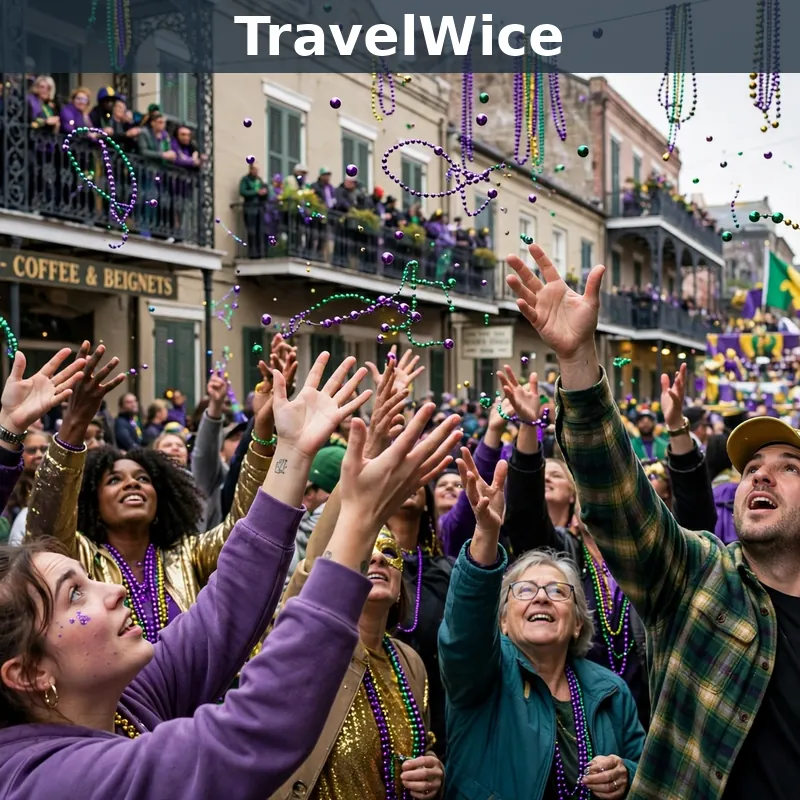
I stood on St. Charles Avenue at 9 in the morning with a coffee going cold in my hand, a purple bead necklace already around my neck from a stranger who had handed it to me like a welcome gift. No idea how loud a parade float could be until the first one turned the corner. The brass band hit first, then the crowd surged forward as one, then the beads started flying — not a gentle rain, a real shower of plastic strands, cups, stuffed animals.
Doubloons — and I caught a string of gold beads in my left hand while my right hand was still holding the coffee. That was my first Mardi Gras. Also, I had made every rookie mistake in the book before noon: I had parked too far away. I had no ladder, I had worn white shoes, and I had planned to watch one parade and leave.
I stayed for three, and by the end of it I looked like a chandelier that had lost a fight with a glitter factory. In fact, this Mardi Gras New Orleans guide 2027 is the plan I wish someone had handed me before that morning. The real dates, the real parade route, the krewes worth planning your whole trip around, where to stand, what to bring, what it costs. The mistakes that cost people a whole day.
The Short Version
TL;DR: Fat Tuesday 2027 is Tuesday, February 9, 2027, and the season runs January 6 to February 9. The parades you plan around are Endymion on Saturday February 6, Bacchus on Sunday February 7, Orpheus on Monday February 8, and Zulu and Rex on Fat Tuesday morning, February 9. The main route runs Napoleon Avenue to St. Charles Avenue to Canal Street, parades do not enter the French Quarter, and watching from the street is free everywhere. Arrive before 10 AM for a good spot, bring a ladder if you have kids, and book your hotel 4 to 6 months ahead because rooms sell out and prices spike. The Zulu coconut is handed to you, never thrown — if someone offers you one, take it with both hands.

What Mardi Gras Actually Is
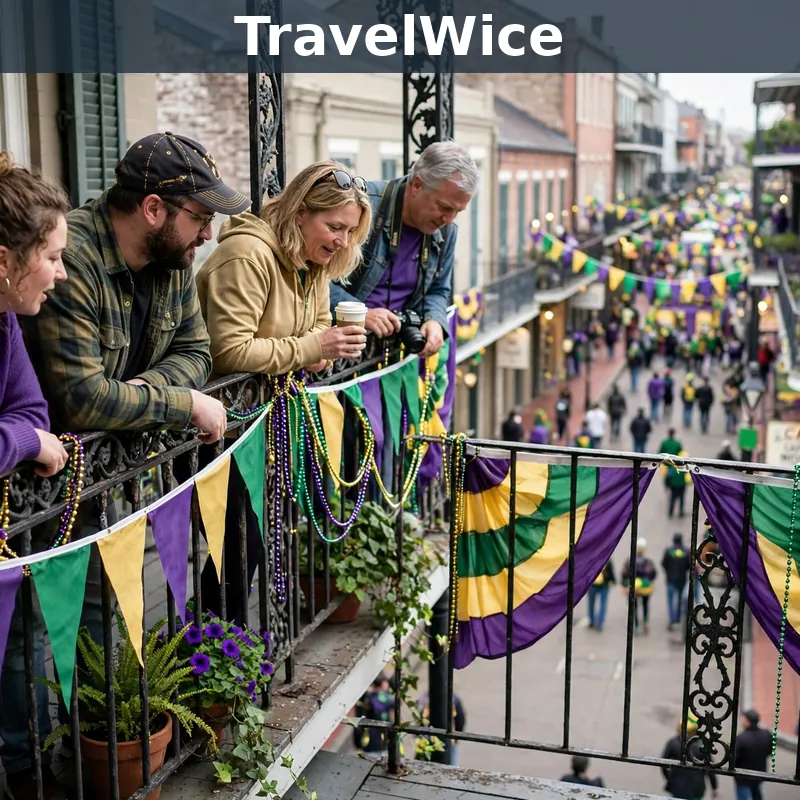
In addition, Mardi Gras is not one day and it is not one parade. It is a season — Carnival — that opens on January 6, Twelfth Night, and runs right through to Fat Tuesday, the day before Ash Wednesday. In particular, in 2027 that means January 6 to February 9, with Easter Sunday falling on March 28, 2027 and Ash Wednesday on February 10. The whole city lives on a different clock during those five weeks. King cakes appear in every bakery and every office break room. Houses on St. Charles Avenue hang purple, green and gold bunting. And the krewes — the private clubs that build the floats and ride in the parades — spend the year getting ready for their one night on the route.
The Colours and Their Meaning
On top of that, the colours are not random. Meanwhile, purple, green and gold were fixed by the Krewe of Rex in 1872. They have meant the same thing ever since: purple for justice, green for faith, gold for power. Rex is the oldest of the big parades still rolling. When the King of Carnival rides past on Fat Tuesday morning in his white suit, people who have watched for forty years still stand a little straighter.
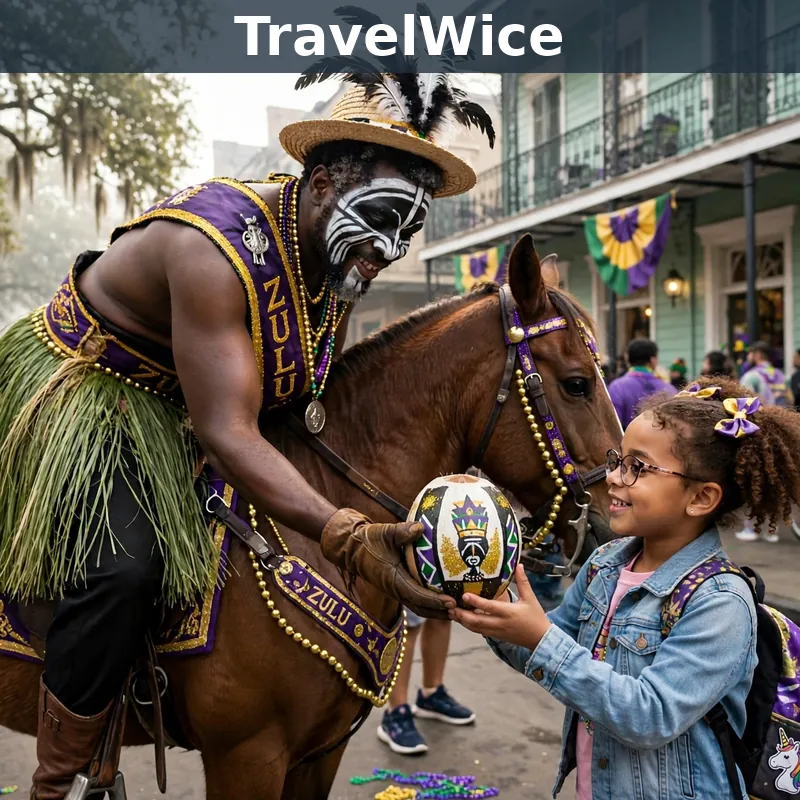
The Zulu Social Aid & Pleasure Club, founded in 1909, rolls the same morning with its own king. Its own brass, and its own tradition — the hand-painted coconut. Zulu riders do not throw their coconuts. They hand them down, one by one, to people in the crowd, usually kids, usually with a grin. A “here you go, baby.” A Zulu coconut is the most prized throw in all of Mardi Gras. You cannot buy one.
A Few Things Worth Knowing
You have to be there, on the route, with your hands up and your eyes on the riders. I have never wanted a piece of fruit so badly in my life. I am saying that as a person who likes fruit a normal amount.
Here is the part that surprises first-timers the most: the parades do not go through the French Quarter. Also, a 1973 city ordinance keeps the big floats out of the Quarter’s narrow streets. Only a few small walking krewes like Krewe du Vieux get in. The Quarter during Mardi Gras is a street party. Costumes, music, open containers, crowds shoulder to shoulder on Bourbon Street — but the floats. The marching bands, the giant super-krewe productions, all of that happens uptown on St. Charles Avenue and downtown on Canal Street. In fact, if you come to New Orleans for Mardi Gras and spend the whole trip in the Quarter. You will have a wild time and you will miss the parades. That is the single most common mistake, and it is an easy one to avoid once you know the route.
The 2027 Dates You Need to Memorise
Get the dates right and everything else falls into place. I am spelling them out plainly here because I have seen travel blogs get 2027 wrong, some of them a full week off. The official New Orleans & Company official tourism site lists Fat Tuesday 2027 as February 9. In addition, the Mardi Gras New Orleans official site agrees. In particular, write it on your hand if you have to: Tuesday, February 9, 2027.
The season opens on Twelfth Night, January 6, with the first small parades and the first king cakes of the year. On top of that, January is the slow build — neighbourhood parades, balls and parties most weekends, and the city warming up. Meanwhile, the last weekend is when it all detonates. Saturday February 6 belongs to Endymion, the biggest of the super krewes, which rolls in the evening with dozens of floats. A parade so long it takes hours to pass one spot. Sunday February 7 is Bacchus, the other giant, with its own celebrity king. Monday February 8 is Lundi Gras — Orpheus rolls that night, and the city holds its breath for the next morning. Tuesday February 9 is Fat Tuesday itself: Zulu rolls in the morning, Rex follows. By mid-afternoon the city feels exhausted, happy, and covered in beads.
Where to Stay for This Part
Also, if you can only come for one day, come for Fat Tuesday, February 9. If you can come for three days, come Saturday February 6 through Tuesday February 9 and catch Endymion, Bacchus and the Fat Tuesday pair. In fact, if you can come for a week, arrive the weekend before and watch the city build. The smaller parades in the week leading up to Fat Tuesday are easier to get close to. The crowds are thinner, and the hotel rates are lower than the final weekend. My first trip was a single Fat Tuesday and it was wonderful. My second trip was four days and it was a different holiday entirely. The parades repeat the same route every year, so the learning from one trip carries straight into the next.
The Super Krewes: Endymion, Bacchus, Orpheus, Zulu and Rex
Endymion is the parade people describe with numbers because the numbers are the story: the biggest krewe. In addition, the most floats, the longest route. The most riders, and a parade that takes three to four hours to pass a single spot on St. Charles Avenue. In particular, it rolls on Saturday night, February 6, 2027. It is the one parade where you should plan your whole evening around a single location.
Find your spot by mid-afternoon, settle in, and do not leave it. Once Endymion starts rolling, crossing the route is impossible and the crowds on the side streets are thick. The throws are generous and the floats are enormous. Bring a bag. A real bag, not a pocket. I filled a grocery bag in the first hour and then started giving beads away to kids behind me, which is the correct use of a surplus.
By the end of the night my shoulders ached from the weight of free plastic jewellery, which is the most New Orleans sentence I have ever written.
On top of that, Bacchus rolls on Sunday night, February 7, and it has a different personality. Bacchus was the first super krewe to put a celebrity on its float as king, and it still does. Meanwhile, the king rides high above the crowd, and the parade has a show-business swagger that Endymion does not. Sunday night is a slightly easier night for families than Saturday. The Saturday crowds are the biggest of the season. A lot of the Saturday crowd has flown home by Sunday. If you have kids and you want one big night parade, Bacchus on Sunday is my pick.
The Music After Dark
Also, Orpheus rolls on Monday night, February 8 — Lundi Gras — and it is the one I love most. In fact, it feels like a musician’s parade. Harry Connick Jr. founded the Krewe of Orpheus, and the parade carries that musical DNA. More bands, more dancing in the streets, more of the feeling that the parade is a performance and not just a procession. It rolls the same route. It ends with the city wide awake at midnight, knowing that Fat Tuesday is six hours away. Do not try to sleep in on Fat Tuesday morning. Set the alarm.
Fat Tuesday morning belongs to Zulu and Rex, and the two of them together are the heart of Mardi Gras. Zulu rolls first, in the morning, with the grass skirts, the black-and-white face paint. The hand-painted coconuts, and a joy that is impossible to describe without sounding sentimental — so I will just say this. I watched a Zulu rider lean down from his float and hand a coconut to a little girl in a pink coat.
She held it up like she had been given the moon, and her father cried, and I cried, and the whole block cheered. Rex follows, the King of Carnival in white, with the purple, green and gold that he fixed in 1872, and the parade that has defined the day for more than 150 years. Zulu and Rex on Fat Tuesday morning is the Mardi Gras you have been picturing since you were a kid.
In addition, be there before 10 AM, or be somewhere you can hear it from a long way off.
Where to Stand: The Route and the Best Spots
In particular, the main parade route is simple and it never changes. The parades start uptown on Napoleon Avenue, turn onto St. Charles Avenue, roll down St. Charles through the Garden District and the Warehouse District, and finish on Canal Street at the edge of the French Quarter. On top of that, learn those three street names and you can find the parade from anywhere in the city. The route is long — several miles — and the character of the crowd changes along it. Uptown on St. Charles, near the Garden District, the crowd is families: ladders, lawn chairs, coolers, kids, grandparents. Closer to Canal Street, the crowd is younger, louder, and standing rather than sitting. Both are good. They are just different holidays.
My favourite spot is St. Charles Avenue in the Garden District, somewhere between Washington Avenue and Louisiana Avenue, on the neutral ground — the wide grassy median that runs down the middle of St. Charles. Meanwhile, the neutral ground is where the families camp, and it is where the kids’ ladders go. Also, it is where you can spread out a blanket and make a day of it. The New Orleans travel guide for 2026 covers the Garden District in detail.
Our Garden District New Orleans guide for 2026 walks the same streets the parades roll down. You will recognise the oak trees and the mansions when the floats pass them. Arrive before 10 AM for a morning parade and by mid-afternoon for a night parade. Visitors claim the good spots on the neutral ground by noon on parade days. By 2 PM you are standing three deep behind someone’s ladder.
What It Costs, in Plain Numbers
In fact, a few practical rules of the route. First, the streetcar does not run on St. Charles Avenue during parades. In addition, the tracks are on the route itself, and the line shuts down for the parade. Normally the streetcar is $1.25 a ride with a two-hour transfer. It is the best way to get to the Garden District. On parade days you walk, or you take a rideshare to a side street and walk in.
Second. The floats do not stop. If you want a throw, you have to be visible and loud — wave, shout, make eye contact with the riders. The riders throw to the people who are paying attention. Third, protect your feet. The route is concrete and asphalt, the day is long. The shoes that looked cute in the hotel mirror will betray you by hour three. Wear the comfortable shoes.
In particular, the French Quarter is the other half of the holiday. There are no big parades in the Quarter, but a walking parade of costumes, brass bands. Second lines never really stops from the Friday before Fat Tuesday through Tuesday night. On top of that, our Bourbon Street New Orleans guide for 2026 covers the bars and the survival tips. The French Quarter New Orleans guide for 2026 maps the balconies where you can watch the street from above. A balcony is the best seat in the Quarter during Mardi Gras. If you can get one, take it.
What You Will Catch: Throws, Doubloons and the Coconut
A “throw” is anything a rider tosses from a float, and the throw is the whole economy of Mardi Gras. Meanwhile, beads are the baseline — plastic strands in purple, green and gold, thrown by the thousands from every float. Also, you will catch more in one parade than you can carry home. Cups are the next tier: plastic krewe cups, printed with the krewe name and the year. People collect them the way other people collect concert posters. Doubloons are the old-school throw — aluminium coins stamped with the krewe’s emblem and the year. The older ones are genuine collector’s items. Stuffed animals, footballs, light-up toys and hand-decorated shoes come off the floats too. The riders aim them at the kids in the front row.
In fact, the unwritten rules of catching are simple and they matter. Hands up, eyes on the riders, shout for what you want — “throw me something, mister” is the traditional call. It works, especially from kids. In addition, do not fight over throws. Do not grab beads out of someone else’s hands. If a throw lands at your feet, it is yours. If it lands at someone else’s feet, it is theirs.
My own catching record is not impressive — I have been hit in the forehead by a flying doubloon. I have watched a perfect string of beads sail over my head into the hands of a delighted seven-year-old behind me. I have learned that the riders throw to the loud ones, not the tall ones. If you catch a doubloon, keep it. A 2027 doubloon from Rex or Zulu is a souvenir you will still have in twenty years.
The Parades Themselves
If you catch a coconut, you have caught the rarest throw in the parade. The correct response is to hold it up, let the crowd cheer, and carry it home in your suitcase wrapped in a T-shirt. Zulu coconuts are handed, never thrown, because a thrown coconut is a weapon and a handed coconut is a gift. When a rider leans down with one, reach up with both hands and say thank you. Mean it.
In particular, King cake is the food of the season. A king cake is a ring of sweet dough, iced in purple, green and gold sugar, filled with cinnamon or cream cheese or fruit. On top of that, hidden inside is a tiny plastic baby. Whoever finds the baby in their slice buys the next cake — that is the rule. Offices and families take it seriously. The New Orleans food guide for 2026 covers the bakeries and the food of the season in full. The prices in that guide are the ones I paid: gumbo $15 to $25, jambalaya $15 to $25, a po’boy $8 to $15.
Mardi Gras Indians, Walking Krewes and the Quarter After Dark
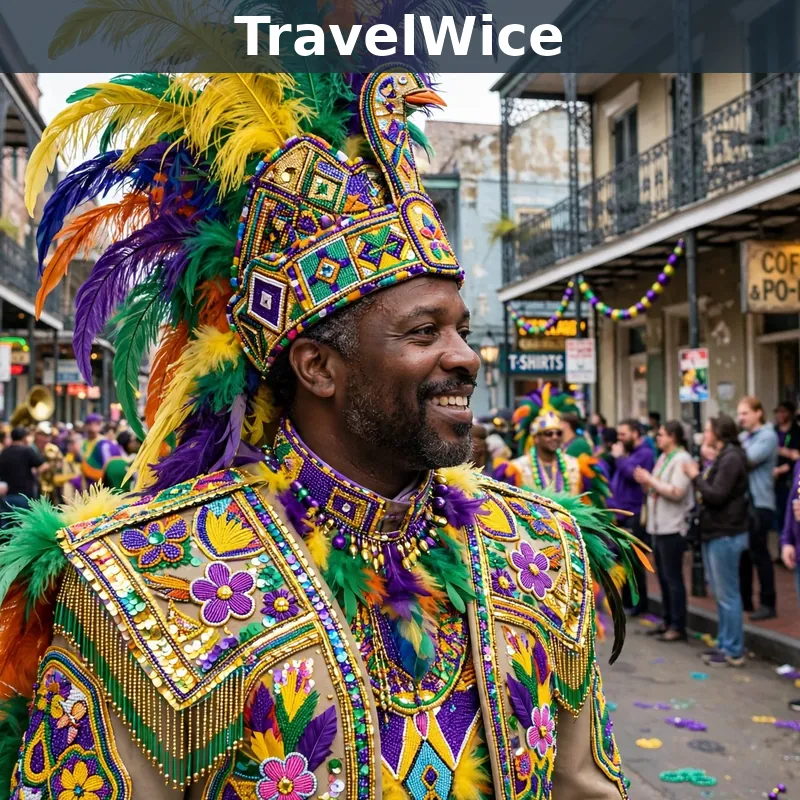
Meanwhile, the Mardi Gras Indians are the part of the holiday that no float can match. They are the part most visitors never see, because they do not follow the parade route. Also, the Indians are Black masking traditions that go back more than a century. On Fat Tuesday morning they come out in suits that took a year to sew by hand.
Beads, feathers, sequins, three-dimensional beaded panels that tell a story, each suit a work of art that weighs more than a suitcase. They parade through the neighbourhoods — the Tremé, Central City, the Ninth Ward — singing, chanting. Dancing in a language of call and response that is older than the floats. If you want to see them, go to the Tremé or Central City on Fat Tuesday morning, ask a local where the Indians are gathering, and be respectful. These are not performers for tourists.
They are a community tradition. The right way to watch is quietly, from the side, with your camera down unless someone invites you to take a photo.
Getting There Without the Hassle
In fact, after dark, the Quarter belongs to the party. In addition, Bourbon Street is loud, crowded, and lit up like a carnival midway. The energy after 9 PM is adults-only in practice. Cocktails run $10 to $16, beer $5 to $8, hurricanes $12 to $15. The bars pour until the crowd thins out, which during Mardi Gras is very late or never. My honest advice: do Bourbon Street once, early in the evening, before 7 PM, when you can walk it and enjoy the music without the crush. Then go to Frenchmen Street, three blocks into the Marigny. A seven-minute walk from the Quarter, where the music is better. The covers are lower, and the crowd is there for the band and not for the spectacle. Our New Orleans jazz guide for 2026 covers Frenchmen Street properly.
The Spotted Cat with no cover and a one-drink minimum, d.b.a. at $10 to $20, Snug Harbor at $20 to $40 — and Preservation Hall official site lists its own sets, 45 minutes each, about $25 to $65, most nights at 5:00, 6:15, 7:30 and 8:45 PM. Book ahead. Preservation Hall has about 100 seats and no bar, and during Mardi Gras it sells out.
Where to Stay and When to Book
Here is the sentence that will save your trip: book your hotel four to six months before Mardi Gras, and book it the moment you know your dates. The hotels sell out, the prices spike, and the people who book in January for a February parade are paying double what the people who booked in September paid, if they find a room at all. In particular, French Quarter hotels run roughly $200 to $350 a night in normal times. On top of that, during Mardi Gras week they go well above that — I am not going to invent a number. The spike depends on the hotel and the night. The direction is always up, and the rooms near the parade route go first.
Meanwhile, where you stay matters more during Mardi Gras than on any other New Orleans trip. Also, the parade route cuts the city in half and the street closures make crossing it slow. If your hotel is on one side of St. Charles Avenue and the parade is rolling. You are walking around the end of the route or waiting for a gap, and neither is quick.
My recommendation: stay in the French Quarter or the Warehouse District if you want the Quarter nightlife. The Canal Street end of the route, and stay in the Garden District or Uptown if you want the family parade scene on St. Charles Avenue. Either way, stay close to where you plan to watch. The walk home at midnight after a parade is long enough without adding a mile to it. Our New Orleans trip cost guide for 2026 works through the full budget.
What to Eat While You Are There
Hotels, food, tours, streetcars and shows — and the New Orleans family vacation guide for 2026 covers the family hotels and the kid-friendly plan.
Getting Around During Carnival
In fact, the streetcar is $1.25 a ride with a two-hour transfer. In addition, on a normal day it is the best way to move around New Orleans. The St. Charles line runs from Canal Street through the Garden District to Carrollton, past the parade route itself. On parade days, the St. Charles line shuts down along the route while the parades roll, so plan around it: ride the streetcar to the edge of the route, then walk in on a side street. The Canal Street streetcar and the Riverfront line keep running. They are useful for getting between the Quarter and the Warehouse District. Walking is the real transport during Mardi Gras. The French Quarter is a 13-by-6-block grid, and you can walk it end to end in twenty minutes.
The walk from the Quarter to the Garden District along St. Charles is one of the best walks in America. Two miles of oak trees, mansions and streetcar tracks. During Carnival the houses are decorated and the porches are full.
Taking a Guided Tour
Rideshares work during Mardi Gras, but surge pricing is real, and the pickup points move. In particular, the apps will send you to a side street a few blocks from where you are standing. On top of that, the main streets are closed. Allow ten minutes to find your car, and check the price before you confirm. The number on the screen at 11 PM is not the number you saw at 11 AM. My rule for the week: walk everywhere you can, take the streetcar when it is running, and save the rideshare for the airport run and the late-night trip home. The airport, MSY, is about 30 minutes from the Quarter. If you are comparing New Orleans with other city breaks, our California travel guide for 2026. Our New York travel guide for 2026 show how the transport costs stack up.
Our Las Vegas travel guide for 2026 covers a city where the walking is longer and the rideshares are dearer.
Meanwhile, pack for February in New Orleans, not for a postcard. February days run mild — often in the 60s Fahrenheit — and February nights can drop into the 40s. Rain is always a possibility. Check the National Weather Service forecasts the week before you go, and pack a rain jacket, a warm layer for the night parades. The comfortable shoes I have already mentioned twice because they matter that much.
Mardi Gras With Kids: The Ladder, the Ear Protection and the Exit Plan
Bringing kids to Mardi Gras is one of the best decisions a family can make. It is also the one that needs the most planning. The daytime parades on St. Charles Avenue are built for families — the neutral ground, the ladders, the coolers, the grandparents in lawn chairs — and a kid on a ladder catching beads from a float is a memory that lasts longer than any toy. The night parades are a different calculation: they are loud, they run late, and the crowds are thicker. My rule, and the rule of every New Orleans parent I have talked to, is simple. Day parades with kids, night parades without them, or with older kids who can handle a crowd and a late night.
The ladder is the single most important piece of gear. It is a small step ladder with a seat on top. The child sits on it above the crowd, facing the parade, with a parent standing right behind it holding the ladder steady. You can buy one in New Orleans before the parades — hardware stores. Grocery stores stock them during Carnival — or bring one if you are driving. The ladder goes on the neutral ground or at the front of the crowd. The child stays on it for the whole parade. Do not let a small child stand in the crowd at ground level. They will see nothing but strangers’ backs, and they will be miserable by the second float. Every adult without a ladder will look at your ladder with pure envy by 10 AM. Bring ear protection for small children too.
Bringing the Kids Along
The brass bands are loud, the floats are louder. A pair of child-sized ear muffs costs a few dollars and saves a headache.
Food, water and bathrooms are the three things parents forget. Bring water and snacks — the parade route has vendors, but the lines are long and the prices are parade prices. Bring a change of clothes for the kids. Someone will spill a drink, sit in something, or get covered in beads and powdered sugar. The walk back to the hotel is long. Know where the nearest bathroom is before the parade starts, and know your exit route — the way out of the crowd to a side street, in case someone needs to leave in a hurry. Write your phone number on your child’s arm in marker, or put it on a wristband, in case you get separated. The crowds are friendly, but they are big. A lost child in a crowd of ten thousand is a scary ten minutes.
The New Orleans family vacation guide for 2026 covers the family plan for the rest of the trip — the zoo, the aquarium, City Park — and the daytime parades are the family highlight of the whole year.
Staying Safe and Sane in the Crowd
Mardi Gras crowds are big, friendly, and occasionally overwhelming. The safety advice is mostly common sense with a parade twist. Keep your phone and your wallet in a front pocket or a bag you can close. The crowds are thick and pickpockets work crowded streets in every city on earth. Drink water between drinks. The February sun is mild, but a day on the parade route with a hurricane in your hand. No water is a headache by 4 PM. The cocktails run $10 to $16, the beer $5 to $8, the hurricanes $12 to $15, so the money adds up as fast as the dehydration. Eat a real meal before the parade — king cake is a food group during Carnival. It is not a lunch — and keep snacks in the bag.
The Police and the Rules
During Mardi Gras, the police presence is heavy and visible. The rules are enforced — no glass on the street, no climbing the floats, no running into the parade route. Stay behind the barricades, stay out of the street when the floats are rolling, and keep kids behind the line. The barricades are there because a float is the size of a house and it does not stop quickly. Respect the line and you will have a safe trip.
Agree on a meeting point with your group before you split up, because phone service on the parade route gives up when ten thousand people all try to post the same float at the same time. Pick a landmark — a specific corner, a specific bar sign, a specific oak tree — and agree that if anyone gets separated, everyone goes to the landmark. Do not rely on texting. Walk to a side street first, then call the car.
Timing It Right
Finally, the part nobody tells you: Mardi Gras is exhausting. The smartest move is to build a rest day into the trip. One full day of parades, then a slow morning. Beignets at Café du Monde, where three beignets run about $4.50 to $6 and a café au lait about $3.60 to $4. The shop is open 24 hours except Christmas Day — then a quiet dinner and an early night. The people who burn out on day two are the ones who tried to do everything on day one. Mardi Gras rewards the people who pace themselves. The parades will still be there tomorrow.
Mardi Gras 2027 at a Glance
| Date (2027) | Event | What to know |
|---|---|---|
| Jan 6 | Twelfth Night — season opens | First parades, first king cakes |
| Feb 6 (Sat) | Endymion | Biggest super krewe, evening, hours long |
| Feb 7 (Sun) | Bacchus | Celebrity king, evening, same route |
| Feb 8 (Mon) | Orpheus — Lundi Gras | Musician’s parade, evening |
| Feb 9 (Tue) | Zulu, then Rex — Fat Tuesday | Morning, coconuts handed, King of Carnival |
| Feb 10 (Wed) | Ash Wednesday | City exhales, Quarter quiet, cheap flights |
Route for the big parades: Napoleon Avenue → St. Charles Avenue → Canal Street. Watching from the street is free everywhere. Parades do not enter the French Quarter.
Chart: How a Mardi Gras Day Breaks Down
This chart shows how a typical full parade day works out for one person, from the morning spot-claim to the night parade, so you can see where the time and the money actually go.
| Part of the day | Time | Typical cost ($) |
|---|---|---|
| Breakfast, beignets and coffee | 7:00–9:00 AM | 8–12 |
| Spot-claim and morning parade (Zulu, Rex) | 9:00 AM–1:00 PM | 0 (watching is free) |
| Lunch on the route | 1:00–2:30 PM | 15–25 |
| Afternoon break, Quarter walk | 2:30–5:00 PM | 0–10 |
| Dinner before the night parade | 5:00–6:30 PM | 20–40 |
| Night parade (Endymion, Bacchus or Orpheus) | 6:30–10:30 PM | 0 (watching is free) |
| Drinks and music after | 10:30 PM–late | 15–30 |
The parades themselves cost nothing, and that is the point. A full day of the best show in America runs about $60 to $120 a person once you add food and drinks, and the hotel is the real cost of the trip, not the entertainment. The waiting is not wasted time — the waiting is when you meet the family next to you, share their king cake, and learn which float to watch for. Arrive early, bring food and water, and treat the spot-claim as part of the holiday, not as a chore before it. You will spend half the day sitting on a curb eating a sandwich, and it will be one of the best sandwiches of your life, because there is a brass band fifty feet away.
References
- New Orleans & Company official tourism site — official Mardi Gras dates, parade routes and visitor information.
- Mardi Gras New Orleans official site — krewe schedules, parade history and the 2027 dates.
- Café du Monde official site — beignets, café au lait and hours.
- Preservation Hall official site — set times, ticket prices and booking.
- National Weather Service forecasts — New Orleans weather before you travel.
Mardi Gras New Orleans Quiz
Test what you picked up from this guide before you book.
1. What day is Fat Tuesday in 2027?
- A) February 2, 2027, a Tuesday
- B) Tuesday, February 9, 2027
- C) February 23, 2027, also a Tuesday
2. Which super krewe rolls on Saturday night, February 6, 2027?
- A) Bacchus
- B) Orpheus
- C) Endymion
3. What is the main parade route for the big krewes?
- A) Bourbon Street through the French Quarter
- B) Napoleon Avenue to St. Charles Avenue to Canal Street
- C) Magazine Street to the Garden District
4. How are Zulu coconuts given to the crowd?
- A) Thrown from the floats like beads
- B) Handed down by the riders, never thrown
- C) Sold at the end of the parade
5. When should you arrive for a good spot at a morning parade?
- A) Before 10 AM
- B) At noon, when the parade starts
- C) After the first float passes
Quiz Answers
- B) Tuesday, February 9, 2027 — Fat Tuesday 2027 is February 9. The season runs January 6 to February 9, and Ash Wednesday is February 10.
- C) Endymion — Endymion rolls on Saturday night, February 6, 2027. Bacchus is Sunday February 7 and Orpheus is Monday February 8.
- B) Napoleon Avenue to St. Charles Avenue to Canal Street — The big parades follow this route. They do not enter the French Quarter, which has been the rule since a 1973 ordinance.
- B) Handed down by the riders, never thrown — Zulu riders hand their hand-painted coconuts to people in the crowd, usually kids. A thrown coconut would be dangerous, and a handed one is a gift.
- A) Before 10 AM — Arrive before 10 AM for a morning parade. The good spots on the neutral ground are taken by noon, and by 2 PM you are standing three deep behind someone’s ladder.