
French Quarter New Orleans Guide 2026: Sights, Walks & Beignets
I got lost in the French Quarter on my first morning. It was the best thing that happened on the whole trip. Also, I had a map, a plan, and a list of streets to tick off. Within twenty minutes I had taken a wrong turn off Decatur, ended up on a quiet block of Royal Street I had never heard of, and found a courtyard with a fountain, a cat asleep on a chair. In fact, a trumpet player practising scales through an open window. I stood there for ten minutes and forgot the map completely. The French Quarter does that. It is a 13-by-6-block grid, founded in 1718 as the Vieux Carré. It is small enough to walk across in half an hour. Dense enough to spend three days in without repeating a street.
This French Quarter New Orleans guide is the walk I ended up doing, after the map failed me — Jackson Square at sunrise, beignets with sugar on my shirt, Royal Street in the quiet morning, the French Market, and the music that finds you on the corners.
TL;DR: Start at Jackson Square before 9 AM, then Café du Monde for beignets at about $4.50–$6 for three and a café au lait at about $3.60–$4. Walk Royal Street in the morning, the French Market before lunch, and Bourbon Street before 7 PM for a calm look. St. Louis Cathedral is free, open roughly 9:30 AM–4 PM outside mass. A guided walking tour runs $25–$30, a carriage tour $20–$25. Wear flat shoes, carry small bills for the musicians, and save Preservation Hall for the evening — book ahead, tickets about $25–$65.
Finding Your Bearings: The Grid, the River, and the Streets That Matter
The Quarter is a grid, and once you learn the shape of it, you cannot really get lost for long. In addition, the Mississippi River runs along one edge, on the Decatur Street side. In particular, Canal Street is the uptown edge, Esplanade Avenue is the downtown edge. Rampart Street is the back edge, away from the river. Between the river and Rampart, the streets run in order: Decatur, Chartres, Royal, Bourbon, Dauphine, and Burgundy. Learn those six names and you can find your way anywhere. Jackson Square sits on Decatur, between St. Peter and St. Ann. Bourbon Street runs parallel, one block over from Royal. Frenchmen Street, where the best music lives, is just across Esplanade Avenue, about a seven-minute walk from the Quarter.
On top of that, the streets are not even, the sidewalks are narrow, and the pavements can be slick after rain. Meanwhile, I wore flat shoes with grip every day, and I was glad of it. The Quarter is also louder and busier than it looks on a map. A street that is quiet at nine in the morning can be packed by noon, and a corner that is empty at lunch can have a full brass band by four. My rule was simple: walk the busy streets in the morning. The quiet streets in the afternoon, and the music streets in the evening. It worked every day.
What It Costs, in Plain Numbers
Also, one more practical note before we start walking: open-container drinking is legal in the Quarter. In fact, a drink in a plastic cup on the street is normal here, and you will see it everywhere. Keep it in the cup, keep it in the Quarter, and do not try it anywhere else in the city. And keep small bills handy. The street musicians work for tips, five to ten dollars in the case is right, and the tip jars run $5–$20. Those tips are the paycheque, and the music is the reason half the people come.
Jackson Square and St. Louis Cathedral: Start Here, Start Early
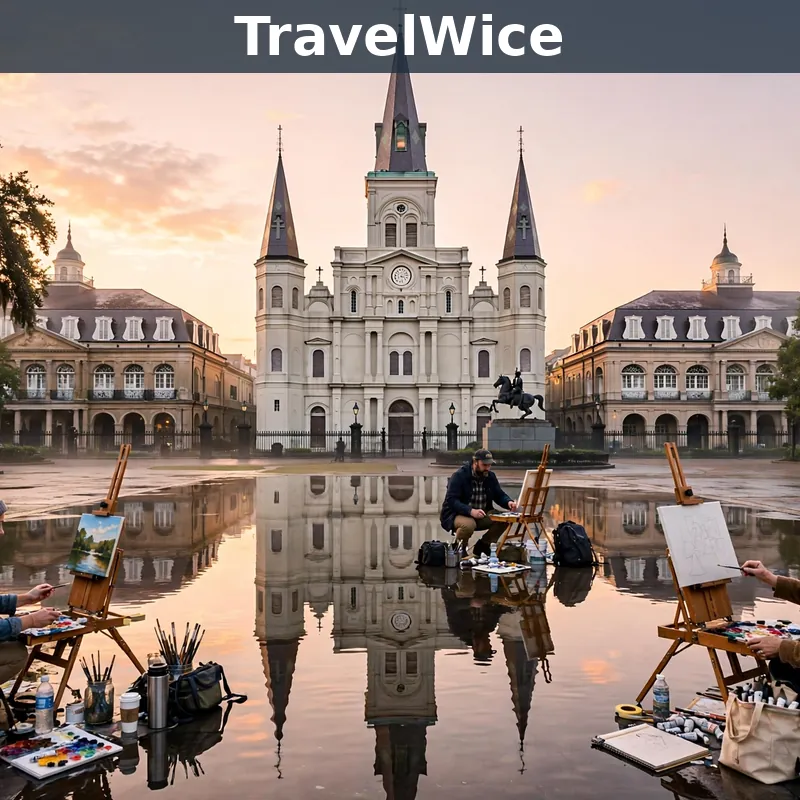
In addition, Jackson Square is a free 2.5-acre park, and it is the heart of the Quarter. In particular, the iron fence, the artists along the railings with their easels. Portraits, the statue of Andrew Jackson in the middle. St. Louis Cathedral rising over it all with its three spires. I went at eight in the morning on my first day, before the crowds. The light was soft and gold, and the square belonged to the artists setting up and the pigeons and me. I went back at noon on a Saturday, and it belonged to everybody. Families, tour groups, a wedding party taking photos on the steps. Both visits were worth it, but the morning one is the one I remember.
On top of that, St. Louis Cathedral sits on the square, and the current building dates to 1850. Meanwhile, it is the oldest continuously active Catholic cathedral in the United States, and entry is free. It is open roughly 9:30 AM to 4 PM outside mass, so check the mass times if you want to go inside during the day. Go inside even if you are not religious. It is quiet, cool, and dark after the bright square. The paintings on the walls are worth ten slow minutes. I sat in a pew for a while, not praying, just resting my feet and listening to the quiet. It was the calmest ten minutes of a very loud trip.
Getting There Without the Hassle
Also, for the best photo, walk round to the river side and climb the Washington Artillery Park steps. In fact, from there you get the whole square, the cathedral, and the river behind you, all in one frame. Go at sunrise or just after, when the light hits the spires, and go before nine if you want the steps to yourself. I took my photo at eight. A couple next to me had been there since seven, waiting for the light. They were right to wait.
Café du Monde: Beignets, Coffee, and Powdered Sugar Everywhere
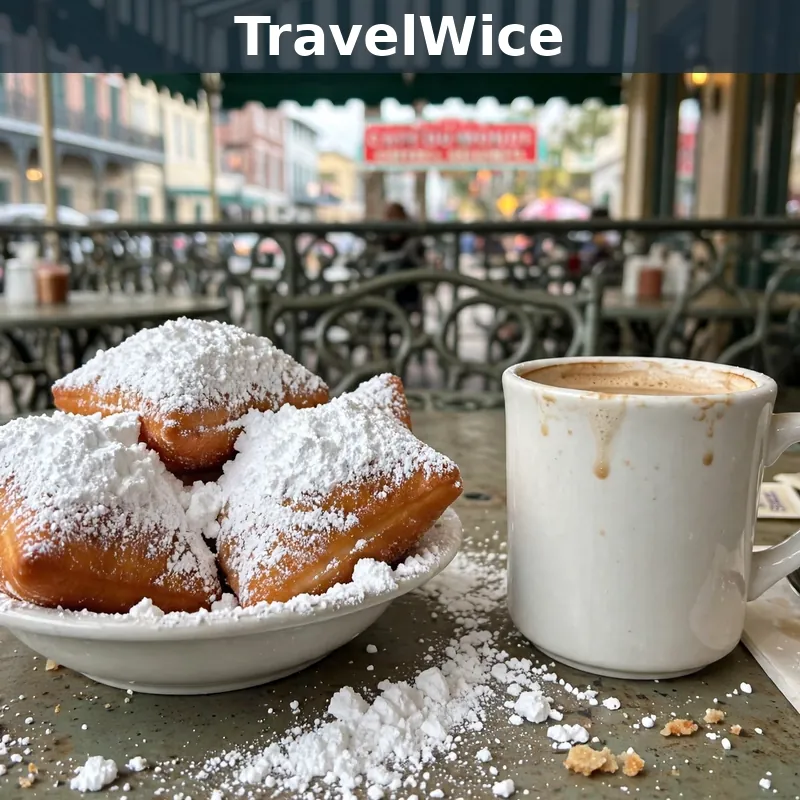
In addition, Café du Monde sits at 800 Decatur Street, right by the square, and it has been there since 1862. In particular, it is open 24 hours and closes only on Christmas Day. Three beignets cost about $4.50–$6, a café au lait about $3.60–$4. Order at the counter, sit down, and accept that the powdered sugar will get everywhere. On your hands, your shirt, your phone, the table, the chair. That is part of it. I went at 7 AM on a weekday and walked straight in. I went at 11 AM on a Saturday. The line was out the door and round the corner. Go early, go late, go at midnight after the music. Just go.
On top of that, a beignet is a square piece of fried dough, covered in powdered sugar, served hot in threes. Meanwhile, it is simple, it is perfect, and it is the cheapest great breakfast in the city. The café au lait is coffee with hot milk, and it is the drink that goes with it. I ordered one of each, sat at a table under the green-and-white striped awning, and watched the square wake up. A man at the next table was on his third order. I understood him completely. If you want the full story on the café, its menu. Its hours, check Café du Monde before you go. If you want the wider food picture. Our New Orleans food guide for 2026 works through the gumbo, the po’boys, and the rest of the menu.
What to Eat While You Are There
Also, my beignet rule: eat them hot, eat them with your hands, and do not wear black. I wore a dark shirt on day one and walked around for an hour looking like I had been in a flour fight. In fact, nobody in the Quarter cared. Everybody there has done the same thing.
Royal Street: Antiques, Art, and the Quiet Quarter
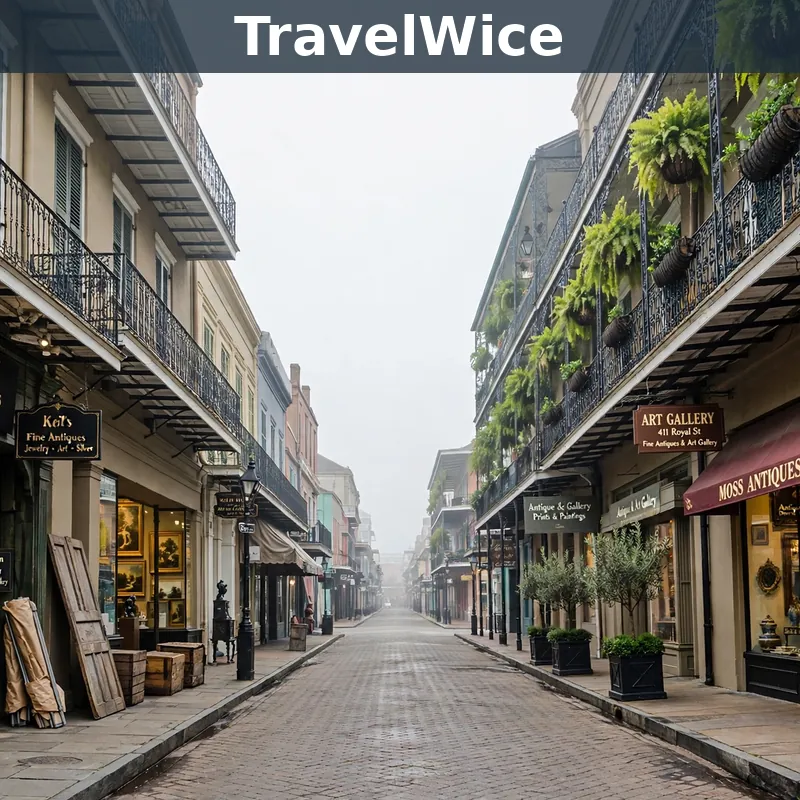
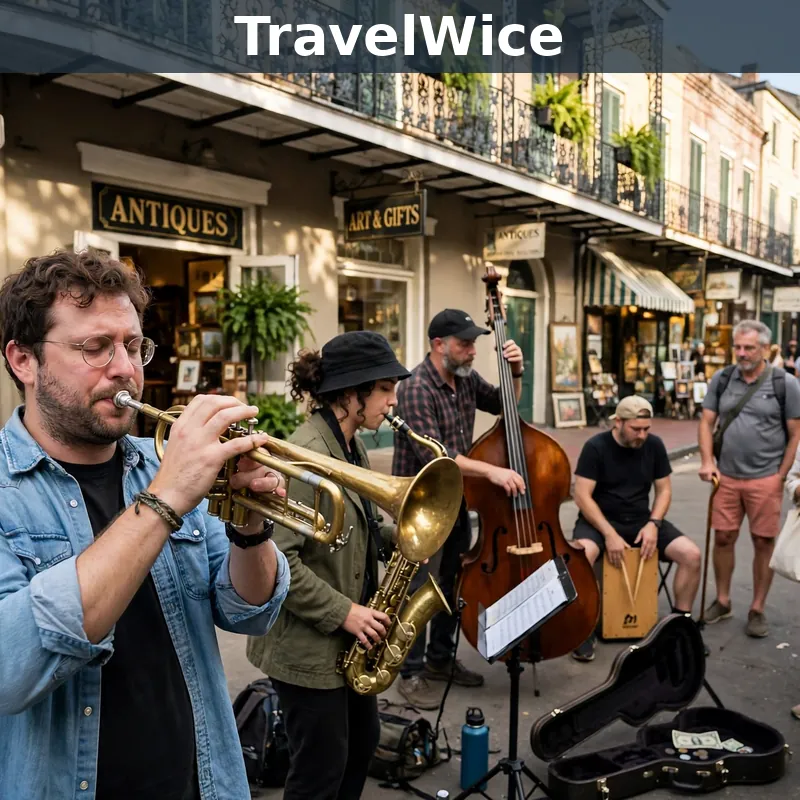
In addition, Royal Street is the Quarter at its prettiest, and it is the street I walked most. Antique shops, art galleries, wrought-iron balconies, hanging plants, pastel buildings, and a pace that feels a whole gear slower than Bourbon Street one block over. In particular, Royal Street stays closed to cars at times during the day. Street musicians set up on the corners — a trumpet player here, a violin there, a whole band on a good afternoon. I stopped for a saxophone player near the corner of Royal and St. Peter and stood there for fifteen minutes, and I still remember the tune. I stopped again the next day for a violinist outside a gallery, and I tipped her ten dollars because the music was that good.
On top of that, the shops on Royal are worth a slow morning. Meanwhile, the antique shops sell everything from chandeliers to old maps. The galleries sell local art you will not find anywhere else. I bought a small print of a balcony on my second day, and it hangs in my kitchen now. Also, I did not buy the chandelier. I thought about it, though. The balconies themselves are the attraction: wrought-iron lacework, hanging plants, shutters in every colour, and the light coming through in the late afternoon. Walk Royal Street between ten and noon, when the shops are open. The street is quiet, and then walk it again at golden hour, when the light turns the whole street gold. The balconies look like they are on fire in the gentlest way.
The Music After Dark
Royal Street is also where the Quarter’s music lives during the day. Also, the bands play on the corners, the trumpet players practise in the doorways. In fact, the sound drifts down the street like weather. Tip the musicians. Five to ten dollars is right. And if a band is playing and people are dancing on the pavement, join them. Nobody will mind. I did, on my last afternoon, and a woman next to me taught me the steps in about thirty seconds.
The French Market: Pralines, Hot Sauce, and People-Watching
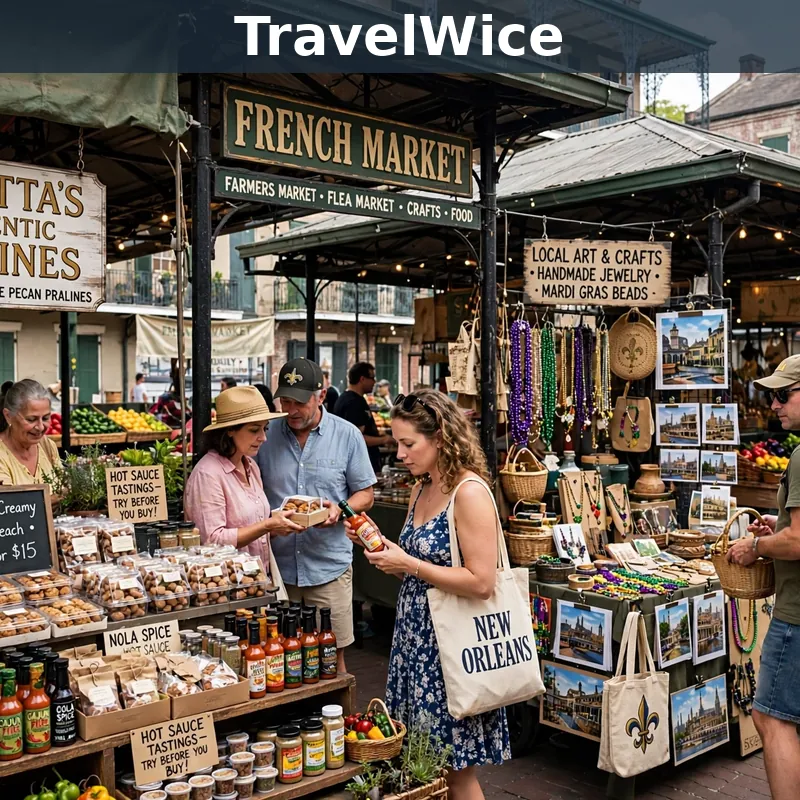
In addition, the French Market sits at the far end of Decatur, past Café du Monde. In particular, it is the oldest market of its kind in the United States. Stalls sell pralines, hot sauce, crafts, jewellery, hats, and T-shirts. The whole place smells like sugar and spice and coffee. I bought hot sauce I did not need. Pralines I ate before I got back to the hotel, and I regret neither. The pralines are the thing to try — soft, sweet, nutty, made fresh in the market, and sold by the piece. Buy one, eat it while you walk, and then buy a box for the flight home. They will not survive the flight. Eat them on the plane instead.
The market is also the best people-watching in the Quarter. Families, tour groups, locals doing their shopping, musicians playing for the stalls, and the river just past the flood wall. On top of that, walk to the end of the market, climb up to the riverfront, and look at the Mississippi. Meanwhile, it is wide, brown, and fast, and it is the reason this city is here at all. I stood there for a while on my first day, watching a barge go past, and I understood the city a little better. The river made the port, the port made the trade, and the trade made the food and the music. It all starts here.
Timing It Right
Also, give the market an hour, in the late morning, before lunch. Go hungry, because the food stalls are part of it, and go with cash. In fact, some of the smaller stalls prefer it. And if a stallholder offers you a taste, take it. That is how I found the pralines, and that is how I found the hot sauce. Both of them were worth the stop.
Bourbon Street: See It on Your Terms
In addition, Bourbon Street is the 13-block nightlife strip in the Quarter. You should see it, but see it on your terms. It is at its best before 7 PM for a calmer walk, when you can actually look at the buildings and hear the music without shouting. I walked it at five in the afternoon, and it was loud but friendly. Bars with their doors open, bands playing, people spilling onto the pavement with plastic cups, neon starting to glow. In particular, I walked it again at midnight, and it was a different street entirely: louder, denser. Not a place for kids or for anyone who wants a quiet night. Both walks were honest. The early one is the one I would repeat.
On top of that, the best Bourbon Street bars are the old ones. Pat O’Brien’s, for the Hurricane cocktail — a red rum drink in a tall glass that tastes like fruit and trouble, $12–$15. Lafitte’s Blacksmith Shop, one of the oldest bars in the US, dark and candlelit, with a piano in the corner. Galatoire’s, going since 1905, white tablecloths and Friday lunch and a room full of people who have been coming for decades. Meanwhile, cocktails run $10–$16, beer $5–$8. My rule: one drink, one bar, one song, then move on.
The street rewards the wanderer, not the person who sits in one bar all night. Our Bourbon Street New Orleans guide for 2026 covers the bars, the music, and how to enjoy the street without the worst of it. Our New Orleans travel guide for 2026 puts Bourbon Street in the wider trip.
Walking Tours, Carriages, and the Stories Behind the Walls
A guided walking tour is worth $25–$30 if it is your first visit. I took one on my second morning. The guide pointed out the things I had walked straight past the day before — the courtyard behind a plain door, the plaque on a wall, the reason one building is pink. The next is green, the balcony where a famous singer once lived. Also, the Quarter is full of stories like that, and a good guide knows them all. Pick a general Quarter tour for your first day, not a themed one, and save the themed tours — food, ghosts, music — for day two or three, when you know the streets well enough to enjoy the stories instead of worrying about where you are.
In fact, a horse-drawn carriage tour runs $20–$25 and is a slower, lazier way to see the same streets. In addition, I took one in the late afternoon, when my feet were tired, and it was the right call. The driver knew the Quarter the way a taxi driver knows a city. The horse knew the route better than both of us. Pick one tour, not both, unless you have three days and a slow afternoon to fill. The carriage is best at sunset, when the light is low and the streets are quieting down. Also, the walking tour is best in the morning, when your feet are fresh and your head is clear.
Tips I Wish Someone Had Told Me
The Quarter also has a darker side, and the ghost tours lean into it. In particular, I did not take one, and I will not pretend I did. On top of that, if ghosts are your thing, book one — they run most evenings, and the guides are good storytellers. If they are not your thing, skip it. The Quarter has enough real stories without the ghosts. The Jean Lafitte National Historical Park runs a French Quarter visitor centre with free exhibits on the city’s past. It is worth twenty minutes if you want the facts behind the stories. Check the Jean Lafitte National Historical Park and Preserve for the visitor centre hours.
Eating and Drinking in the Quarter
The Quarter is where you eat breakfast, lunch, and at least one great dinner. Meanwhile, breakfast is beignets at Café du Monde, or a full breakfast at a café on Decatur or Royal. Also, eggs, grits, coffee, under $15 if you pick well. Lunch is a po’boy or a bowl of gumbo, $8–$25 a person, eaten at a counter or on a bench. Dinner is the splurge: a sit-down Creole meal, $40–$100 a person, at a place like Galatoire’s or Antoine’s, the oldest family-run restaurant in the US, where Oysters Rockefeller was invented. I ate my best meal of the trip on a rainy Tuesday in a small Creole room off Royal Street.
I still think about the gumbo. Dark, rich, with rice on the side, and a spoonful of hot sauce that made my eyes water in the best way.
The muffuletta, from Central Grocery, going since 1906, is the Quarter’s great takeaway — a round sesame loaf stuffed with ham, salami, cheese, and olive salad, $15–$25, that feeds two people easily. In fact, I split one with a friend on a bench near the square and we both walked away full. In addition, the po’boy shops are the other lunch: roast beef, fried shrimp, oyster, dressed with lettuce, tomato, and mayonnaise, $8–$15. The bread is the thing — crisp outside, soft inside, and made for holding gravy. Our New Orleans food guide for 2026 covers every plate, every price, and every restaurant I would send a friend to.
A Few Things Worth Knowing
In particular, drink water between cocktails. On top of that, eat before you drink. And if a restaurant has a line out the door at noon, join it. In the Quarter, the line is usually the review. I joined three lines in four days, and all three were worth it.
Evenings in the Quarter: Preservation Hall and Frenchmen Street
The Quarter’s evenings belong to music, and the two places that matter most are Preservation Hall and Frenchmen Street. Meanwhile, Preservation Hall, at 726 St. Peter Street, has been going since 1961. The room holds about 100 seats, there is no bar, and the sets run 45 minutes, most nights at 5:00, 6:15, 7:30, and 8:45 PM. Also, tickets run about $25–$65, and you should book online ahead. The 5 PM set sells out and the later sets go fast. I sat in the back row for the 7:30 set.
The band played traditional jazz the way it was played a hundred years ago — no amplification, no showmanship, just seven musicians in a bare wooden room. A silence between songs that felt like respect. It was the best money I spent in the Quarter. Book through Preservation Hall and go early, because the doors open before the set and the good seats go first.
Where to Stay for This Part
Frenchmen Street sits in the Marigny, three blocks of clubs, about a seven-minute walk from the Quarter across Esplanade Avenue. The Spotted Cat has no cover and a one-drink minimum. d.b.a. charges $10–$20 cover. Snug Harbor runs $20–$40. The Blue Nile is about $10. Three Muses is free, with a dinner show from 7–9 PM. I spent a whole evening hopping between three clubs, paid less than $30 in covers all night. Heard three completely different bands. Frenchmen is where the locals go, and it shows: the crowds are smaller.
The music is better, and nobody is trying to sell you anything. Walk back to the Quarter with a friend after dark, stay on the busy streets, and you will be fine. Our New Orleans jazz guide for 2026 has the full club list, the covers, and the nights I loved best.
Where to Stay in the Quarter, and What It Costs
Stay in the Quarter for a first trip, or just outside it on Canal Street or in the Marigny, within a ten-minute walk. French Quarter hotels run roughly $200–$350 a night, higher at Mardi Gras. Festivals, lower in the quiet weeks of January and August. I stayed in a small hotel off Royal Street, with a courtyard, a balcony, and a front desk that knew the good restaurants by name. It cost more than a hotel out by the airport. It was worth every dollar, because I walked everywhere and never once needed a car.
A room on Bourbon Street is loud all night. Also, a room on Royal or Chartres is quiet. A room with a courtyard is quieter still. Ask for a courtyard room, ask for a high floor, and bring earplugs just in case. The Quarter is a loud neighbourhood, and the music does not stop at ten.
If the Quarter prices are too high, stay on Canal Street or in the Garden District and ride the $1.25 streetcar in. The St. Charles line runs from Canal Street through the Garden District. It is a ride in itself. Our New Orleans trip cost guide for 2026 works through the hotel numbers. Our Garden District New Orleans guide for 2026 covers the streetcar neighbourhood in full. For a sense of how another American city break compares on hotels, our California travel guide for 2026. Our New York travel guide for 2026 use the same honest method. Our Colorado travel guide for 2026 covers a mountain trip at a similar budget.
My Mistakes, So You Can Skip Them
I made four mistakes in the Quarter, and all four were avoidable. First, I wore new sandals on day one and my feet were sore by lunch. Wear broken-in flat shoes with grip. Second, I went to Café du Monde at 11 AM on a Saturday and waited in line for half an hour. Go at seven, or go at midnight. Third, I paid for a carriage tour and a walking tour on the same day. Pick one. Fourth, I tried to see everything before dark on day one and missed the evening music. The Quarter after dark is the best part. Plan your days so the evenings are free for music, not for ticking off sights.
A few more practical notes: check the National Weather Service forecasts before you pack. A cold front can drop the temperature fast and a warm spell can bring the humidity back. Carry water, because even in winter the sun is strong at midday. Keep your bag in front of you in a crowd. Stay on the busy streets at night. And do not drive in the Quarter. Parking is expensive, the streets are one-way and confusing. A car is a liability you have to feed and park. I did not drive once in four days, and I never missed it.
A One-Day Quarter Walk That Works
Here is the walk, in order, the way I would do it again. Eight in the morning: Jackson Square and the cathedral steps, before the crowds. Eight-thirty: Café du Monde for beignets and coffee. Nine-thirty: Royal Street, slow, with the shops and the musicians. Eleven: the French Market, pralines and hot sauce. Twelve-thirty: a po’boy for lunch. Two in the afternoon: a walking tour, or a carriage ride if your feet are tired.
Four: a rest at the hotel, a change of shoes, a glass of water. Five: Bourbon Street before seven, one drink, one song. Seven: dinner, sit-down, Creole, somewhere with a white tablecloth. Nine: Preservation Hall, or Frenchmen Street, or both if you have the energy. Midnight: one last beignet, if you can still walk. That is a full day. It is the day I would give a friend who had only one day in New Orleans.
French Quarter at a Glance
| Place | Best time | Cost | My tip |
|---|---|---|---|
| Jackson Square | Before 9 AM | Free | Take the cathedral photo from the river steps |
| St. Louis Cathedral | Morning, outside mass | Free | Open roughly 9:30 AM–4 PM |
| Café du Monde | 7 AM or midnight | Beignets $4.50–$6 | Do not wear black — the sugar gets everywhere |
| Royal Street | 10 AM–noon | Free to walk | Tip the street musicians $5–$10 |
| French Market | Late morning | Free to browse | Buy pralines and eat them while you walk |
| Bourbon Street | Before 7 PM | Drinks $5–$16 | One drink, one bar, one song, then move on |
| Preservation Hall | 7:30 PM set | Tickets $25–$65 | Book online ahead — the early sets sell out |
Chart: How a Quarter Day Breaks Down
This chart shows how a typical full day in the Quarter breaks down by time, so you can plan your energy, not just your money.
Morning sights, Jackson Square and Royal Street, about 4 hours: ████████████████ 33%
Food, beignets, lunch, and dinner, about 3 hours: ████████████ 25%
Music, Preservation Hall or Frenchmen Street, about 3 hours: ████████████ 25%
Market and riverfront, about 1 hour: ████ 8%
Bourbon Street and evening walk, about 1 hour: ████ 8%
The morning is the biggest block, and it should be, because the light is best and the streets are quietest. Food and music split the rest of the day evenly, and that is the right balance for this neighbourhood: eat well, listen well, and do not rush either one. The practical takeaway: protect the morning for the sights, protect the evening for the music, and let lunch and the market fill the middle.
References
- New Orleans & Company official tourism site — the official visitor guide, Quarter walks, and event dates.
- Café du Monde — the original coffee stand, menu, and hours.
- Preservation Hall — show times, tickets, and booking.
- Jean Lafitte National Historical Park and Preserve — the French Quarter visitor centre and park information.
- National Weather Service forecasts — New Orleans weather before you travel.
French Quarter New Orleans Quiz
Test what you picked up from this guide before you walk the Quarter.
1. When was the French Quarter founded, and under what name?
- A) 1718, as the Vieux Carré
- B) 1850, as the Garden District
- C) 1906, as the French Market
2. How much do three beignets cost at Café du Monde, and when is it closed?
- A) About $4.50–$6, closed Christmas Day
- B) Roughly $10, closed Sundays
- C) Near $2, never closed
3. What are the six streets between the river and Rampart, in order?
- A) Decatur, Chartres, Royal, Bourbon, Dauphine, Burgundy
- B) Bourbon, Royal, Decatur, Canal, Esplanade, Rampart
- C) Royal, Bourbon, Canal, Magazine, St. Charles, Decatur
4. How much does a guided walking tour cost in the Quarter, and how much is a carriage tour?
- A) Walking $25–$30, carriage $20–$25
- B) A $5 walking tour, carriage $100
- C) Walking $50, carriage $10
5. When is Bourbon Street at its best for a calmer walk?
- A) Before 7 PM
- B) After midnight
- C) At 3 AM
Quiz Answers
- The French Quarter was founded in 1718 as the Vieux Carré, a 13-by-6-block walkable grid (A).
- Three beignets cost about $4.50–$6 at Café du Monde, which is open 24 hours and closes only on Christmas Day (A).
- Those six streets — Decatur, Chartres, Royal, Bourbon, Dauphine and Burgundy — run in order between the river and Rampart Street (A).
- A guided walking tour runs $25–$30 and a horse-drawn carriage tour runs $20–$25 (A).
- Bourbon Street is at its best before 7 PM for a calmer walk; after dark it turns into adults-only energy (A).